Showing posts with label T-35. Show all posts

Saturday, October 15, 2022

Soviet T-35 Heavy Tank: Abandoned Outside of Lwów


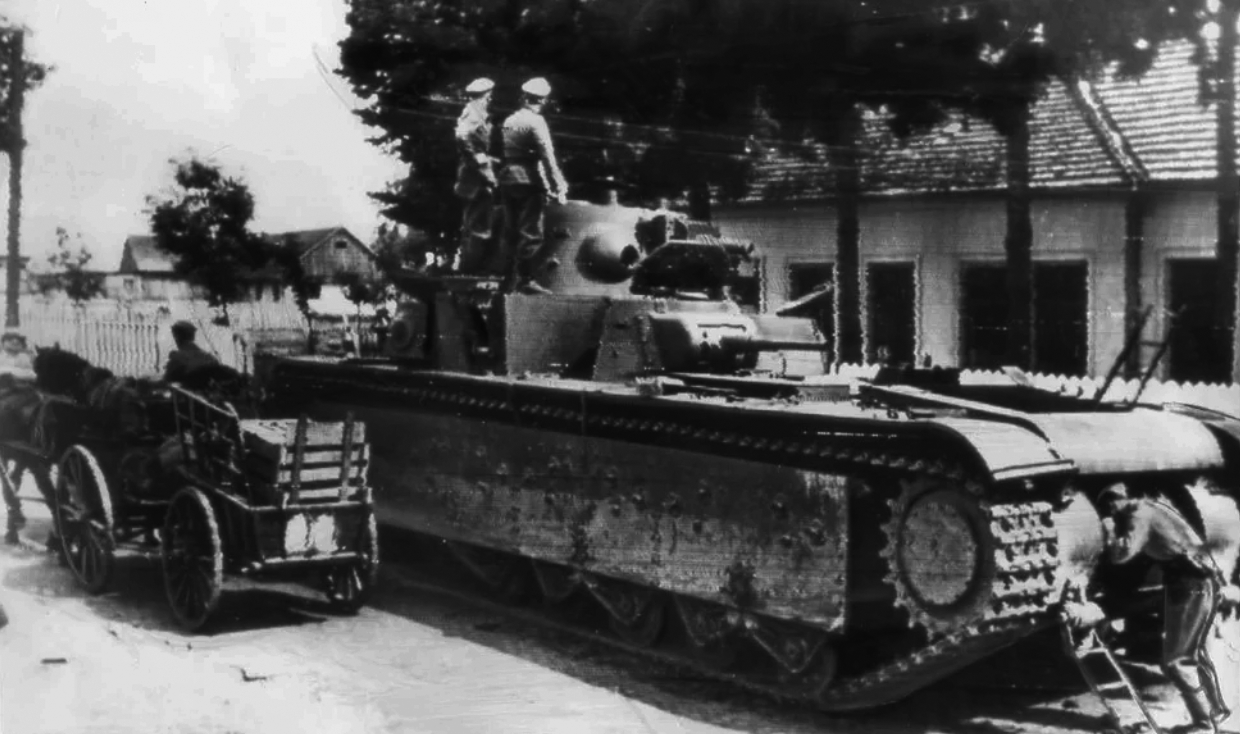
Francis Pulham's excellent book entitled Fallen Giants: The Combat Debut of the T-35A Tank catalogs the fates of the 61 Soviet T-35 heavy tanks that went into battle in 1941 to repel the German invasion of Mother Russia. A 45-ton monster of a tank that had five turrets and featured heavily in pre-World War Two Soviet military parades, the T-35 rarely engaged German forces and instead, ended up broken down and abandoned due to mechanical problems. Even when they did, the T-35 had a maximum of 30mm of armor, paltry for a tank meant to operate independently as a breakthrough vehicle. Despite their poor combat history, the T-35 enthralled German soldiers who came across one and because of this, photographs taken by German soldiers and kriegsberichter (war correspondents) abound of the T-35 with which Pulham was able to illustrate his book.

While Pulham is able to identify most of the T-35 tanks, this particular tank remains unknown. Pulham believes it to be chassis number 0183-5 which was a T-35A built in 1936, one of sixteen produced that year. The tank was assigned to the 67th. Tank Regiment. Combat records for the regiment only list the tank as lost near Lwów (Lviv), Ukraine but no chassis number was given. Pulham examined known losses in the area and was able to identify the tank was abandoned along what is today the H17 highway, some 20 miles outside Lviv. Still, despite his evidence, Pulham cannot positively state the tank is, indeed, 0183-5.

Pulham's book uses a photograph similar to the one here, perhaps taken by soldiers in the same unit, which shows the T-35 as it was found. As the tank was in the road, a later photograph shows it pushed off into the ditch. The tracks had been removed and white bands were painted on the left rear of the tank as a warning to drivers at night as the left side was still partially in the roadway. The white paint was repeated on the left front as well. A third picture in the book shows the derelict T-35 with some missing components, namely the turret mounted antenna. Following the war, the tank was most likely scrapped.

Primary Source:

Pulham, Francis Fallen Giants: The Combat Debut of the T-35A Tank (Stroud, Gloucestershire: Fonthill Media, 2017)

Wednesday, August 18, 2021

Soviet T-35 Heavy Tank: Left Behind on the Stalin Prospekt


     Prior to the German invasion of Russia (Operation Barbarossa) which commenced on June 22, 1941, five T-35 heavy tanks from the 14th. Heavy Tank Brigade were in the city of Kharkov for refitting. One of these was this T-35 (chassis 220-28), the twentieth T-35 built, having rolled out of the factory sometime in 1936. Kharkov was a strategically important city because of its manufacturing and industrial complex. It was the birthplace of the T-34 medium tank but also was the site of numerous small arms and infantry weapon manufacturing plants as well as the location of the Sukhoi Su-2 reece/light bomber aircraft production plant. Thus, the city would be embroiled in four major battles between 1941 and 1943. 

     On October 20, 1941, LV. Armeekorps deployed the 101. Leichte-Division, the 57. Infanterie-Division, and Sturmgeschütz-Abteilung 197 to commence the taking of Kharkov. Defending the city was the Soviet 216th. Rifle Division and the ad-hoc Separate Armored Unit which was made up of twenty-five T-27 tankettes, thirteen KhTZ-16 vehicles (improved tank built on a STZ-3 tractor), five T-26 light tanks, and four of the five T-35 heavy tanks. The Soviets were to defend the city and buy time for factory equipment to be evacuated. The actual assault on the city began on June 23, 1941 by which time the evacuation of the equipment was completed and the next day, the city was in German hands. The T-35 in the photograph was being driven along Stalin Prospekt, a main road leading out of Kharkov, when the tank either broke down or was abandoned. The crew had enough time to plant charges and scuttle the tank which blew the roof off the main turret, upended the rear facing 45-mm gun turret, and completely blew the two machine-gun turrets off the tank. 

     The tank would remain on the road, becoming a sign post and attraction for photographs. By May 1942, the tank had been pushed off the road and photographs taken by German troops show the tank as losing more and more pieces. Some of the last photographs were taken in 1943 and show that the T-35, despite being derelict, was mistaken for an active tank and sustained a penetrating hit to the rear. It is presumed that following the Fourth Battle of Kharkov (which ended August 23, 1943) in which the Russians reclaimed Kharkov for good, the T-35 was scrapped.

Tuesday, August 10, 2021

Soviet T-35 Heavy Tank: Abandoned in Sudova Vyshnia


     A group of Reichsarbeitsdienst (RAD; Reich Labor Service) soldiers take some time to explore an abandoned Soviet T-35 heavy tank in the village of Sudova Vyshnia sometime in 1942. The tank, hull number 715-61, was constructed in 1936 and was the first to be fitted with the P-40 anti-aircraft machine-gun mount on the main turret and was the thirty-first overall T-35 tank to be built. It was issued to the 68th. Tank Regiment whose repair center was located within the village and on June 24, 1941, the tank was listed as needing repair to its gearbox and fan drive. However, the rapid advance of German forces would see to it that the repairs were not completed (or perhaps not even started) and so on June 29, 1941, the breeches of the main turret's 76.2mm KT-28 gun and the two 45mm 20K guns in the secondary turrets were removed along with all the machine-guns, ammunition and optics. This was all buried in the ground away from the tank to keep it from falling into the hands of the Germans. When the Germans occupied Sudova Vyshnia, the T-35 was a favored curiosity to visit and be photographed with. Over time, bits and pieces of the tank were removed and photographs of the derelict T-35 by January 1942 showed the radio antenna around the main turret missing, leaving only the support struts which dates this photograph to the late spring or summer of 1942. The two white stripes on the main turret identify the tank as belonging to the 68th. Tank Regiment.

     Of interest is the fact that the RAD troops are equipped with old Gewehr 98 rifles which are of World War One vintage. This is evidenced by the straight bolt handle, the location of the front rifle strap fitting, and the overall length of the rifle. Some of them appear to have been modified in some degree to post-WW1 Karabiner 98b standards. These changes included using a tangent-leaf rear sight instead of the Lange tangent sight, turning down the bolt handle, and the removal of the front and rear rifle strap swivel mounts and replacing them with simple loop on the front barrel band and a lateral slot cut into the stock. The RAD soldier nearest the camera appears to only have the newer tangent-leaf sight as it retains the straight bolt handle and given the way the rifle is slung, appears to have the original swivel strap mounts. Notice also the variance in the wood coloration of the rifle stocks among the soldiers. RAD units were not considered, at this time, as front line combat troops and so had to make do with elderly weapons. Given the lack of equipment, these men may have been taking an excursion to visit the T-35 wreck. The distinctive RAD service cap can be seen tucked into the front of the belts of some of the soldiers. What informs the viewer they are RAD men is due to the arm shields (Dienststellenabzeichen) seen above the armband but the photograph is too blurry to make out the numbers on the shields which would identify their unit. As a note, by 1942, there were some 427 RAD units deployed on the Eastern Front and as the war ground on and the Soviet war machine ground up regular Wehrmacht forces, these units saw more and more combat rather than the rear echelon tasks they had originally been deployed to do.

Tuesday, July 20, 2021

Soviet T-35 Heavy Tank: Abandoned in Gorodok

     Photographed by a kriegsberichter (war correspondent) attached to the 257. Infanterie-Division, a T-35 (chassis 744-62) belonging to the Soviet 67th. Tank Regiment sits abandoned in the village of Gorodok along the T1425 road. On June 26, 1941, the tank was reported as broken down due to its clutch friction discs having burnt out. It was intended that the tank be towed away for repairs and tow ropes were deployed (not visible in this photograph) but the tank was abandoned instead, apparently in haste as only one of the two ropes was attached to the hull front’s two rings. Still, the crew stripped the tank of its machineguns before departing the area between June 27-30, 1941. This hasty departure was perhaps due to the continued advance of Army Group South (which contained the 257th.) through the region. 

     This T-35 is notable as being one of the last six T-35 tanks built in 1939 before production ceased. It features the final modifications to the design, the most obvious being the conical shaped turrets which afforded better protection due to its sloped armor. 

     After sitting in the road for months, by February 1942, the derelict tank had been pushed off the road where it continued to attract the photographer’s eye. Photographs of the T-35 in the summer of 1942 show the tank missing all of its tracks (possibly taken by tank and assault gun troops to affix to their vehicles for added armor). The ultimate fate of this tank is unknown but presumably it was scrapped.

Saturday, July 17, 2021

Soviet T-35 Heavy Tank: Not Going Down Without a Fight


    Of all the T-35 tanks to be photographed by the Germans, T-35A (Chassis 0200-0) was the most popular. In part, this was due to it being along a major route. The tank was part of the Soviet 68th. Tank Regiment and was one of the few T-35 tanks which actually saw combat. On June 30, 1941, four T-35 tanks (including 0200-0) comprised the main force of an ad-hoc tank group assembled to participate in the Battle of Verba which was the last significant engagement in the larger Battle of Brody which ran from June 23 to June 30, 1941. The group consisted of the four T-35s, one KV-1 heavy tank (from the 34th. Tank Division), two T-26 light tanks (also from the 34th. Tank Division), and two BT-7 fast tanks. Verba Road was a two-lane road with the lanes separated by a ditch. The group split up with two T-35s (including 0200-0), the KV-1, and the T-26 tanks in one unit while the remaining T-35s were paired with the BT-7 tanks and each moved out down one of the lanes towards the German held town of Verba. There, elements of the 16th. Panzer Division and the XXXXVIII Motorized Division were situated to repel the Soviet attack. 

     0200-0 was struck by anti-tank fire which caused it to veer off the road into the ditch. It is believed either track damage or a hit to the driver’s position was the reason for the crash. The tank continued to give battle by means of its 45mm gun armed secondary turret before a German anti-tank round struck the barrel (visible in the picture as a whitish spot on the barrel). This finally rendered the tank silent. Overall, the Soviet attack, devoid of any kind of support, was easily repulsed with every one of the Soviet tanks being put out of action though the Germans suffered the loss of two PzKpfw III tanks and three trucks in the process. 

     0200-0 would be photographed by passing soldiers well into 1942 by which time the tank had completely slid into the ditch. Soviet tanks were usually devoid of extensive markings and the Red Star can just be made out next to the soldier closest to the tank and on the central, main turret can be seen two white lines which denoted the tank belonging to the 68th. Tank Regiment.