Showing posts with label Wehrmacht. Show all posts

Monday, March 23, 2026

Maschinengewehrschütze (369. (Kroatische) Infanterie-Division)

Source: Author's Collection

    A machine-gunner belonging to the 369. (Kroatische) Infanterie-Division (369th. (Croatian) Infantry Division). This is identified by the pin he is wearing on his feldbluse’s pocket. The pin, called the Croatian Legion 1941 Linden Leaf, was awarded to those who served in the original unit, the Verstärktes Kroatisches Infanterie-Regiment 369 (369th. Reinforced Croatian Infantry Regiment), and had survived the Battle of Stalingrad. This battle effectively marked the end of the original regiment with only a little over 1,000 soldiers having been evacuated out. These men formed the core of the new 369. (Kroatische) Infanterie-Division. 

    The unit was used almost exclusively for anti-partisan warfare in the territory of the Unabhängiger Staat Kroatien (Independent State of Croatia; NDH)). The unit was nicknamed the “Teufels Division” (Devil’s Division) and took it from a Croatian WW1 unit, the 42. Domobranska Pješačka Divizija (42. Home Guard Infantry Division) which was a part of the Austro-Hungarian Army. During 1943 to 1945, the unit was involved in numerous operations against the various partisan forces within the NDH, chiefly Chetnik partisan units. However, the combat record of the 369. (Kroatische) Infanterie-Division was mediocre at best, desertion was a constant problem and the unit was more known for its brutality rather than its prowess in battle. By April 1945, the 369. (Kroatische) Infanterie-Division was a shell of itself and when the unit was captured in Slovenia, the Germans remaining were allowed to retreat into Austria but the Croatians became prisoners of the partisans which was a near certain death sentence. 

    This enlisted man, evident by his lack of tresse (braid) along his collar edges and schulterklappen (shoulder boards), is armed with the 7.92mm Maschinengewehr 34 select fire machinegun and tucked into his belt is a Model 1924 Stielhandgranate (M24 stick grenade). There is a lanyard looped around his shoulder and tucked into the feldbluse pocket but what is on the end of it isn’t identifiable.

Wednesday, November 5, 2025

Artillerie-Panzerbeobachtungswagen III, 75. Panzer-Artillerie-Regiment

Source: Author's collection

     As World War Two continued, the German military utilized more and more self-propelled artillery though such guns were never able to fully replace horse-drawn or those guns drawn by half-tracks or other soft-skinned vehicles. Of course, for artillery of any kind to be truly effective during the war, it required forward observers who would watch the fall of the rounds and radio back corrections to the firing batteries to ensure that as much of the incoming fire was as close to on-target as possible and thus maximize the destruction. These forward observers were often small teams on foot or moved about the battlefield in lightly armored vehicles such as armored cars or light tanks. By 1943, such vehicles had a very limited lifespan. Typically artillery was used defensively to break up an attack or was used on the offense to soften up the enemy prior to committing ground troops. Either way, it meant the forward observers had to be in the vicinity of the action in order to witness the incoming fire missions and correct as needed. Thus, it was seen that something better was needed to support the self-propelled artillery batteries and give forward observers the means to survive the front lines. The initial answer was the Artillerie-Panzerbeobachtungswagen III (PzBeobWg III).

     The Artillery Tank Observation Vehicle III was, in reality, a stop-gap measure which was undertaken to provide such a vehicle while development of a purpose-built armored observation vehicle was conducted (something that did not happen). Using war-weary and obsolete Ausf E through Ausf H models of the Panzerkampfwagen III medium tank, several modifications were done to convert them to their new role. The biggest change was the removal of the main gun armament. In place of the main gun, a Maschínengewehr 34 (MG 34) in a ball mounting was fitted and provided with 1,500 rounds of ammunition. The weight savings by not having a main gun nor the associated shells allowed for the fitting of an additional 30mm of armor plate on the hull front and on the entire rear of the tank. In addition, a new gun mantlet replaced the original, increasing the thickness from 30mm to 50mm. A feature of this mantlet was the addition of a dummy gun fitted to the right of the MG 34. The hull machine-gun was removed and the hole for the machine-gun was fitted with a metal plug. For radio equipment to allow communication back to the battery, the PzBeobWg III was fitted with a Funkgerät 4 (FuG 4) and the FuG 8. The FuG 4 utilized a 2 meter tall star antenna though specifics about it are not well known. The FuG 8 was heavily used for divisional communication with later models using a 30 watt transmitter, MW receiver C, and had a frequency band of 835 to 3,000 kilocycles per second. It used a 8 meter tall mast antenna. The FuG 4 had a much shorter range, with a Wireless Telegraph (WT) range of 2.3 miles and a Radiotelephone (RT) range of 1.2 miles. The FuG 8, on the other hand had a WT range of 31.1 miles and a RT range of 6.2 miles. In all, 262 PzBeobWg III vehicles were constructed between February 1943 to April 1944 and two such vehicles were deployed to each Hummel (“Bumblebee”) or Wespe (“Wasp”) self-propelled gun batteries as supply permitted.

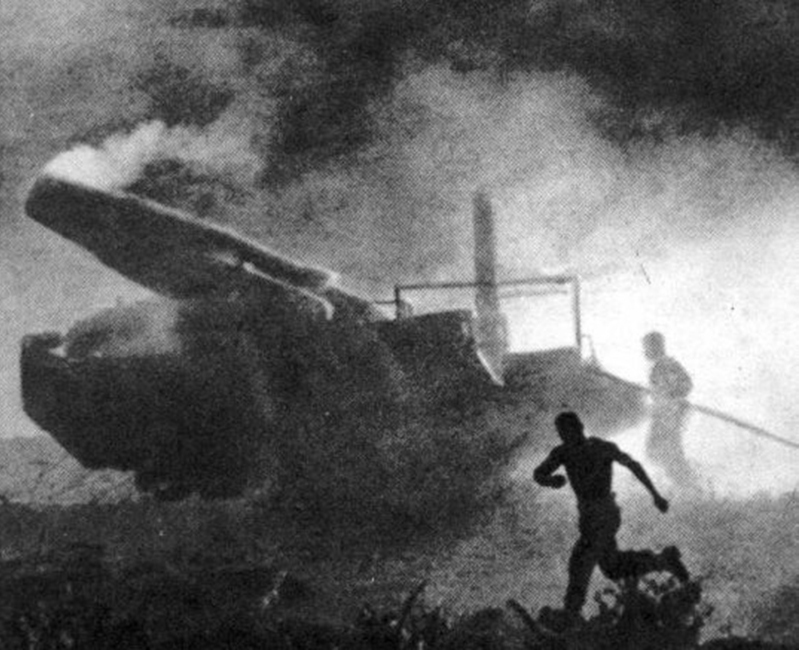
     The photograph was reportedly taken following the German defeat at the hands of the Soviets following Unternehmen Frühlingserwachen (Operation Spring Awakening) in mid-March 1945 near Lake Balaton, Hungary. If this is accurate, then the PzBeobWg III belonged to 75. Panzer-Artillerie-Regiment underneath the III. Panzerkorps, 6. Armee, Heeresgruppe Süd. This unit was equipped with “Wespe“ 10.5cm self-propelled guns on the Panzerkampfwagen II chassis. It is difficult to assess what model the PzBeobWg III shown was built on but given the late date in the war, it is likely an Ausf H version. The crew had secured three links of track to the front of the tank in an effort to increase the protection. Since the hull machine-gun was not fitted, the track covered where it had been but one can see a portion of the track missing to allow the driver to see through his vision block. Just visible are the schürzen (armored skirts) fitted to the turret and hull. The front part of the skirt on the hull can be made out to the right (as one looks at the photograph) of the Soviet soldier. The turret skirt is visible just behind the dummy gun mantlet. These skirts were designed to reduce the velocity or divert the trajectory of incoming kinetic rounds. In the upper, right corner of the photograph is the star antenna for the FuG 4 radio. 

     Of interest, however, is the dummy gun itself. The crew of this PzBeobWg III fashioned an entirely new dummy gun and fit it over the existing one. The likely reason for this is because the standard dummy gun gave the appearance of the far weaker short 5cm KwK L/42 or the 3.7cm KwK L/46.5. By adding the additional wooden mantlet sleeve and the longer wooden barrel with a muzzle brake, it gave the PzBeobWg III the appearance of a Panzerkampfwagen IV fitted with the potent 7.5cm KwK40 L/48 gun. This was made more so by the use of the schürzen which many late-war PzKpfw IV tanks were equipped with. In so doing, the elaborate wooden dummy gun assembly helped the PzBeobWg III blend in more and not be singled out. Of course, the Soviet soldier hefting the broken gun tube for the camera means it didn't make much of a difference for this PzBeobWg III.

Wednesday, October 29, 2025

Flieger Otto Vieth, 1. Lw.-Kriegsberichter-Kompanie (mot.) z.b.V.

Source: Author's collection

     During a lull in the combat that raged through the streets and buildings of Stalingrad from August 23, 1942 to February 2, 1943, Luftwaffe Kriegsberichter Otto Vieth enjoys a cigar while resting on the fender of a Mercedes-Benz truck. Vieth was part of 1. Lw.-Kriegsberichter-Kompanie (mot.) z.b.V. which was short for 1st. Luftwaffe War Correspondent Company (motorized) zur besonderen Verfügung. Units with the designation z.b.V. were units that had no subordinate combat troops and thus were on special deployment or special duty. Vieth was a contributor to the Luftwaffe's biweekly magazine “Der Adler” (“The Eagle”).

     This color photograph of Vieth shows him with the rank of Flieger, the lowest rank which was equivalent to a Airman Basic in the U.S. Air Force. This is denoted by the single “gull wing” rank pip pinned through his collar tabs. The collar tabs on his fliegerbluse are gold-yellow (goldgelb) which was the Luftwaffe waffenfarbe (corps color) for both men in aviation units (pilots and ground personnel) as well as Fallschirmjäger (paratroopers). This same color was used on the piping of his uniform's shoulder boards. Vieth was not a Fallschirmjäger but he was a glider pilot and we know this from the insignia seen below his medal. This is the Segelflieger B Abzeichen Gleitfliegerprüfung which translates to Glider Pilot Level B Proficiency Badge. The badge was awarded to glider students in the Deutscher Luftsportverband (DLV; German Air Sports Association) which was, more or less, a training organization for the future Luftwaffe. The DLV was established in March 1933 and then absorbed into the Nationalsozialistisches Fliegerkorps (NSFK; National Socialist Flyers Corps) on April 15, 1937. The badge consisted of a round base of blue-gray material with a machine-embroidered circle with two gulls within it. This particular badge was the middle of three proficiency levels with A being the lowest proficiency and C being the highest. To earn the B level proficiency required the student to make a 60 second free flight and execute a “S” turn maneuver. Those who earned the B and C level proficiency badges were allowed to wear them on Luftwaffe uniforms even though they were not Luftwaffe awards. Returning to the medal, it is the Deutsches Sportabzeichen (German Sports Badge) which was awarded for excellence in physical endurance, speed, strength, and agility. Though not too visible, the letters DRL are within the wreath which stood for Deutsche Reichsauszeichnung für Leibesübungen meaning German Reich Award for Physical Exercise.

     Not visible in this particular photograph of Vieth is the cuff title (Ärmelband) on the lower right sleeve of his fliegerbluse which read “Kriegsberichter der Luftwaffe”. This was a blue band with the words (in a Fraktur-style script) embroidered in white thread. Also not visible, but on the lower left sleeve, was his Fliegendes Personal (flying personnel) badge. This badge had a blue-gray material background with a embroidered four-bladed propeller superimposed over a pair of wings in white threading. This particular badge was worn by flying personnel not eligible to wear the Pilotenabzeichen (Pilot's Badge).

     For a camera, Vieth is using a manual Leica IIIc 35mm rangefinder camera. This particular model was produced from 1940 into 1946, the Leica IIIc used a die-cast body, pin bearing equipped shutter, cold shoe flash mount, and a M39 lens mount. The viewfinder of the camera was set for the standard 50mm lens and if other lens were used, then the user had to fit an alternate viewfinder on the camera's accessory socket.

     Little is known about Vieth's Luftwaffe career. What we do know is that he worked exclusively for “Der Adler” and was a highly experienced photographer as his pictures were often used for the covers of the magazine. As a reporter, Vieth spent time in France, the Eastern Front, North Africa, Italy, as well as in Germany. From surviving photographs of Vieth, at some point in time, he was promoted to Unteroffizier (equivalent to a U.S. Air Force Sergeant) and was able to earn either the Fliegerschützenabzeichen (Air Gunner Badge) or the Fliegerschützenabzeichen für Bordfunker (Air Gunner Badge for Radio Operators) as there is a photograph of him wearing one of these two badges on his Luftwaffe service shirt in a 1943 photograph taken of him while in Russia. At that time, he was still using his Leica IIIc camera. Another photograph shows him as a Fahnenjunker-Unterfeldwebel, having been promoted again to Unterfeldwebel (equivalent to a Staff Sergeant) and then selected for officer training but there is no date associated with the photograph. Even though the last issue of “Der Adler” came out on September 12, 1944, Vieth continued to work as a photographer as the Bundesarchiv Bildarchiv (Federal Image Archive) in Germany has cataloged photographs attributed to Vieth into 1945. It is presumed he survived the war.

Tuesday, October 14, 2025

7.5cm PaK40/2 auf Fgst Pz.Kpfw II (Sf) "Marder II": Demolitioned Outside Rome

Source: U.S. Signal Corps

     Somewhere outside Rome on June 5, 1944, a U.S. soldier from the 5th. Army examines what is left of a German 7.5cm PaK40/2 auf Fahrgestell Panzerkampfwagen II (Sd.Kfz 131) tank destroyer which was, mercifully, simply called the Marder II. The need to both bolster and improve tank destroying capability resulted in two tank destroyers utilizing the chassis of the Panzerkampfwagen II light tank. 

     The first version was designated the Panzer Selbstfahrlafette 1 für 7.62cm PaK36(r) auf Fahrgestell Panzerkampfwagen II Ausf D¹ und D² (Sd.Kfz 132). Sometimes (again, mercifully) known as the LaS 762, this tank destroyer utilized Panzer II ausf. D and E as well as Flammpanzer II (a flamethrower variant of the Panzer II) chassis and mounted a captured Soviet 76.2mm F-22 Model 1930 field gun rechambered to fire the 75mm round used by the potent PaK 40 anti-tank gun. The LaS 762 was a stop-gap design while more purpose-built tank destroyers were designed and put into production. It was characterized by its tall profile and 201 vehicles were converted between April 1942 and June 1943.

     The second version was the Sd.Kfz 131, a more dedicated tank destroyer design, and it used war weary Panzer II ausf. A, B, and C chassis (but would later use factory "fresh" ausf. F chassis). The Marder II had the excellent 75mm PaK 40 gun as its main weapon. All told, 651 Marder II were produced between June 1942 and March 1944 and saw service on all fronts (though the majority were deployed to the Eastern Front). Both the German Army (Heer) and Waffen-SS were heavy users of the Marder II, equipping the panzerjäger abteilungen of panzer divisions. In addition, some Luftwaffe ground forces used the Marder II in their own tank destroyer units.

     The Marder II in the photograph has lost its entire superstructure save the forward portion and the front of the hull has been completely blown out as has the back of the vehicle. Given the extent of the damage and most notably by the burst barrel of the PaK 40, this particular Marder II was destroyed by the crew using demolition charges. This was not too uncommon when the vehicle could not be recovered from whatever circumstance disabled it (mired in the ground, mechanical breakdown, or battle damage) and so blowing the vehicle up denied its use by the enemy.

Monday, September 1, 2025

Jagdtigers of 2/s.Pz.Jg.Abt.512: Demolitioned Near Letmathe

Source: Author's collection.

     The remains of two Jagdtigers of 2nd. Kompanie, Schwere Panzerjäger Abteilung 512 (2/s.Pz.Jg.Abt.512) sit alongside a road near the German town of Letmathe. On April 11, 1945, 2/s.Pz.Jg.Abt.512, commanded by Hauptmann Walter Scherf, was part of Kampfgruppe (Battle Group) Ernst and set up in hidden positions to check U.S. advances to the Ruhr River. That day, the Jagdtigers fired high explosive ammunition out to 3 miles and the group was able to cause enough havoc to force the U.S. forces to retreat. Despite the victory, 2/s.Pz.Jg.Abt.512 was ordered to withdraw and so during the night, Scherf positioned his Jagdtigers on high ground outside the village of Kalthof. The next day, the Jagdtigers shot up U.S. tanks, again halting the advance of U.S. forces. Nevertheless, 2/s.Pz.Jg.Abt.512 continued to withdraw and by April 14, was in the village of Ergste. 

     The Jagdtigers were situated in a wooded area near Letmathe where mechanics worked to effect repairs. Scherf could see that his men had no fight left and when word came that 1/s.Pz.Jg.Abt.512 was all but finished, that was the final straw. 2/s.Pz.Jg.Abt.512 was ordered to destroy their Jagdtigers and on April 15, 1945, 2/s.Pz.Jg.Abt.512 surrendered. 

     Thus, when the Allies passed through, they found these two Jagdtigers. The second one is difficult to make out but it is parked immediately behind the Jagdtiger in the foreground and it is believed that this Jagdtiger had towed the other after it suffered a mechanical breakdown.

Friday, August 29, 2025

The "Übungsfaust": Practice Makes Perfect

Source: Bundesarchiv

     Curiously, the books in my library that discuss the Panzerfaust (”Tank Fist”) and all of its variants leave out one variant that can be clearly seen in the photograph here. In fact, this particular image is pretty widely used in many books and articles. It depicts a Bataillonsführer (denoted by the four rank pips on the black tabs affixed to his great coat collar) of the German Volkssturm overseeing training of Volkssturm militiamen in the usage of the Panzerfaust. It is believed the location was somewhere in Berlin, spring of 1945. For the interested, the Bundesarchiv (German Federal Archives) identification code for this picture is 183-J31391. Anyone familiar with the Panzerfaust's profile will notice some peculiarities with the Panzerfaust the Volkssturmmann (Private) is holding. What he is holding is not a live Panzerfaust at all and it is what today would be termed a Übungsschießgerät, meaning Practice Shooting Device. What it was called in 1945 is not known nor is it known how many of them were actually produced. Besides this photograph, I have another photograph showing a U.S. Army soldier guarding a collection of German weapons and in the background, one of these training devices can be seen. In keeping with the naming theme for the Panzerfaust and its variants, I am going to call it the Übungsfaust (meaning Practice Fist) throughout the rest of this article. Again, there is no historical evidence this name was ever used.

     The Panzerfaust was one of the most important anti-tank weapons available to the German infantrymen. It was simple to build, cheap (costing at most 25 Reichsmarks or $22USD in 1945), and was available in large quantities and the most common variant was the Panzerfaust 60 (Pzf 60). The number referred to the effective range of the projectile, in this case 60 meters. Although the warhead looks like a rocket, the Panzerfaust is technically a recoilless rifle. Within the metal tube was an explosive charge and when triggered, the blast propelled the warhead out of the front of the tube while the rearward blast forces vented out the back of the tube canceled out any recoil. Aiming was accomplished using a flip-up sight and usage of the top mounted trigger would set off the charge. Once the warhead left the tube, four metal fins would unfurl to provide stability in flight. The Panzerfaust 60 was able to penetrate up to 200mm of armor...more than enough to defeat nearly all Allied tanks. The Panzerfaust was also a one-shot, disposable weapon. Once fired, the soldier would discard the empty tube. While it is true that the Panzerfaust deployed during World War Two could not be reloaded by soldiers in the field, the tubes could be reloaded by the manufacturers that produced Panzerfaust. Thus, if German troops held the battlefield where Panzerfaust were used (and if the situation allowed it), the tubes would be collected and sent back to the factories to be reused. In part, this was an attempt to conserve war critical materials.

     So, why was there a need for something like the Übungsfaust? Over 8 million Panzerfaust (of all variants) were built from 1942 to 1945 so surely there were plenty to spare for training. It should be mentioned that Panzerfaust were sold to other Axis countries, namely Bulgaria, Finland, Hungary, Italy, and Romania. Also, around one in eight Panzerfaust were rejected by inspectors and the parts recycled and of those that were issued, around 10% were returned to the factories as defective. Finally, up to 6% of the issued Panzerfaust either misfired or failed to detonate against the target. Combine these factors, that number dwindles rapidly. As such, there can be seen a use for something like the Übungsfaust to ensure as many Panzerfaust can be put into the hands of German and allied Axis troops. 

     According to the website bergflak.com, there were at least three different types of  Übungsfaust and diagrams and plans on how to construct them were distributed via the publication series “Von der Front für die Front" (“From the Front, For the Front”). The publication can be compared to the U.S. Army's “PS Magazine” which contained bulletins on the care of equipment and tricks and tips submitted by soldiers for useful modifications, service/repair methods, and field adaptations. 

     The Übungsfaust was built using spent Panzerfaust. One might also presume that tubes rejected by the factories could also be repurposed for constructing Übungsfaust but given the intent was to have units in the field construct the Übungsfaust, the most likely source were tubes from Panzerfaust which have been discharged. The Übungsfaust permitted the trainee to get familiar with the weapon as it retained the same tube (and heft), sight, and trigger mechanism. The warhead was made of solid wood with no TNT or hexogen explosive inside. This dummy warhead allowed the trainee to practice loading the tube as in some cases, Panzerfaust were shipped without the warhead installed. Another reason for needing a warhead is that part of the aiming process required the warhead to be present. With the sight in position, the operator tucked the tube underneath the arm, peered through the sight, and aligned the range gradients by looking over the top of the warhead's widest point where a protrusion called the korn (literally front sight) was situated.

     The main modification to create the Übungsfaust consisted of inserting a circular chamber piece (with a cap) into the tube, just behind the trigger. In a live Panzerfaust, this is where the treibladung (propellant charge) would have been. To prepare the Übungsfaust, it required two 7.92x57mm Platzpatrone 33 blank cartridges. The wooden bullet was removed from the cartridge and the powder, enveloped in felt wadding, was extracted. The powder charges were placed into chamber and the chamber had a perforation in the front (facing the warhead) and a second perforation facing to the rear. The cap was then closed. An ignitor, using the existing trigger, would set off the powder in the chamber. The resultant detonation, while not as powerful as a genuine Panzerfaust, would still give the trainee some experience of what it would be like to fire the weapon but more importantly, demonstrate the backblast effects which were even more dangerous with the Panzerfaust. In fact, the backblast of a Panzerfaust 60 was lethal out to 3 meters (10 feet). Exactly how far the wooden warhead would be flung from the tube isn't known but distance wasn't the point. The warhead would be collected and assuming it wasn't too beat up, it would be reused. It is said some units would reinforce the warhead with metal bands or sheath it in iron to keep it from being damaged too rapidly.

     Of interest, the Übungsfaust wasn't the only training device for the Wehrmacht's man-portable anti-tank weapons. The other tank buster was the Raketenpanzerbüchse 54 (RPzB 54), better known as the Panzerschreck (“Tank Terror”). This was the German response to the M1 “Bazooka”. Again, documents exist which show how unserviceable RPzB 54 launchers could be modified into training devices by using a heavily cut down Karabiner 98k bolt-action rifle. To facilitate the training process, a wooden facsimile of a 88mm RPzB. Gr. 4312 rocket was fitted to the barrel end of the rifle. The rifle itself was loaded with between one to five Platzpatrone 33 blank rounds. This entire assembly was then loaded into the rear of the tube by the loader in the same fashion as a genuine rocket round. There was even a fake wire and contact so that the loader could practice preparing the rocket (which was electrically fired when the trigger was pulled). The trigger of the RPzB 54 was connected to the rifle's trigger via a rod. When the operator squeezed the trigger, the rod pushed the rifle's trigger backwards, firing off the blank round which then pushed the dummy rocket out the front of the launch tube. There was recoil due to the rifle, something which would not occur when firing a operational RPzB 54.

Friday, August 22, 2025

Oberleutnant Heinz Halmes (Luftlandebrigade 25)

Source: Author's collection.

     Little is known about the military history of Heinz Halmes. Much of what is known comes from scattered sources including, among others, a 2015 auction in München, Germany of award documents and the soldbuch (pay book) which belonged to Halmes. Halmes was born in Aachen, Germany on April 6, 1923 and his military career, at least what has been found in documentation, started sometime in 1942 when Halmes entered into the Luftwaffe as a Fallschirmjäger (paratrooper) and held the rank of Gefreiter (equivalent to a U.S. Air Force Airman rank). His initial posting was with Fallschirmjäger-Regiment 5. This was a unit first formed in May 1942 and consisted of three battalions. I. Bataillon and III. Bataillon trained for Unternehmen Herkules (Operation Hercules, the invasion of Malta) at Truppenübungsplatz Mourmelon (Military Training Area Mourmelon) which was located near Reims, France while II. Bataillon was shipped to Africa and placed under Fallschirmjäger-Brigade Ramcke. However, the Allied landings in Algeria on November 7, 1942 (and the eventual cancellation of the Malta invasion that same month) saw the two battalions in France sent to Tunisia to join up with the II. Bataillon. The regiment saw heavy combat in defensive positions around Medjez El Bab starting on November 20, 1942 and in the face of American armored attacks, gave ground five days later. II. Bataillon suffered severe casualties and further action south of Tunis against British paratroopers saw the III. Bataillon worn down. Enough reinforcements arrived to reconstitute the II. Bataillon but by December 1942, hard, but successful, defensive combat around Tebourba and Fourna stymied the Allied advance towards Tunis. What remained of Fallschirmjäger-Regiment 5 was renamed as Jäger-Regiment "Hermann Göring" in January 1943 and operated under Panzer Division "Hermann Göring". It saw extensive combat from April 1943 to May 6, 1943 and suffered very heavy casualties in the fighting. Many of the survivors went into captivity but others, including a sizable number from the remains of II. Bataillon, managed to be evacuated by ship to Italy. The survivors were assembled into II./ Fallschirmjäger-Regiment 5 and placed under the 2. Fallschirmjäger Division where the battalion fought briefly in Italy through September 1943 before being transferred along with the 2. Fallschirmjäger Division to the Eastern Front in October 1943. The battalion saw action around Kirovograd but in January 1944, the battalion was withdrawn and sent to France where it would become Fallschirmjäger-Regiment 16, 6. Fallschirmjäger-Division.

     Prior to the unit change to Fallschirmjäger-Regiment 16, Halmes had been promoted to Unteroffizier (other sources say Oberjäger) which was equivalent to a Sergeant in the U.S. Air Force. In this period of time, Halmes had earned the Eisernes Kreuz 2. Klasse (Iron Cross 2nd. Class) on December 19, 1942, the Verwundetenabzeichen 3. Klasse (Wound Badge in Black) on May 6, 1943, the Medaille für den Italienisch-Deutschen Feldzug in Afrika (Italo-German Campaign Medal in Africa) on June 30, 1943, the Erdkampfabzeichen der Luftwaffe (Luftwaffe Ground Assault Badge) on July 10, 1943, the Ärmelband Afrika (Africa campaign cufftitle) on July 14, 1943, and the Fallschirmschützenabzeichen der Luftwaffe (Parachutist Badge) on September 23, 1943.

     As 1944 arrived, Halmes was promoted again, this time to a Fähnrich (officer candidate) and he was made Zugführer (platoon leader) of 1. Zug (1st. Platoon), 11. Kompanie, Fallschirmjäger-Regiment 16. The 6. Fallschirmjäger-Division saw combat during the Normandy Invasion but Fallschirmjäger-Regiment 16 was pulled from the West Front in June 1944 and shifted to Heeresgruppe Nord (Army Group North) on the Eastern Front. It saw brief combat in Lithuania under Kampfgruppe Oberst Schirmer from July 1944 to September 1944. On September 24, 1944, the unit was renamed to Fallschirm-Panzergrenadier-Division 3 "Hermann Göring" while in Radom, Poland. On October 28, 1944, he was made company commander of 11. Kompanie, III. Bataillon, Fallschirmjäger-Regiment 16. By this time, Halmes had received the Eisernes Kreuz 1. Klasse (Iron Cross 1st. Class) on April 5, 1944 and the Deutsches Kreuz im Gold (German Cross in Gold) on October 19, 1944. Halmes, for a very brief period of time, had been transferred into Fallschirmjäger-Regiment z.b.V. which was formed on November 25, 1944. By the close of December 1944, Halmes was the company commander for 7. Kompanie, Fallschirm-Panzergrenadier-Regiment 3 ”Hermann Göring”. In this brief period, Halmes was awarded the Nahkampfspange in Silber (Close Combat Clasp in Silver) and the Panzerkampfabzeichen der Luftwaffe 3. Klasse (Luftwaffe Tank Battle Badge 3rd. Class), both dated December 15, 1944. At some point late in 1944, Halmes was promoted to Oberfähnrich (the highest rank of officer candidate) as in 1945, he graduated and was commissioned as a Leutnant. His last award was the Verwundetenabzeichen 2. Klasse (Wound Badge in Silver) which was received on January 24, 1945.

     What happened to Halmer following World War Two isn't known. However, this photograph of him shows that he survived any captivity and entered into the Bundeswehr as, not surprisingly, a paratrooper. On his left shoulder is the patch for Luftlandebrigade 25 ”Schwarzwald“ (Airborne Brigade 25 “Black Forest”) of the 1. Luftlandedivision. His rank, as denoted by the two rank pips on his shoulder boards, is that of a Oberleutnant (1st. Lieutenant). His ribbon bar consists solely of his World War Two decorations as per the 1957 regulations. The top row, from the left, is his German Cross, Iron Cross 1st. Class, Iron Cross 2nd. Class, and the Close Combat Clasp. The second row is his Wound Badge in Silver, Luftwaffe Ground Assault Badge, Luftwaffe Tank Battle Badge, and the Africa Campaign Title. The last row is his Parachutist Badge and the Italo-German Campaign Medal in Africa.

     Halmer died on July 14, 2009 in St. Ingbert-Hassel, Germany at the age of 86.

Tuesday, August 19, 2025

Remnants of War: Mittlerer Schützenpanzerwagen S307(f) mit Reihenwerfer (21. Panzer-Division)

Source: Facebook

     On October 23, 1942, the Allies launched a three part plan under Operations Lightfoot, Bertram, and Braganza which began the Second Battle of El Alamein. Facing the Allies was Panzerarmee Afrika commanded by Generalfeldmarschall Erwin Rommel. Included in the order of battle for the Germans was the 21st. Panzer Division (21.Pz.Dv.) and when the Second Battle of El Alamein concluded in an Allied victory on November 11, 1942, 21.Pz.Dv. was a shell of itself with only four total tanks left operational. After fighting rear-guard actions to cover the German retreat, what was left of 21.Pz.Dv. was split into two kampfgruppen (battle groups); Kampfgruppe Pfeiffer and Kampfgruppe Gruen. Following the Battle of Kasserine Pass which occured from February 19 through February 24, 1943, the 21.Pz.Dv. ceased to be when Major General Von Hulsen surrendered the tattered remains of one of the most potent units within the Deutsches Afrikakorps on May 13, 1943.

     Beginning in June 1943, in France, the Germans commenced to organizing a new type of combat unit whose key asset was being highly mobile and thus able to rapidly deploy to locations where they were most needed. In essence, these new units were to be “fire brigades” to be rushed around the front where required in order to bolster the strength of local forces. The first of these units was Schnelle Division West (Fast Division West) and its creation was directly in response to what the Germans knew was coming; the Allied invasion of Europe. Schnelle Division West was to be completely motorized in regards to combat units as well as support units such as artillery and logistical assets. In fact, Schnelle Division West would be more motorized than the standard Heer (Army) panzer division. There was a rather large problem which put a severe crimp in the idea of Schnelle Division West.The problem was that German industry could not supply enough vehicles to equip the division and make the totally mobile force a reality. The Germans were only able to equip a single brigade and so the unit changed names to Schnelle Brigade West. However, the Germans went about the process of scraping together as much armor and vehicles as possible to push the unit to division size. A good part of this process was utilizing captured French tanks and light armored vehicles but the Germans wanted to make these tanks and vehicles more useful and more potent and for that, they called in one Major Alfred Becker.

     Becker, a mechanical engineer by trade, was an artillery officer both in World War One and World War Two. As much of the German artillery forces relied on horses to move their guns and ammunition trains, Becker believed in mobility but being an engineer, he began to convert captured British light tanks and Bren carriers into self-propelled guns and munition carriers while his unit (Infantarie Division 227 "Rheinisch-Westfälische") was on garrison duty in France. Within six months, he and his fellow engineers, mechanics, and metal workers assembled a complete self-propelled gun battery. Soon, Becker and his unit was sent to the Eastern Front as part of Heeresgruppe Nord (Army Group North) and there, his mobile battery proved an immense success to the point it was often used as a “fire brigade” and deployed where it was needed. In order to meet the threat of new Soviet tanks, the T-34 medium tank and the KV-1 heavy tank, Altmärkische Kettenwerk GmbH, better known as Alkett, sent modified French Renault R35 light tanks equipped with the 47mm PaK(t) anti-tank gun to Russia as the 4,7 cm PaK(t) Panzerjäger Geschützwagen 35R(f) tank destroyer. To make a lengthy story more brief, Becker was recalled to Germany and directed to partner with Alkett and formulate a way to repurpose captured tanks and vehicles. After spending a short time in Germany, Becker was sent back to France and given the monumental task of scavenging the French countryside for any and all French and British tanks and armored vehicles, collecting them all, figuring out how to re-purpose them, then produce enough such tanks and vehicles to equip two panzer divisions. And so by June 17, 1943, Baukommando Becker (Construction Unit Becker) was able to supply Schnelle Brigade West with enough additional armored vehicles to restore it to division size. On June 27, 1943, the unit was re-designated as the 21.Pz.Dv. in honor of the original unit and put under the command of Generalfeldmarschall Erwin Rommel. Becker himself was put in command of the 21.Pz.Dv.'s assault gun battalion, Panzerjäger-Abteilung 200.

     The remains of the vehicle in the photograph is a French SOMUA MCL half-track which Alkett repurposed as a self-propelled barrage mortar. The long German designation for it was Mittlerer Schützenpanzerwagen S307(f) mit Reihenwerfer (Medium Armored Personnel Carrier S307(f) with “Row Thrower”). The Reihenwerfer consisted of sixteen captured French 81mm Brandt Mle 27/31 mortars, known as the Granatwerfer 278(f) (Gr.W 278(f)) in German service, set in a frame with two rows of eight mortar tubes. The entire frame sat on a turntable which allowed for 360 degree rotation and the tubes could be elevated from 35 degrees up to a maximum of 90 degrees. To ensure a wider distribution of rounds on the target, the lower set of tubes had a slight outward angle. In operation, the firing mechanism held a round in the top of each mortar tube and when the gunner pulled the lanyard, the rounds would drop down their respective tubes, strike the firing pin at the bottom of each tube, and then be launched towards the target. A total of 90 rounds of ammunition was available for the mortars and the front of the half-track, cab, and a portion of the rear deck was protected with 12mm thick armor. For self-defense, a MG 34 or MG 42 machine-gun was carried on the vehicle. In all, Alkett produced sixteen of the Reihenwerfer equipped MCL half-tracks and all of them went to 21.Pz.Dv., likely deployed with the Nebelwerfer companies of Panzer-Grenadier-Regiment 192 (mot.) and Panzer-Grenadier-Regiment 152, these being 10.Kompanie (s-Werfer) and 10.Kompanie (Werfer) respectively.

     The 21.Pz.Dv. was the only armored unit that contested the initial D-Day landing, namely at Juno Beach. Not surprisingly, it bore the brunt of Allied attacks as the U.S. and British/British Commonwealth forces pushed further inland. The unit was bleeding tanks with losses never being completely made up by replacements despite being able to achieve almost a 2 to 1 kill ratio. The last gasp for 21.Pz.Dv. Came when it was nearly wiped out in the Kessel von Falaise, the Falaise Pocket, which was closed by the Allies on August 21, 1944. The remnants were bolstered with the remains of Luftwaffen-Feld-Divisionen 16 and retreated to Lorraine where it was further battered down before its ranks were again increased by absorbing the remains of Panzer-Brigade 112. The unit would participate in the last major German offensive of the war, Unternehmen Nordwind (Operation Nordwind), from December 31, 1944 to January 25, 1945 before being redeployed to the Eastern Front where it was demolished by the Soviets during the Kesselschlacht von Halbe (Battle of Halbe). What was left surrendered to Soviet forces on April 29, 1945.

     It isn't possible from the surviving photographs of this particular S307(f) to tell which regiment it was part of. It was struck at least three times, the penetration on the cab having cracked off a piece of the armor. Exactly where the S307(f) was knocked out or abandoned isn't known but it was likely in the initial area of operations of the 21.Pz.Dv. which was south-east of the city of Caen. Photographs taken of this S307(f) after the combat show that at least five of the mortar tubes were missing from the frame, both tracks were gone, and it even appeared the 4-cylinder engine was removed as it is certainly missing in the photographs. This suggests that it may have been abandoned and what could be salvaged from it was taken. This would mean the shell penetrations were done after, possibly by Allied tankers making sure it was truly disabled. This particular photograph was taken after World War Two ended though what year is unknown. By now, all of the mortar tubes are gone, rust has spread across the Reihenwerfer, chassis, and superstructure, and the Balkenkreuz is nearly washed away. Given the derelict state, in time, it was likely retrieved and taken to the scrap yard to be broken down if it wasn't scrapped where it stood.

Tuesday, August 12, 2025

Kradmelder (Regimentsstab, Artillerie-Regiment 110)

Source: Flickr

     Somewhere on the Eastern Front, a kradmelder (dispatch rider) for the regimental headquarters (Regimentsstab) of Artillerie-Regiment 110 prepares to get under way. Of all the belligerents during World War Two, the German military was the largest user of both motorcycles as well as dispatch riders. These men played a critical role in delivering urgent orders and messages between headquarters and units out in the field. Often, this was because wire communications between units and their headquarters was either not yet in place, the distance too far to establish such communication, time was not available to set up wire lines, or the wire lines run had been broken, sabotaged, or in some way destroyed thus severing such communication channels. Typically, dispatches were sent back and forth by foot when moving messages between züge (platoons) and kompanie (companies) but when communicating to bataillone (battalions) and higher units, the kradmelder was utilized. Obviously, the job of a kradmelder, or any dispatch rider regardless of nation, was a dangerous one as they often operated alone. Even moving behind friendly lines, front depending, was no guarantee of safety. Each kradmelder was trained to maintain his motorcycle and spare parts were often carried so that any common mechanical failure could be corrected in the field.

     The Germans issued the kradmelder, and other users of motorcycles, a unique piece of protective clothing which was called the Schutzmantel für Kraft Radfaher which translates as Protective Coat for Motorcyclists. The double-breasted coat was rubberized so that it was waterproof and it also fit loosely. The coat also featured a wool faced collar, split tail, and four large pockets (two on the front, one on each side) with button-closure flaps. Each tail could be gathered around the rider's leg and buttoned into place. This made for a more snug fit and thus made the coat less awkward to wear when sitting on the motorcycle and also lessened the chances the coat material might catch on objects, to include the motorcycle's own rear tire. The coat was standard for both enlisted men as well as officers who operated motorcycles. The rider in the photograph has wrapped the coats' tails around his legs and the bottom of one of the front pockets can just be seen beneath his arm. The clear shield he is using to protect his face is not often seen in photographs with the usual protective equipment being a pair of goggles and conditions depending, a scarf or piece of cloth to cover the mouth and nose. In cold weather, some kradmelder used their gas masks, without the filter, to protect their face from the frigid temperatures. Other equipment visible includes the cylindrical gasmaskenbüche (gas mask case) and the square, rubberized pouch for the gaskap (gas cape). Strapped to his back is a Mauser 7.92mm k98 bolt-action rifle.

     The motorcycle he is riding is a DKW (DampfKraftWagen) NZ 350. By the time this photograph was taken, DKW was building the NZ 350 exclusively for the Wehrmacht. The motorcycle was powered by a 1-cylinder, 2-stroke, air-cooled 346cc engine which developed approximately 12hp. This was paired with a 4-speed transmission. Top speed of the NZ 350 was 65mph. Fuel capacity came from a 3.6 gallon fuel tank with the engine consuming, under normal operating conditions, almost one gallon of gasoline every 62 miles. Of interest, however, is that the license plate affixed to the top of the front fender is not military but a civilian plate. This is because all Wehrmacht military plates started with WH (Wehrmacht Heer for the Army), WL (Wehrmacht Luftwaffe for the Air Force), WM (Wehrmacht Kriegsmarine for the Navy), or SS for Waffen-SS license plates. The “M” on the plate is the Roman numeral that corresponded to a German city or district in which the motorcycle had been registered. The circular red object is the registration proof of issue by the local police. The upper portion read “Der Polizeiprälident” (Chief of Police) and below it would be the city name. It was not uncommon that civilian owned motorcycles were impressed into German military service given that demand for them was high.

     Finally, when this photograph was taken, the regimental headquarters staff for Artillerie-Regiment 110 had been attached to the I. Armeekorps (1st. Army Corps), 18. Armee (18th. Army) which was a part of Heeresgruppe Nord (Army Group North) during the invasion of Russia that commenced on June 22, 1941 with the launch of Unternehmen Barbarossa or Operation Barbarossa. By October 1941, it was subordinated to L. Armeekorps on several occasions. By the close of 1944, the unit was the 17. Armee and by the spring of 1945, it was under 1. Panzerarmee, LIX. Armeekorps in Silesia. As for the remainder of the unit, I.Abteilung (which encompassed three batteries) was assigned to Artillerie-Regiment 74 in 1939 and III.Abteilung (also three batteries) joined Artillerie-Regiment 74 on July 29, 1940. Artillerie-Regiment 110 was designated a heavy artillery regiment which meant it was equipped with 150mm or 170mm caliber guns.


Sunday, July 13, 2025

28cm Haubitze L/12: Vintage Siege Howitzer


     On June 2, 1942, the Germans launched Operation Störfang (Sturgeon Catch) to take the Russian held port city of Sevastopol once and for all. Rather than launch conventional attacks as before which got them nowhere, the Germans instead elected for siege warfare, intending to pound the defenders into submission using heavy artillery before sending in ground forces. To do this, the 306. Artilleriekommando der Armee (Army Artillery Command) assembled the biggest siege guns and heavy artillery that could be had under the 11. Armee. All together, nine artillery battalions and three heavy and railroad artillery batteries came together, including elements from Artillerie-Bataillon 672 which fielded the massive 80cm Schwerer Gustav railway gun, Schweres Mörser-Bataillon 833 which operated two of the huge 60cm Karl-Gerät self-propelled siege mortars, and Schwere Artillerie-Batterie 459 that operated the sole remaining Krupp built 42cm Gamma-Gerät siege gun. Also in that number was Artillerie-Bataillon 744 and this unit and the guns it was equipped with is the subject of the photograph.

     Obscured by gun smoke and dust kicked up after firing is one of two 28cm Haubitze L/12 ( H L/12) heavy siege howitzers operated by Artillerie-Bataillon 744 during Operation Störfang. The gun was originally designed as a coastal howitzer (Küstenhaubitze) that was to be placed near critical coastal infrastructure and it was designed to fire projectiles at a high-angle so as to come down onto the thinner armor of a warship's decking rather than the much thicker belt armor (meaning, the sides). As a coastal defense gun, it was mounted on a turntable set into concrete and to protect the gun and crew, it had a 60mm thick armored dome fitted to it. The entire assembly was called the Mittelpivotlafette C/92 (Center Pivot Mount C/92). The H L/12 entered service in 1892 with a four gun battery being deployed in Tsingtao, China to defend the German colony there while another battery protected the ports of Wilhelmshaven and Blankenberge in Belgium. The only other user of the howitzer was Portugal who bought several of the guns in 1902 to protect the port of Lisbon. While the exact number of howitzers built by Krupp isn't known, some survived World War One and remained in the hands of the Reichswehr and ultimately it is believed nineteen examples were still on inventory at the start of World War Two. Long by this time, the howitzer had passed into obsolescence when the ranges of main guns mounted on warships exceeded that of the howitzer. Still, the artillery forces of the Wehrmacht lacked heavy siege guns and so a small number were pulled from static defensive locations in order to deploy them in the field. To do this required significant manpower, effort, and time.

     To transport the H L/12 required four loads: the barrel, the cradle, the gun mounting, and the components of the wooden ground platform. Once a suitable firing position was selected, a pit was dug and once that was completed, the wooden platform was assembled within the pit. After the platform was completed, the gun mount was fitted and secured down on the platform then the gun cradle and finally the barrel itself was installed. All together, to set up a single howitzer took between three to four days. The length of the H L/12 was 11.1 feet and the combat weight was 49.5 tons. The gun mounting provided a full 360 degree rotation thanks to a turntable situated on the bottom of the mounting. The maximum elevation of the gun was 65 degrees but the mounting provided no gun depression. The H L/12 used a horizontal sliding block breech and was percussion fired. Recoil absorption was by way of two hydraulic-pneumatic recuperator cylinders with additional absorption coming from the inclined plane of the gun mounting. The howitzer only fired one type of ammunition, the 28cm Sprenggranate L/3.5 high-explosive shell that weighed 772 pounds. To effect the maximum range of 6.5 miles, a seven-part powder charge that weighed 38 pounds was used. The H L/12 was not overly accurate and the effective range was a bit less at 6.2 miles. Against ships, the shell was able to penetrate 100mm of desk armor at a 63 degree angle. To facilitate loading, a crane was fitted to the gun mount and a trained crew could fire one round every one to four minutes. While the lack of accuracy of the H L/12 was an issue against mobile warships, against stationary targets like a city, the howitzer was more than effective in delivering its share of devastation.

     All told, the artillery amassed under 11. Armee dropped 46,750 tons of ordnance on Sevastopol and when the Germans took the city on July 4, 1942, only eleven buildings still stood without damage following both the artillery bombardment and the aerial bombing campaign. Although a German victory, the Germans suffered 27, 412 casualties and the Romanians 8,454 casualties in comparison to 118,000 Soviet casualties.

     The H L/12 howitzers would appear again in combat, this time during the Warsaw Uprising which commenced on August 1, 1944. There, the howitzers contributed to the purposeful destruction of Warsaw during the combat (which ended on October 2, 1944) and afterwards. By January 1945, some 85% of Warsaw was destroyed. The scale of the destruction was immense with 10,455 buildings, 923 historical buildings, 25 churches, 12 libraries, 81 primary schools, 64 high schools, and 2 universities being razed to the ground.

Tuesday, January 11, 2022

Panzerkampfwagen I in Poland: The Cross Marks the Spot


      When Germany went to war with Poland on September 1, 1939, the armored vehicles of the Panzerwaffe wore a uniform dark gray (dunkelgrau) paint. In part, this was both an economic and a simplistic move as it cost less and was easier to apply than a more complex two- or three-color camouflage pattern. Interestingly, in bright sunlight, dunkelgrau turned a lighter shade of gray while in shadow, it was almost black. Another reason for the one-tone paint was the principle of Blitzkrieg (Lightening War). As tanks and armored cars would be on the move during the attack, there was no point to camouflage as motion nullifies the value of elaborate camouflage. When German tanks and other armor vehicles were at rest, they were often dispersed amongst natural cover (such as under trees) which had the same, if not superior, benefit of camouflage paint schemes.

     As for national markings, initially, German tanks had no such identification. But that changed when Germany prepared for the invasion of Poland. Starting in August 1939, simple white crosses were applied to tanks and armored cars. There was no standardized size for the crosses, or balkenkreuz, and so how large...or small...they were varied from vehicle to vehicle. There was, though, a standardization on where the crosses had to be applied. A cross was to be applied on the front, left side, right side, and rear of both the turret and the superstructure for a total of eight crosses on the vehicle. The use of the white crosses made what little value the dunkelgrau paint had as camouflage null and void but there was a far more serious problem the white crosses presented: they made excellent aiming points for Polish anti-tank gunners.

     This problem is graphically illustrated in this photograph of a knocked out Panzerkampfwagen I (PzKpfw I) light tank. Developed in 1932, the PzKpfw I entered service in 1934 and even by 1939, it remained in service in large numbers. Incapable of engaging other tanks due to its dual 7.92mm MG 13 machine-gun armament, it was still able to attack soft targets such as infantry and unarmored vehicles that lacked anti-tank support. If faced with anti-tank guns, the PzKpfw I crew knew the protection of their tank, between 7 to 13mm thick, was of little worth.

     The most common Polish towed anti-tank gun was the 37mm wz.36. Using a split-trail carriage and fitted with a vertical sliding-block breech, the wz.36 presented a low profile and a skilled crew was able to fire 12 rounds per minute. The gun had a 5mm thick shield to offer some protection to the gunners from small arms and shell splinters. When firing the standard armor-piercing round, the wz.36 could punch through 22mm of 45 degree sloped armor at 1,000 meters. This was more than ample to penetrate the PzKpfw I frontally. While Polish infantry platoons were equipped with the Model 35 7.92x107mm anti-tank rifle (Karabin Przeciwpancerny wzór 35), the rifle's ammunition wasn't meant to pierce armor plate but instead “pancake“ on the armor and cause spalling on the interior of the armor. Typically, the round could dislodge a 20mm sized shard of armor that, at high speed, would ricochet around the inside of the tank, causing injury/death to the crew and damaging equipment.

     Clearly, the PzKpfw I was struck by an anti-tank gun, most likely fired from a wz.36, that punched through the superstructure's frontal plate. Fortunately for the driver, the round went to the right of his position. The commander may or may not have been so lucky depending on the type of armor-piercing round utilized. The commander's seat was situated in the center of the turret and fitted to the turret ring so that the commander moved as the turret moved. This also allowed him to operate the twin MG 13 weapons which were fed from 25-round box magazines. The unit the tank belonged to isn't known but either 4. Panzer-Division or 5. Panzer-Division are likely candidates.

     Within a few days of the invasion of Poland, German tank and armored vehicle crews were already  obscuring the white crosses so as to both camouflage them as well as deny an easy aim point for enemy gunners. In some cases, yellow was used to overpaint the white but the more common means was to use mud, grease, or gray paint. Usually, the front crosses were totally covered while the crosses on the sides and rear had their interiors coated so only a white outline remained.

     Not surprisingly, following the Poland campaign, the Wehrmacht undertook a revision of the national identification for their tanks and armored vehicles so as not to make them so obvious.

Primary Sources:

Hogg, Ian V. and Weeks, John Military Small Arms of the 20th. Century (Northfield: DBI Books, 1985)

Zaloga, Steven J. Blitzkrieg: Armour Camouflage and Markings, 1939-1940 (London: Arms and Armour Press, 1991)


Saturday, October 30, 2021

Obergefreiter: 3. Fallschirmjäger-Division

(Author's Collection)

     There are numerous photographs from World War Two that are very well known as they have been reprinted in books and magazines time and time again until they are easily recognized. This particular photograph is one of those. Taken in the city of Weywertz, Belgium on January 15, 1945 by SGT Bill Augustine who was with the 16th. Infantry Regiment, 1st. Infantry Division, the photograph is of a Luftwaffe Obergefreiter hiding his face from SGT Augustine's camera with his hand. Captions often equate this to the soldier not wanting to be photographed and capture forever his shame at becoming a prisoner of war.

     The Obergefreiter, whose rank was equivalent to a Corporal, belonged to the 3. Fallschirmjäger-Division (3rd. Parachute Division). Formed in October 1943 near Reims, France, the division's cadre was made up of experienced Fallschirmjägers from the disbanded 6. Fallschirmjäger-Division and it was expected that the unit would be at full strength and trained by February 1944. Despite the Luftwaffe having long ceased airborne operations, some 90% of the men in the division qualified for their Fallschirmschützenabzeichen (Parachutist's Badge) by successfully completing six jumps. The unit was well equipped and by March 1, 1944, it had a total of 15,075 men on strength. Although the division was to be motorized, there was significant difficulty in providing the division with the vehicles it needed to achieve this and even with the commandeering of civilian vehicles, it was never able to attain more than 40% motorization by June 1944. In that month, the division went into action against U.S. forces on June 12, 1944 in the St. Lô area, deployed under II. Fallschirm-Korps. The advance elements of the division had set up positions on Hill 192 which provided the Germans a commanding view of the eastern approaches to St. Lô. The U.S. launched multiple attacks against Hill 192 which the Fallschirmjägers stubbornly repelled inflicting significant casualties on elements of the 38th. Infantry Regiment and the 23rd. Infantry Regiment. So stiff was the Fallschirmjägers resistance that U.S. soldiers started calling a piece of ground near Hill 192 as “Purple Heart Draw”. Nevertheless, the Fallschirmjägers were eventually forced to withdraw from Hill 192 to positions behind St. Lô. In St. Lô proper, elements of 3. Fallschirmjäger-Division punished the 115th. Infantry Regiment of the 29th. Infantry Division but despite the resistance, the unit was withdrawn from St. Lô and the city fell to the Americans on July 19, 1944. Many of the U.S. soldiers held the Fallschirmjägers in high regard and one battalion commander of the 116th. Infantry Regiment, 29th. Infantry Division is quoted as saying: “You know those Germans are the best soldiers I ever saw. They’re smart and they don’t know what the word ‘fear’ means. They come in and they keep coming until they get their job done or you kill them....”

     When Operation Cobra kicked off on July 25, 1944, the 3. Fallschirmjäger-Division continued to put up a tough fight, as did other elements under II. Fallschirm-Korps, but the onslaught of U.S. forces kept pushing the Fallschirmjägers further and further back. Although the Fallschirmjägers could gain local superiority and halt Allied attacks, overall, they were unable to collectively stem the advance and continually withdrew to new defensive positions. By August 10, 1944, the 3. Fallschirmjäger-Division was a shell of its former self. In addition to the combat, the unit was subjected to aerial bombardment and strafing attacks from fighter-bombers, artillery shelling, and was running low on fuel and ammunition in addition to losing a sizable portion of its heavy weapons. The unit became trapped within the Falaise Pocket and on August 19, the II. Fallschirm-Korps was ordered to break out of the pocket, which it was able to do, escaping into Belgium. From September to October 1944, losses were made up by the transfer of men from three Luftwaffen-Feld-Divisionen (Luftwaffe Field Divisions), the 22nd., 51st., and 53rd. Luftwaffen-Feld-Divisionen into the 3. Fallschirmjäger-Division. Elements from the division were involved in the fighting around Arnhem under Kampfgruppe Becker which took place from September 17-26, 1944. The division was committed as a whole during the Ardennes Counteroffensive which commenced on December 16, 1944 where it was attached to Kampfgruppe Peiper. Led by SS-Obersturmbannführer Joachim Peiper, the kampfgruppe fought until December 24, 1944 when it could advance no further and American attacks saw the unit cut off from resupply and so it had to abandon all of its vehicles and retreat into Belgium. Of the 3,000 men in the kampfgruppe which began the counteroffensive, only 717 remained to escape of which some included men from 3. Fallschirmjäger-Division.

     Some colorists of this photograph have chosen to use the goldgelb (golden yellow) color for the rank collar tabs which was the waffenfarb (service color) for parachutists. However, the original photograph appears to show a darker color, likely tiefrot (deep red) which was used by flak (anti-aircraft) and artillery personnel. Thus, he was likely part of 3. Fallschirmjäger Artillery Battalion or 3. Fallschirmjäger Flak Battalion. For decorations, he is wearing the Fallschirmschützenabzeichen in the center of his fliegerbluse with the Sportabzeichen (Sports Badge) to the right of it and the Hitler-Jugend-Abzeichen (Hitler Youth Badge) to the left. Interestingly, the Sportabzeichen, instituted in 1913, can still be earned today. The Hitler-Jugend-Abzeichen was earned for excelling in athletics, field craft, and political indoctrination. He has also received the Eisernes Kreuz 2. Klasse (Iron Cross 2nd. Class) as evidenced by the ribbon through his fliegerbluse's button hole. Over his uniform he is wearing the Luftwaffe Feld-Division Jacke (Luftwaffe Field Division Jacket) in the first Sumpfmuster (literally “marsh pattern“) camouflage pattern. This is identified by the presence of a Luftwaffe splinter pattern (Splittermuster) within the camouflage though the edges are “burred“ rather than left sharp. Today, collectors call this pattern “tan and water“ while others use Luftwaffe-Sumpfmuster to identify the Luftwaffe pattern. The item in his left hand is the belt buckle to his belt.

     Of interest is the German sanitäter (medic) seen in the background. He is wearing the Heeres Rotes-Kreuz Hemd für Sanitäter (Army Red Cross Medic Vest) which was widely utilized starting in the summer of 1944. Made of cotton, the vest had a large red cross on the front and back and was tied at the waist by cloth tapes. It made the sanitäter far more conspicuous than the regulation Red Cross brassard which was normally issued and that only fit around the sleeve of the left arm. 

Primary Sources:

Davis, Brian L. Uniforms and Insignia of the Luftwaffe, Volume 2: 1940-1945 (London: Arms and Armour Press, 1995)

Windrow, Martin Luftwaffe Airborne and Field Units (London: Osprey Publishing Ltd., 1972)


Thursday, October 21, 2021

The Maschinengewehr 08: Workhorse of the German Military

(Author's Collection)

     In 1887, Hiram Maxim demonstrated his machine-gun to the Germans and suitably impressed after a long period of trials with the Maxim, a limited number were purchased by the Deutsches Heer in 1895 and the Kaiserliche Marine in 1896. In service, these weapons were designated as the Maschinengewehr 99 (MG 99). Minor updates were made to the MG 99 which resulted in the Maschinengewehr 01 which was officially put into service in limited numbers in 1901 as the MG 01. The Deutsches Heer was still not completely satisfied with the MG 01 and so further refinements were developed by both Spandau Aresnal and Deutsche Waffen- und Munitionsfabriken (DWM), mainly to lighten the weapon in action. The distinctive sled mount for the machine-gun was much the same as with the early MG 99 except that the ability to affix travel wheels to the sled which was introduced with the MG 01 was removed in order to save weight. The new machine-gun, the MG 08, went into production at Spandau in 1908 and entered service with the Deutsches Heer the same year. The MG 08, in action, was by no means a lightweight weapon. The entire apparatus for the MG 08, called the Maschinengewehr-Gerät 08, included the machine-gun (with 4 liters of water in the cooling jacket), the sled mount (called the Schlitten 08), two extra barrels, and two extra toggle locks added up to 137 pounds not including the ammunition. The MG 08 itself made up 58 pounds of the total weight. The MG 08 was 46 inches long with a 28 inch long barrel. The MG 08 had a rate of fire of 300 to 350 rounds per minute and ammunition was fed into the gun in 250-round cloth belts. To increase the rate of fire, muzzle boosters were fitted to some MG 08 weapons (which appeared as a reverse conical addition on the end of the muzzle) which increased the rate of fire by some 45%. Such guns were designated as the MG 08 mit Rilckstorsverstärker S. The effective range of the MG 08 was 2,000 meters though it had a maximum range of 3,500 meters thanks to its 2,838 feet per second muzzle velocity (with booster). By August 1914, the Deutsches Heer had 4,114 MG 08s, 398 MG 01s, and 18 MG 99s in service.

     The photograph, however, does not come from World War One. Instead, it likely comes from the early 1930s and the main clue to this is the gas masks this machine-gun crew is wearing. The gas mask appears to be the Gasmaske 30, also known as the S-Maske or “Schutzmaske“, as evidenced by the rubberized canvas and the shape of the metal snout. The Gasmaske 30 was introduced in 1930 and would remain the primary gas mask until the introduction of the Gasmaske 38 in 1938. The loader, and probably the gunner, don't appear to have the filter in place. Had they, it would have been screwed into the snout. The mounting, however, isn't the Schlitten 08, and instead, it is the lighter Dreifuss 16 tripod which was introduced in 1916. We can also tell this is a training exercise as a blank firing adapter has been fitted to the barrel. Around the loader's chest and back are the drag straps used to haul the weapon around and near his foot is a shovel that was carried in order to quickly improve their position.

     As for the unit, this might be told on the Dreifuss 16 where what appears to be 2/J.R.9 is painted in white on the tripod. Thus, if accurate, the men would be from the 2nd. Bataillon, Jäger-Regiment 9. This unit can be traced back to August 1916 when it was formed in Galicia under the original unit name of Regiment Veith. It was originally under Infanterie-Regiment 199 (I.R.199) commanded by Major von Notz of the XX. Armee Korps. Jäger units were considered light infantry whose primary missions were skirmishing, reconnaissance, and sharpshooting. However, most of the of the Jäger-Regiments that existed in World War One were disbanded with the onset of the post-WW1 German military, the Reichswehr, which was limited to only 100,000 men. Still, the traditions of the Jäger-Regiments carried on into the infantry regiments created under the Reichswehr and by 1933, the usage of the term “Jäger“ would again reappear as Germany expanded the military. That said, the men could be from a different unit all together only that their equipment, in this case the MG 08, was from the disbanded J.R.9. 

Primary Sources:

de Quesada, Alejandro M. Uniforms of the German Soldier (St. Paul: MBI Publishing Co., 2006)

Markham, George Guns of the Reich: Firearms of the German Forces, 1939-1945 (London: Arms and Armour Press, 1991)

Sunday, September 26, 2021

Jagdtiger: Victim of U.S. Air Power

(Source: pics_of_warfare @ Instagram)

     On October 14, 1944, both the Royal Air Force (RAF) and U.S. Army Air Force (USAAF) launched Operation Hurricane against German targets. The intent of the operation was to show the Germans that both British and American bomber forces could exert their dominance at will in German airspace. In addition, the intended targets were designed to pummel German communication lines, demoralize the German populace, further inhibit German industry, and attempt to impart the futility of continued resistance. The bombing was mainly done by the RAF, flying 2,589 sorties in twenty-four hours, with some crews flying both daylight and nighttime missions. 10,210 tons of bombs were dropped on several targets in addition to incendiary munitions to cause as much destruction as possible. For the USAAF's part, the VIII Bomber Command (8th. Air Force) worked in conjunction with RAF Pathfinder squadrons to attack German military infrastructure in several cities.

     This brings us to October 16, 1944. On this date, the Nibelungenwerk was struck by Allied bombers. The facility, located in St. Valentin, Austria, was not only the largest tank producer for the German military, it also had the most modern assembly equipment and processes of any other manufacturer. The factory officially opened in 1942 and commenced to producing Panzerkampfwagen IV medium tanks and later, added assembly tasks for Tiger I heavy tanks. The PzKpfw IV and Tiger I tanks were not the only armored vehicles produced and assembled at the Nibelungenwerk through the years and by September 1944, the Jagdtiger commenced to being produced at the factory. This, then, is the subject of the photograph.

     Exactly who struck the Nibelungenwerk on October 16 isn't given in most sources on the Jagdtiger, only that 143 tons of bombs struck the factory, causing an obvious disruption in production. This shouldn't be too surprising as the aerial campaign against German military industry isn't the subject of those books. Still, we can hazard a guess that the most likely candidates were USAAF bombardment groups under the 15th. Air Force that were conducting bombing raids in Austria at the time. For example, on that date, squadrons from the 451st. and 461st. Bombardment Group hit the Hermann Göring benzol (meaning, benzene) fuel additive plant in Linz, Austria which was only some 18 miles from St. Valentin. On the same date, squadrons of the 484th. Bombardment Group targeted munition works in Linz. All three of these groups belonged to the 49th. Bombardment Wing. With the 15th. Air Force having operations in the vicinity of the Nibelungenwerk on October 16, 1944, it is almost certain that one of the twenty-one bombardment groups under the 15th. Air Force was assigned to strike the plant that day.

     The effects of the bombardment were not as damaging as they could have been for one reason or another. For example, the bombs from the 484th. dropped long and to the left of the munition targets, causing little damage to the target itself while cloud cover affected the effectiveness of the bombing against the benzol plant. The bombing of the Nibelungenwerk facility caused a shutdown of production while the damage was cleaned up and repaired and reduced the output by some 55% for the month which, as a consequence, delayed the completion of Jagdtiger vehicles destined for the German military (namely schwere Panzerjäger-Abteilung 653; 653rd. Heavy Tank Destroyer Battalion). The incomplete Jagdtiger in the photograph shows the damage wrought on the chassis by the bombing, to include part of the building on the rear of it. It is said that the factory workers were rather surprised at the extent of the damage to the vehicle. Since the chassis had not yet been put onto the production line, repair was considered impractical and so it was simply scrapped. Because of this, the chassis in the photograph was never assigned a production number. The wheeled device next to the Jagdtiger is a electric arc welder. Another well-known photograph of this same Jagdtiger shows workers with shovels having cleaned up the debris into piles on the factory floor.

Sources:

Davis, Richard G. Bombing the European Axis Powers (Montgomery: Air University Press, 2006)

Devey, Andrew Jagdtiger, Volume 2: Operational History (Atglen: Schiffer Publishing Ltd., 1999)

Spielberger, Walter J., Doyle, Hilary L., and Jentz, Thomas L. Heavy Jagdpanzer (Atglen: Schiffer Publishing Ltd., 2007)

Wednesday, September 8, 2021

Oberfeldwebel: Panzertruppen Funkmeister

(Author's Collection)

     Leaning out of the open loader's hatch of a Panzerkampfwagen III (PzKpfw III) medium tank is one of the tank's five man crew. What theater of war the tank and crew is in can be hinted to by looking at his feldbluse insignia on the lapels. Troops within the Deutsches Afrikakorps (DAK; German Africa Corps), from the rank of Oberst (Major) down to the lowliest Soldat (Private), wore the same litzenspiegel (collar patch) and in the case of panzer troops, the waffenfarbe (corps color) of rosa (Rose-Pink) formed the backing of the litzen. The litzen can barely be seen on the upper lapels of the feldbluse's collar. Below the litzen are the silver metal totenkopf (death's head) that represented the Panzertruppen (armored troops), pinned directly through the material of the feldbluse. Normally, the totenkopf were pinned through the center of the black collar patches piped in rosa waffenfarbe that were worn on the wool panzer uniforms on the Continent. For rank, the crewman is a Oberfeldwebel, equivalent Sergeant Major in the U.S. Army. This can be told by the two metal rank pips on his schulterstücke (shoulder boards) which are also edged in silver or subdued tress.

     As for his position within the tank, a likely one is that of radio operator. That this is probable is because of the trade sleeve badge (ärmelabzeichen) seen on the lower right sleeve of his feldbluse. The badge, consisting of three double-ended lightening bolts in gold threading crossed over each other, signify that he is a Funkmeister (radio operator). However, there is braid encircling the badge which means he earned a higher level of proficiency. A silver braid signified a Funkmeister Wärte II (Radio Operator 2nd. Class) while a gold braid was for a Funkmeister Wärte I (Radio Operator 1st. Class). The badge without a braid was the basic level of skill in radio operation. It is difficult to say what he earned based on the black and white photograph.

     As for the tank itself, given we see so little of it, it is difficult to determine what model of PzKpfw III the tank is but within the DAK panzer forces, the Ausf E, G, H, and Ausf J models predominated. As to the unit, only two main armored forces were encompassed within the DAK and that was the 15. Panzerdivision and the 21. Panzerdivision.

Primary Sources:

Davis, Brian L. Badges & Insignia of the Third Reich 1933-1945 (London: Arms and Armour Press, 1994)

Spielberger, Walter J. Panzer III & Its Variants (Atglen: Schiffer Publishing Ltd., 1993)

Monday, September 6, 2021

Obergefreiter: Panzer-Lehr-Pionier-Bataillon 130

(Author's Collection)

     Sturmpioniere (combat engineers; literal translation assault engineers) of 2nd. Kompanie, Panzer-Lehr-Pionier-Bataillon 130 make ready to launch an attack against an enemy position...or, it could very well be a training exercise. The main subject of the photograph, an Obergefreiter (the equivalent to a Lance Corporal), as denoted by the two chevrons on his feldbluse's sleeve, makes ready with a Nebelhandgranate (fog hand grenade). This was a modification to the standard M24 Stielhandgranate (stick hand grenade; better known as the "potato masher") in which the explosive warhead was replaced with one which generated smoke. To ensure there was no mistaking the smoke grenade for the M24, it had white bands around the warhead and also in white, the initials Nb.Hgr.39B which stood for the grenade name and the model which was M39B. If that was not enough, many examples had a white band around the shaft and grooves cut into the bottom which allowed the soldier to know which grenade was which by feel if he could not see or was in darkness as the regular M24 grenade did not have such grooves. The smoke issued from vents along the bottom of the warhead. 

     Of interest is the fact he is armed with Karabiner 98a rifle. This was a rifle designed in 1908 as the 98AZ and in 1914 when Germany went to war, it was issued to cavalry, telegraph/telephone operators, artillery troops, transport drivers, and pionieres. These rifles would again go to war in 1939 with the only real modification being grasping grooves in the stock and a new designation (98a). The key identifier is the stacking hook seen underneath the barrel. 

     On his back is the backpack portion of the full Pioniersturmgepäck (Engineer Assault Pack) and this backpack housed the soldier's mess kit (kochgeschirr), shelter half (zeltbahn) and accessories, two Nebelhandgranaten, and one 3kg explosive charge. If need be, the two smoke grenades could be replaced with another 3kg charge. The remainder of the Pioniersturmgepäck is hidden by his body but consisted of two special pouches which held his rifle ammunition (40 rounds total), his gas mask, and a stock of Model 1939 Eihandgranaten ("egg" grenades). In some cases, Stielhandgranaten were carried despite not fitting fully within the pouches or one to two 1kg explosive charges could be carried along with another 3kg charge. That these men belong to 2nd. Kompanie, Panzer-Lehr-Pionier-Bataillon 130 is from another photograph of the same Obergefreiter in which his shoulderboard is visible showing the embroidered "L" for Lehr (which meant "teach") and the number "2" which was for 2nd. Kompanie.

     Much of the initial Panzer-Lehr-Division (which formed in December 1943), of which Panzer-Lehr-Pionier-Bataillon 130 belonged, was made up of instructors, training cadre, and demonstration units which gave the division an elite status from the beginning due to their high level of training and ability. By March 1945, Panzer-Lehr-Division had been ground down to a mere 300 men and 15 tanks and on April 15, what remained after further losses, surrendered to the U.S. 99th. Infantry Division.
 

Wednesday, September 1, 2021

Gefreiter: Sibirisches Kosaken-Reiter-Regiment 2


      A Gefreiter of the Sibirisches Kosaken-Reiter-Regiment 2 (2nd. Siberian Cossack Regiment). Identification of this unit is made simple by the sleeve shield which consists of the Cyrillic letters for PSV in yellow with yellow upper and lower segments of the shield design with blue being the left and right segments. His rank is evidenced by the single silver tress stripe on each of his shoulderboards, as authorized for all Cossack units beginning May 29, 1943. The rank of gefreiter was the equivalent to a British lance corporal. 

     For decorations, he is wearing two Tapferkeitsauszeichnung für Angehörige der Ostvölker (Valor Award for the Eastern Peoples; shorted to Ostvolkmedaille [Eastern Peoples’ Medal]) of which both appear to be the Ostvolkmedaille 2nd. Class in Bronze (what appear to be stripes on one are more likely wrinkles in the ribbon material). The other is the Kriegsverdienstkreuz 2. Klasse mit Schwertern (War Merit Cross with Swords 2nd. Class). Although this ribbon could be worn through the button hole like the Iron Cross ribbon, it is said that veteran German soldiers held the War Merit Cross with Swords 2nd. Class in low regard, calling any soldier who elected to wear the ribbon as “soldaten im Eisenkreuz ausbildung” (“Soldiers in Iron Cross training.”). If the Iron Cross ribbon was worn with the War Merit Cross ribbon, the former took precedence and would be worn over the latter.

Tuesday, August 31, 2021

Obergefreiter Panzerkommandant: Eyes to the Sky

 
(Author's Collection)

     As World War Two moved into 1944 and later 1945, the ability of the Luftwaffe to deploy aircraft into the skies diminished to the point that ground forces could expect little support nor protection against Allied attack aircraft on either the West or the East Front. In part, this was because the focus of the Luftwaffe by this time was the defense of the Reich against U.S. daylight bomber raids in which the majority of what aircraft the Luftwaffe had were thrown at the U.S. Army Air Force's Boeing B-17 and Consolidated B-24 bombers. At best, the Luftwaffe only supplied German ground forces with sorties against Allied troops during large scale operations, such as the Ardennes Counteroffensive. Following the Normandy landings (D-Day) in June 1944, Allied ground attack and fighter aircraft prowled the skies, attacking any German target they came across. German forces caught out during the daylight hours could expect to be savagely worked over. One particular aircraft, the Hawker Typhoon, gained a fearsome reputation. The British aircraft was armed with four 20mm Hispano Mk.II cannons, eight 3” RP-3 air-to-ground rockets, or two 500lb. or 1,000lb. bombs. Flying under the 2nd. Tactical Air Force during the Normandy campaign, pilots flying the Typhoon were well able to bring German advances to a halt with the RP-3 rockets able to destroy or disable even the heavier of German tanks such as the Tiger I. Another effect was the negative morale impact the Typhoons had on German troops to the point vehicles and tanks would be abandoned even if the damage done was negligible. The losses and the inability of the Luftwaffe to provide air cover meant that in short order, German forces only moved by night when they could help it.

     When troops had to move during daylight, eyes were to the skies and this is evidenced in this photograph. A tank commander, holding the rank of Obergefreiter (equivalent to a U.S. Army Corporal), sits in the commander's cupola of a Panzerkampfwagen IV medium tank, gazing upwards. Around his neck is a kehlkopfmikrofon (throat microphone) and in his hands is the accompanying kopfhörer (headphones) and these were used for communication within the tank by the crew members. He is wearing heavy fur lined mittens (the white fur can just be seen on the right mitten) and over his regular uniform trousers, he has on the winter overtrousers, likely lined as well. Given the bulky appearance of the black panzer wrap, he probably has a thick sweater or other warm piece of clothing on underneath. We can tell his rank by the insignia on his left sleeve which has two silver tress chevrons. For decorations, he appears to have the Panzerkampfabzeichen (Panzer Assault Badge) and what could be one other award but all we see is the edge of it. The ribbon through the button hole on his panzer wrap is for the Eisernes Kreuz 2. Klasse (Iron Cross 2nd. Class). The collar insignia is that of the German Heer (Army) panzer troops and consisted of a black tab piped in pink with a silver totenkopf (“death's head”) in the center. The shoulderboards (schulterstücke) were also piped in pink, pink being the waffenfarbe (branch color) of panzer troops.

     Visible behind him are two or three more Panzer IV tanks and further down the road are two Sonderkraftfahrzeug 251 (SdKfz 251) half-tracks and a truck. Notice that the commanders of the other tanks are also sitting in their turrets, scanning the skies and passengers on the other vehicles are doing the same.