Showing posts with label howitzer. Show all posts

Sunday, November 9, 2025

Russo-Ukrainian War: The 2A65 Msta-B 152mm Howitzer

Source: Alexey Konovalov/TASS

     In a well-prepared position, a Russian crew of a 2A65 Msta-B 152mm howitzer ready a round for firing. Named after the Msta River that flows through Novgorod and Tver Oblasts in Russia, the 2A65 first entered service in 1987. The “B” stands for “buksiruemyi” which translates to “towed”. In 2024, the International Institute for Strategic Studies estimated that Russian artillery units had a approximate total of 400 2A65 howitzers. To date, the Russians have lost 131 documented Msta-B howitzers with 78 being destroyed, 17 suffering damage, one abandoned, and the remainder having falling into Ukrainian hands.

     Speaking of damaged, the 2A65 in the photograph has clearly endured its fair share. It is missing the left gun shield and the remaining shield is peppered with what could be shrapnel damage which has caused rust to start. The wheels have been removed and what one sees beneath the gun shield is the pneumatic drum brake system for the right wheel. Finally, the howitzer is missing the spring-operated rammer. This is the reason the soldier behind the loader wields a stout stick which he will use to ram the projectile and powder charge into the breech.

     The caliber of the 2A65 is, specifically, 152.4mm and with the muzzle brake, the barrel is 26.8 feet long. The combat weight of the 2A65 is 7.5 tons. The howitzer uses a split trail carriage (here, almost buried in fine grain dirt) and the mounting permits a maximum elevation of 70 degrees to a maximum depression of 3.5 degrees. Traverse is limited to 28 degrees without moving the entire howitzer. All adjustments to gun direction are manual. Just visible on the front of the howitzer is a circular hydraulic firing jack which is lowered to add stabilization to the howitzer, augmenting the spade on each end of the trailing arms. With a full crew of 11 men, a Msta-B can achieve a 5 to 6 round a minute rate of fire. Usually, the tow vehicle is a KrAZ-260 or Ural 4320 6x6 truck though any vehicle with a tow hitch and capable of hauling the Msta-B can be utilized.

     While the Msta-B can fire any legacy 152mm projectile used by older howitzers, it primarily fires more modern munitions. The main projectile is the OF45 HE (High-Explosive) round and with a maximum charge, it can be fired out to a range of 15.3 miles. Speaking of charges, the gunner can select from three types depending on the engagement range. They are: OF73 (short range), OF58 (standard charge), and OF72 (maximum charge). For additional range, the base-bleed OF61 projectile can be utilized and this achieves a maximum range of 18 miles. Other munitions include the OF23 which contains 42 HEAT (High-Explosive Anti-Tank) submunitions which can penetrate 100mm of conventional (not rolled homogeneous) armor, the HS30 EW (Electronic Warfare) round which creates interference, and the 2K25 Krasnopol base-bleed, fin-stabilized, semi-automatic, laser-guided munition. The latter, however, requires forward observers to effectively use the round (by “painting” targets with lasers) and the effective firing range is 12 miles. A panoramic sight is used for indirect fire while a second sight is used if the Msta-B has to engage in direct fire.

     The Ukrainian Army also utilizes the Msta-B with some 70 noted as being in service in the 2024 “The Military Balance” report issued by the International Institute for Strategic Studies. Of these, to date, 8 have been lost with 3 destroyed, 2 damaged, 2 abandoned, and one captured by Russian Forces.

Tuesday, November 4, 2025

Russo-Ukrainian War: The 2S19 Msta-S 152mm SPH

Source: Russian Defense Ministry Press Service

     Somewhere in Russian occupied Ukraine, a Russian 2S19 Msta-S 152mm SPH (Self-Propelled Howitzer) moves into a position on October 29, 2025. The symbol on the hull front, below the blurred image of the driver, is what is sometimes termed as a “theater tactical” symbol. These are used to identify Russian vehicles from Ukrainian ones since in many cases, both sides are using the same equipment. This particular theater tactical symbol first appeared in May 2024 on Russian vehicles during combat actions in Kharkiv Oblast.

     The 2S19 is liberally draped in rubber panels made from conveyor belts. Fairly easy to obtain, conveyor belts often find use as appliqué armor where they are cut into pieces and applied as best possible to combat vehicles. The main purpose is to offer a small measure of protection from HEAT (High-Explosive Anti-Tank) munitions. The turret of the 2S19 has a metal frame to which the panels are hung and a portion of that frame can be seen above the turret. A panel hangs down from the front of the 2S19, protecting the lower glacis while panels on the sides of the 2S19 hang almost to the ground. Atop the entire turret is a camouflage net. What could be a video camera can just be seen attached to the visible portion of the metal frame.

     Since the 2S19 isn't meant to be on the front lines, relying on the range of its howitzer to keep it further back from the majority of prowling FPV drones, it doesn't carry the extensive anti-drone defenses seen on vehicles much closer to the front. Such defenses include drone jammers, more extensive screen armor, explosive reactive armor blocks, and wire/cable “spike” armor.

For more information on the 2S19 Msta-S, visit:

https://photosofmilitaryhistory.blogspot.com/2023/07/russo-ukrainian-war-2s19-msta.html

Monday, October 20, 2025

Russo-Ukrainian War: The M114A1 155mm Howitzer

Source: Anatolii Stepanov (Reuters)

     Artillery units of the Ukrainian Army are fielding two artillery pieces whose service debut occured during World War Two. The first is the M101A1 105mm howitzer which first entered service with the U.S. Army in 1941. Lithuania, Portugal, and Slovenia have provided Ukraine with a combined total of 43 M101A1 howitzers between 2022 and 2024. The second is shown in action here in service with the 152nd. Jäger Brigade, the M114A1 155mm howitzer. The M114A1 first saw service with the U.S. Army in 1942 and despite the age, 21 countries still use the M114A1 with Turkey and Greece maintaining the largest stocks. In fact, the M114A1 shown in the photograph is a former Hellenic Army weapon. In early 2024, Greece and the Czech Republic entered into an agreement where the Czech Republic would purchase 70 M114A1 howitzers which were surplus to the Hellenic Army's needs. Upon completion of the sale, Greece will deliver the M114A1s to Ukraine. From appearances, this sale has completed but how many of the purchase have been delivered to date is not known.

     Captured by the cameraman in full recoil, the M114A1's barrel is 12.5 feet long and it uses a slow-cone, interrupted screw breech. This means that it takes two actions on the part of the gunner to open the breech rather then one action for a steep-cone type. The combat weight of the M114A1 is 5.6 tons and requires a crew of 11 men though operating the howitzer can be done with less crew if necessary. The M1A2 carriage is a split trail style and the gun mount permits a maximum barrel elevation of 63 degrees and in the right conditions, a maximum gun depression of 2 degrees. Traverse is limited to 25 degrees to the left and right of center. Elevation, depression, and traverse is all affected manually using cranks. Any additional traverse requires the entire howitzer to be repositioned. The only recoil reduction comes from the hydro-pneumatic mechanism as the M114A1 does not use a muzzle brake. The crew is provided with a minimal gun shield that offers a limited defense against some small arms fire and shell fragments.

     Despite the breech type, a trained crew can run 4 rounds through the M114A1 during burst firing. A sustained fire rate is 1 round every minute but not exceeding 40 rounds per hour. As a comparison, the M777 155mm howitzer, which entered U.S. Army service in 2005 and is in use by some Ukrainian artillery units, can maintain a sustained fire rate of between 2 to 4 rounds every minute and a burst fire of no more than 16 rounds in 2 minutes. Sighting is done using a M12 panoramic telescope.

     It is not known if the Ukrainian M114A1 howitzers will be firing RAP (Rocket Assisted Projectiles) munitions (on the assumption the venerable howitzer is not designed to withstand the breech pressures) and it certainly is not compatible with the M982 Excalibur guided projectile. It is unlikely that extended-range projectiles using base-bleed would be fired from the M114A1 and instead, would be reserved for more modern systems such as the M777. This, then, leaves the M107 HE (High-Explosive) projectile as the most likely ammunition to be issued to and used by M114A1 crews. The M107 has a weight of 90 pounds of which 15 pounds is composed of TNT. The ammunition is two-part, consisting of the M107 projectile and the propelling charge. The maximum charge, the M4A1, contains a base charge and four incremental charges. This collection of propellent powder weighs just under 14 pounds. Using the M4A1 charge, the M114A1 can fire the M107 shell out to a maximum range of 9.2 miles. As another comparison, the M777 can fire the same M107 shell to a maximum range of 13 miles. Against hard targets, a M107 shell fired from the M114A1 can penetrate a maximum of 488mm of concrete at a meet angle of 0 degrees at a range of 2.8 miles.

     To date, no Ukrainian M114A1 has been lost in action. The photograph was taken on October 15, 2025, the crew firing on Russian positions near Pokrovsk, Donetsk Oblast.

Wednesday, September 24, 2025

Russo-Ukrainian War: "Office" of the 2S1 Gvozdika 122mm SPH

Source: inukraine.official on Instagram

     The “office” of a Ukrainian 2S1 Gvozdika (“Carnation”) 122mm SPH (Self-Propelled Howitzer), a screen shot from a social media video. The 2S1, first entering service in 1972, is the second oldest self-propelled gun currently in use with the Ukrainian Army. Only the 2S3 Akatsiya (“Acacia”) 152mm SPH is the oldest, having first entered service in 1971.

     The breech belongs to the vehicle's 2A18 122mm howitzer, a variant of the towed D-30 howitzer. The 2A18 uses a horizontal, sliding-wedge, semi-automatic breech. The latter means the empty shell case is automatically ejected from the breech after firing. One empty case can be seen on the turret floor. Above the breech are the howitzer's hydropneumatic recuperator system which assists in absorbing recoil energy after firing. The lever with the horizontal grip operates the breech while the more vertical positioned lever to the left of the breech with the round grip is a manual trigger for the howitzer. The curved plate above the howitzer is the barrel mantlet.

     Along the inside of the turret are racks for ready projectiles and propellant charge cases. All told, the turret holds 24 complete rounds (projectile + propellant case) while another 16 rounds are stored in the rear hull. Spent cases can be reused though they need to be returned to a ammunition manufacturer to effect the refurbishment. This includes a thorough cleaning followed by inspection for damage, deformity, or other flaws. After passing inspection, the case is provided with new primer and propellant charges.

     The loader's position is to the right of the gun and he is assisted with a power rammer whose tray and arm can just be seen at the far right of the image. The loader will first open the breech (it is closed in the image) then places the projectile into the tray. With a push, the loader slides the rammer apparatus so that it is lined up with the breech. After the loader hits the activation switch, the rammer engages and pushes the projectile into the breech. The loader next places the propellant case onto the tray, hits the activation switch, and the rammer pushes the case into the breech. At this point, the breech closes and the rammer apparatus automatically shifts to the right, out of the way of the breech. The howitzer is now ready to fire.

     The gunner sits to the left of the gun and he can just be seen at the very left edge of the image wearing a t-shirt (above and behind him is the commander). After quickly checking his targeting information, he pushes down on the vertical lever and this fires the howitzer. The empty propellant case is then ejected out of the breech and falls to the turret floor. The breech remains open, ready for the next shell.

     A trained crew can run up to 5 rounds per minute through the 2A18 but a more sustained rate of fire is between 1 to 2 rounds every minute.

Monday, September 22, 2025

Panzerhaubitze M109G (4. Batterie, Artillerielehrbataillon 145)

Source: Author's collection

     Most likely a publicity photograph, one gets a good view of the business end of a Bundeswehr Panzerhaubitze M109G self-propelled gun (SPG). Between 1964 and 1972, the Bundeswehr purchased a mixture of M109A1 and M109A2 SPGs from the United States. In two waves, the SPGs were sent to Rheinmetall AG who performed a myriad of improvements and adaptations to make them suitable for German service. The original 155mm howitzer was replaced with a Rheinmetall version which featured a new barrel, fume extractor, two-chamber muzzle brake, and a flat wedge breech block. The exterior appearance of the new gun still bore a resemblance to the original M109's short M126 155mm howitzer. The panoramic telescope and sighting scope were replaced with German optics while the M109G's commander was provided with a cupola and vision blocks taken directly from the M113 armored personnel carrier which was in use by the Bundeswehr. Other changes included replacing the 12.7mm M2 heavy machine-gun with the German built 7.62mm Maschinengewehr 3 (MG 3) and fitting German smoke grenade dischargers to the turret front.

     The M109G had a crew of six which consisted of the commander, driver, gunner, two loaders, and two ammunition handlers. The M109G was powered by a 450hp Detroit Diesel 8V71T turbo 8-cylinder, water-cooled engine paired with a 6-speed (4 forward, 2 reverse gears) Allison XTG-411-4A hydro-mechanical manual transmission. This was enough to move the M109G along at a top speed of 35mph with an operational range of 216 miles. The German howitzer had a maximum range of a little over 11 miles and a trained gun crew could sustain a rate of fire of one round every minute. The need for four men to feed the gun was due to the ammunition coming in two separate components; the shell and the bagged powder charge. Because of this, the M109G was only able to carry 28 rounds and thus relied on ammunition carriers to resupply it in the field as the onboard ammunition could be easily expended in a short period of time. Thus, having the extra hands allowed the M109G to be quickly replenished from ammunition carriers.

     As the M109G continued in service, it received one major upgrade in the early 1980s and that was to the M109A3GA1 standard. The gun was replaced with a longer barreled howitzer derived from the towed Feldhaubitze FH155-1 (which gave a maximum range of 15 miles), onboard ammunition capacity was increased to 35 rounds, IFAB (Integrierte Feuerleitmittel Artillerie Batterie) fire control system integration was added, and the installation of the AURORA (Autonome Richt- und Orientierungsaustattung Rohrartillerie; Autonomous Straightening and Orientation Equipment, Tube Artillery) targeting system enhanced the strike capability of the M109A3GA1. By the 1990s, the M109G was being phased out and replaced with the Panzerhaubitze 2000 but it was seen that the PzH 2000 would not be available in enough numbers to quickly replace the M109G and so 262 of the M109A3GA1 were given a further upgrade to the M109A3GEA2 standard. This included expanding the IFAB capability, improving the communication equipment, and incorporating the M109 into the ADLER (Artillerie-, Daten-, Lage- und Einsatz-Rechnerverbund; Artillery, Data, Situation and Deployment Computer Network) system. The ADLER system is a radio assisted artillery command, control, and weapon deployment network. To ease the burden of the loaders and ammunition handlers, a lifting aid and automatic loader was fitted but proved unreliable and so they were often disabled by the crew. The M109 was finally retired from German service in mid-2007.

     The content on the left side of the lower hull is the military symbology for the M109G's unit. The rectangle, called the frame in military terms, represents a unit. The squashed oval with the dot in the center represents a self-propelled howitzer or gun. The line to the right of the oval represents “gun system equipped” while the little line on top of the frame designates a battery. The number 4 is the battery the M109G belongs to while the 145 designates the battalion the battery belongs to. Thus, the unit would the 4. Batterie, Artillerielehrbataillon 145. This unit is no longer in existence with the current artillery units being Artillerielehrbataillon 131, Artillerielehrbataillon 295, Artillerielehrbataillon 325, and Artillerielehrbataillon 345. With the exception of Artillerielehrbataillon 295 (which is under the Franco-German Brigade), the other units are division level assets.

Wednesday, July 30, 2025

Remnants of War: Type 96 15cm Howitzers, 4th. Artillery Regiment, 35th. Brigade

Source: A.A. Image

     On August 7, 1942, the 1st. Marine Division, 2nd. Marine Division, the 23rd. Infantry Division (the “American Division”), the 25th. Infantry Division, and other U.S. Forces commenced landings on the island of Guadalcanal. It was the opening salvo by the Allies who were now going on the offensive against the Japanese in the Pacific Theater. The Battle of Guadalcanal, code-named Operation Watchtower, raged for over 6 months, finally ending with an Allied victory on February 9, 1943. The Japanese forces who had been stationed on Guadalcanal since May 1942 were overwhelmed by the initial landings and subsequent battles. The Japanese high command had not expected such an attack and after the shock of it wore off, set about plans to land forces on Guadalcanal and evict the Allied forces from the island. Between August 18, 1942 through November 5, 1942, the Japanese thrust the 2nd. Infantry Division (nicknamed Isamu Heidan, the “Courageous Division”), the remains of the 38th. Infantry Division (nicknamed Numa Heidan, the “Swamp Division”), and elements of the 38th. Brigade onto the island in an effort to defeat Allied forces. In the end, it was all for naught. On February 7, 1943, the Japanese evacuated what forces they could, 10,200 in all, and left Guadalcanal in Allied hands for good. The Japanese lost 19,200 dead of which 8,500 were from combat with the rest dying from malnutrition and disease. The Allies also paid a heavy price with 7,100 dead with another 7,789 wounded.

     Today, the jungles of Guadalcanal remain littered with the debris of war. Some of it is vandalized or stolen by treasure seekers. But, some of the remains of the campaign have been collected together and preserved at the Vilu War Museum. Situated on grounds an hour away and west of the city of Honiara on Guadalcanal, the museum is difficult to find as there is little in the way of signage or promotion to direct visitors to it. Scattered about the property are relics of the conflict, located and brought to the land in the 1950s and 1960s by the current owner's father-in-law. Among the open air displays are these two Type 96 150mm howitzers.

     Development of the Type 96 began in 1920 as a replacement for the Type 4 150mm howitzer that had been in service since 1915. However, the new howitzer was not completed in prototype form until 1934 and even then, changes to the design would not see it put into production until 1937. A total of 440 examples were built and it never did replace the Type 4 which was still in service with the Imperial Japanese Army and would remain so until the end of the war. According to U.S. Intelligence sources (namely from the October 1944 dated manual TM-E 30-480), the Type 96 was considered an excellent gun in design, construction, and effectiveness. The Type 96 was able to fire an 80lb. high-explosive projectile out to a range of 6.2 miles and a good crew could maintain a rate of fire of six to eight rounds per minute. The Type 96 had a maximum elevation of 75 degrees, which was much higher than contemporary howitzers in the same caliber. This elevation, however, could only be achieved if a pit was dug beneath the breech to allow for loading. Without the pit, the maximum elevation was 45 degrees. The Type 96 used the same ammunition as the Type 4 which simplified logistics in regards to supply. The museum's Type 96 examples are devoid of the rubber shod, wooden wheels and the breech locks are missing. This may have been done by the Japanese prior to evacuating the island and thus rendering the guns useless or they may have been removed as a means to demilitarize the guns by Allied forces.

     It is difficult to guess to what unit these guns belonged but it is possible to make an educated guess. The 2nd. Infantry Division included the 2nd. Artillery Regiment. However, the artillery regiments of infantry divisions did not utilize heavy guns like the Type 96. Instead, they were often equipped with 75mm guns, such as the Type 95. The 38th. Infantry Division included the 38th. Mountain Gun Regiment but artillery units such as these, by this time, were equipped with the Type 94 or Type 41 75mm mountain gun. This, then, leaves the 4th. Artillery Regiment which was under the 35th. Brigade. While the 35th. Brigade also had the 10th. Mountain Gun Battalion and the 20th. Mountain Gun Battalion, neither was equipped with the Type 96 and so only the 4th. Artillery Regiment is left. The IJA utilized several non-divisional forces and included in these was the medium artillery regiment. Unlike regular divisional artillery regiments, often, these independent artillery regiments only contained two battalions rather than three. Such medium artillery regiments were equipped with twenty-four Type 96 howitzers. If the guns did indeed belong to the 2nd. Division, this would assume that the 2nd. Artillery Regiment was a mixed field artillery regiment in which one of the three battalions was a medium artillery battalion equipped with seven Type 96 guns. The only other option was that the 2nd. Division was considered a “strengthened division” which meant that the unit's artillery assets would be increased to include a medium artillery battalion but there is no documentation that I found which says when the 2nd. Division deployed to Guadalcanal, it was a strengthened division.

Monday, July 28, 2025

M102 105mm Howitzer: Battle for Quảng Trị

Source: The Associated Press

     On March 30, 1972, the Chiến dịch Xuân Hè 1972 (1972 Spring - Summer Offensive), better known as the Easter Offensive, was launched by the People's Army of Vietnam (PAVN) supported by Việt Cộng forces. In the attack, the PAVN took the city of Quảng Trị as well as Quảng Trị Province along with a portion of Thừa Thiên Province. The Army of the Republic of Vietnam (ARVN), while initially thrown back, dug in along the My Chanh River north of Huế and halted the PAVN advance with the assistance of U.S. air support. On June 14, 1972, I Corps commander Lieutenant-General Ngô Quang Trưởng commenced planning to retake Quảng Trị Province with a combined U.S. and ARVN mission called Operation Lam Son 72.

     On June 27, 1972, the U.S. 9th. Marine Amphibious Brigade launched a feint assault along the Cua Việt River but on the ground, RVN Marine and RVN Airborne forces met stiff resistance from PAVN troops as they moved northwest of the Thạch Hãn River. To assist, on June 28, U.S. Marine Medium Helicopter Squadron 164 (HMM-164; the “Death Riders”) and HMM-165 (the “White Knights”) airlifted the 1st. and 4th. RVN Marine Battalions behind PAVN positions. After further fighting, both the Marine and Airborne forces reached the outskirts of Quảng Trị on July 7. The defenders within the city were not the cream of the PAVN crop and instead, were relatively untrained replacement soldiers and militiamen. This was because the PAVN 304th. Division and 308th. Division had pulled their more experienced fighters out of Quảng Trị to protect them from U.S. air power. Despite this, PAVN forces in the city had artillery support, terrain advantage, and had well prepared positions to the point that ARVN attacks against the city met with stiff resistance. On July 11, U.S. Air Force Boeing B-52 bombers bombarded the city and in an effort to cut off the PAVN supply line, HMM-164 and HMM-165 were again called in to drop the RVN 1st. Marine Division north of the city. It was costly as three helicopters were downed with another 25 receiving various amounts of damage from viscous anti-aircraft fire. After three days of brutal combat against the PAVN 48th. Regiment of the 320th. Division (the Đồng Bằng Division or Delta Division), the regiment was forced to retreat. By July 20, the Marines had consolidated their positions while the RVN Airborne forces continued to penetrate into Quảng Trị. Two days later, the 5th. Marine Battalion was airlifted by HMM-164 to interdict PAVN supply lines near the Cua Việt River and combined with two additional Marine battalions, including tanks, managed to defeat PAVN forces in the area after two days of fighting. By July 27, it was the RVN Marines assaulting the city after relieving the diminished RVN Airborne troops and for weeks, combat raged in bitter house-to-house fighting. On September 9, 1972, the 147th. Marine Brigade and the 258th. Marine Brigade pushed on the heavily defended city center which finally fell on September 15. The brutal combat cost ARVN forces 3,658 dead with 20 U.S. servicemen killed while it is estimated PAVN losses were at least 10,000 killed. In support of the RVN troops, the U.S. Air Force and U.S. Navy (flying from five aircraft carriers) flew 5,461 close air support sorties while the U.S. Air Force launched 2,054 B-52 bomber sorties.

     The Associated Press photograph shown here was taken on July 10, 1972 and shows a RVN Airborne artilleryman manning a U.S. built M102 105mm howitzer. The location was a firebase situated near La Vang which was 3 miles south of Quảng Trị. The M102 was a lightweight (1.5 tons) howitzer whose design commenced in 1962 with the first examples entering service in 1966 to replace the World War Two era M101A1 howitzers. The gun used a box trail that had a platform beneath the gun that when in place and the wheels raised, allowed the gun to be traversed a full 360 degrees. Gun depression was a maximum of 5 degrees with a maximum elevation of 75 degrees. Recoil was via a hydro-pneumatic system and the gun used a vertical sliding-wedge breech. The standard high-explosive shell weighed 33lbs. and with the maximum powder charge, the range was 7.1 miles. With a rocket-assisted shell, the range was increased to 9.4 miles. Today, the M102 is no longer used by the U.S. Army, having been replaced by the M119 though it still exists in some U.S. National Guard inventories. It is also still used by the U.S. Marine Corps but usually only for ceremonial duties. The U.S. Air Force continues to use the M102 in the Lockheed AC-130J Ghostrider gunship. Outside of the U.S., a handful of operators still use the M102 with the largest user being Jordan that maintains 50 guns on inventory.

Sunday, July 13, 2025

28cm Haubitze L/12: Vintage Siege Howitzer


     On June 2, 1942, the Germans launched Operation Störfang (Sturgeon Catch) to take the Russian held port city of Sevastopol once and for all. Rather than launch conventional attacks as before which got them nowhere, the Germans instead elected for siege warfare, intending to pound the defenders into submission using heavy artillery before sending in ground forces. To do this, the 306. Artilleriekommando der Armee (Army Artillery Command) assembled the biggest siege guns and heavy artillery that could be had under the 11. Armee. All together, nine artillery battalions and three heavy and railroad artillery batteries came together, including elements from Artillerie-Bataillon 672 which fielded the massive 80cm Schwerer Gustav railway gun, Schweres Mörser-Bataillon 833 which operated two of the huge 60cm Karl-Gerät self-propelled siege mortars, and Schwere Artillerie-Batterie 459 that operated the sole remaining Krupp built 42cm Gamma-Gerät siege gun. Also in that number was Artillerie-Bataillon 744 and this unit and the guns it was equipped with is the subject of the photograph.

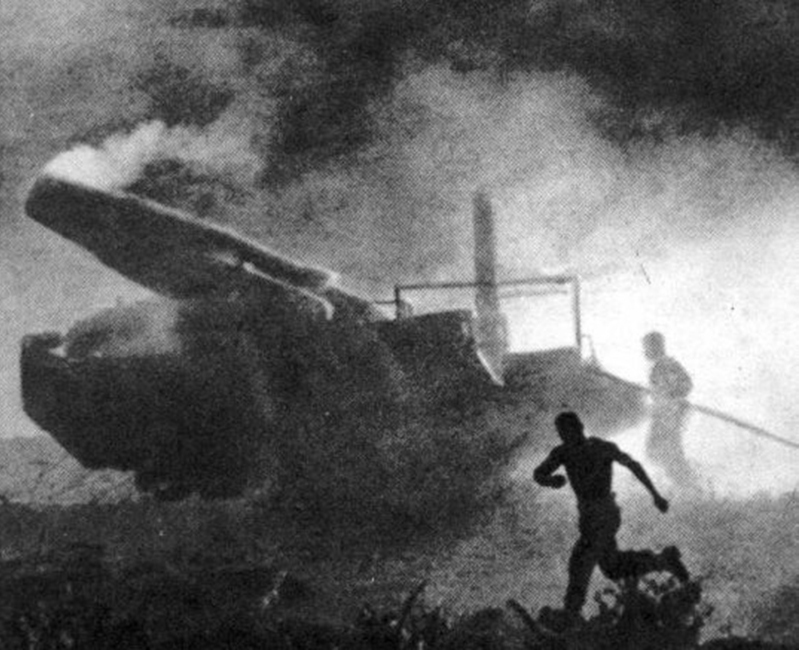
     Obscured by gun smoke and dust kicked up after firing is one of two 28cm Haubitze L/12 ( H L/12) heavy siege howitzers operated by Artillerie-Bataillon 744 during Operation Störfang. The gun was originally designed as a coastal howitzer (Küstenhaubitze) that was to be placed near critical coastal infrastructure and it was designed to fire projectiles at a high-angle so as to come down onto the thinner armor of a warship's decking rather than the much thicker belt armor (meaning, the sides). As a coastal defense gun, it was mounted on a turntable set into concrete and to protect the gun and crew, it had a 60mm thick armored dome fitted to it. The entire assembly was called the Mittelpivotlafette C/92 (Center Pivot Mount C/92). The H L/12 entered service in 1892 with a four gun battery being deployed in Tsingtao, China to defend the German colony there while another battery protected the ports of Wilhelmshaven and Blankenberge in Belgium. The only other user of the howitzer was Portugal who bought several of the guns in 1902 to protect the port of Lisbon. While the exact number of howitzers built by Krupp isn't known, some survived World War One and remained in the hands of the Reichswehr and ultimately it is believed nineteen examples were still on inventory at the start of World War Two. Long by this time, the howitzer had passed into obsolescence when the ranges of main guns mounted on warships exceeded that of the howitzer. Still, the artillery forces of the Wehrmacht lacked heavy siege guns and so a small number were pulled from static defensive locations in order to deploy them in the field. To do this required significant manpower, effort, and time.

     To transport the H L/12 required four loads: the barrel, the cradle, the gun mounting, and the components of the wooden ground platform. Once a suitable firing position was selected, a pit was dug and once that was completed, the wooden platform was assembled within the pit. After the platform was completed, the gun mount was fitted and secured down on the platform then the gun cradle and finally the barrel itself was installed. All together, to set up a single howitzer took between three to four days. The length of the H L/12 was 11.1 feet and the combat weight was 49.5 tons. The gun mounting provided a full 360 degree rotation thanks to a turntable situated on the bottom of the mounting. The maximum elevation of the gun was 65 degrees but the mounting provided no gun depression. The H L/12 used a horizontal sliding block breech and was percussion fired. Recoil absorption was by way of two hydraulic-pneumatic recuperator cylinders with additional absorption coming from the inclined plane of the gun mounting. The howitzer only fired one type of ammunition, the 28cm Sprenggranate L/3.5 high-explosive shell that weighed 772 pounds. To effect the maximum range of 6.5 miles, a seven-part powder charge that weighed 38 pounds was used. The H L/12 was not overly accurate and the effective range was a bit less at 6.2 miles. Against ships, the shell was able to penetrate 100mm of desk armor at a 63 degree angle. To facilitate loading, a crane was fitted to the gun mount and a trained crew could fire one round every one to four minutes. While the lack of accuracy of the H L/12 was an issue against mobile warships, against stationary targets like a city, the howitzer was more than effective in delivering its share of devastation.

     All told, the artillery amassed under 11. Armee dropped 46,750 tons of ordnance on Sevastopol and when the Germans took the city on July 4, 1942, only eleven buildings still stood without damage following both the artillery bombardment and the aerial bombing campaign. Although a German victory, the Germans suffered 27, 412 casualties and the Romanians 8,454 casualties in comparison to 118,000 Soviet casualties.

     The H L/12 howitzers would appear again in combat, this time during the Warsaw Uprising which commenced on August 1, 1944. There, the howitzers contributed to the purposeful destruction of Warsaw during the combat (which ended on October 2, 1944) and afterwards. By January 1945, some 85% of Warsaw was destroyed. The scale of the destruction was immense with 10,455 buildings, 923 historical buildings, 25 churches, 12 libraries, 81 primary schools, 64 high schools, and 2 universities being razed to the ground.

Friday, February 14, 2025

Russo-Ukrainian War: DITA 155mm SPH

Source: Public Affairs, 12th. Special Operations Brigade

     The Netherlands has provided Ukraine with nine DITA 155mm self-propelled howitzers (SPHs) and this is one of them, in service with the Artillery Group, 12th. Special Operations Brigade “Azov”. The DITA (Digital Integrated Targeting Artillery), built by the Czech arms manufacturer Excalibur Army, entered production status in 2023 and it shares a high level of commonality with another Excalibur Army product, the DANA M2 152mm SPH. The key difference is the caliber of the howitzer. The DANA M2 uses a 152.4mm howitzer, a caliber that is mainly unique to artillery from the former Soviet Union, from former Warsaw Pact countries, and currently from the Russian Federation. The DITA, on the other hand, uses a 155mm howitzer which is the standard caliber across most NATO countries and thus is capable of firing any compatible 155mm projectile regardless of the country of manufacture. Both calibers still find widespread use in military forces around the world, to include Ukraine which fields self-propelled guns and towed artillery using both 152mm and 155mm calibers, the latter typically coming via military aid from NATO countries. In addition to the nine, the Netherlands has pledged to provide another six DITA. 

     The 29-ton DITA uses a Tatra 815 VP31M 8x8 wheeled truck chassis which uses a Tatra T3C-928-90 12-cylinder, air-cooled, turbocharged vee diesel engine that develops 408 horsepower that is mated to a Tatra Norgren 10-TS-210N semi-automatic transmission. The gearbox has 12 speeds: 10 forward, 2 reverse. This provides the DITA with a top road speed of 55 miles per hour and in optimum off-road conditions, the maximum speed is 15 miles per hour. Off-road performance is improved through a central tire inflation system (CTIS). Enough diesel fuel is carried to give the DITA a maximum cruise range of 372 miles.

     The main weapon is a 155mm L45 howitzer situated within a centrally mounted turret. The mount permits a maximum howitzer elevation of 70 degrees and 3 degrees of depression. The turret does not provide a full 360 degrees of traverse, offering only a total of 60 degrees of total traverse. The DITA has outriggers to stabilize the vehicle when firing from the halt with hydraulics that can quickly deploy and retract to enable the DITA to be ready for firing fast and move just as fast once the fire mission is complete. The DITA uses much the same electronics from the Czech company Retia that equips the DANA M2. In regards to the howitzer, the ASAP (Automatic Setting of Action Position) system permits the DITA to fully automate firing data calculations which in turn directs the turret to traverse and the gun mount to lay the howitzer at the optimum elevation to engage the target. The ASAP system also selects the appropriate ammunition from the 40 rounds carried in the DITA's 40-round automatic loader. Both the commander and the gunner are provided with a digital fire control system (FCS) that tie into the ASAP system. The DITA can be manually aimed using a ZZ-73 mechanical sight, a PG-1M-D panoramic telescope, a K-1 collimator, and a PAB-2A artillery compass. These are calibrated for the 155mm caliber. For manual direct fire, the gunner would use a OP-5-38D telescopic sight. With the automatic loader, the DITA can fire up to 6 rounds in the first minute with a sustained rate of 5 rounds per minute. It is known that some of the DITAs in Ukrainian service are firing the U.S. made M107 155mm HE (High-Explosive) projectile. The M107,which remains in production despite being introduced in 1959, has a weight of 95 pounds with a M739 fuze of which 14.6 pounds is Composite B explosive. Upon detonating, the M107 can produce almost 2,000 fragments. With a full powder charge, the M107 has a maximum range of 12 miles and if using a base bleed M107 variant, the range can be extended out to 20 miles. Of course, the 155mm L45 howitzer can fire RAP (Rocket Assisted Projectile) shells which can reach a maximum range of 24 miles. Unlike the DANA M2, the DITA is not fitted with a heavy machine-gun for anti-air or local defense. Instead, the DITA has to rely on any small arms carried by the crew.

     For armor, the cab is protected to STANAG 4569 Level 1 standard. This is proof up to 5.56x45mm and 7.62x51mm ball ammunition at 30 meters and against 155mm artillery shell fragments at 100 meters. Against explosives, the armor can protect against hand grenades and small artillery fragmentation submunitions. The turret is not armored as the howitzer can be operated from within the cab. The cab is also NBC (Nuclear Biological Chemical) protected and crew comfort provided by a heater and air-conditioning system. Speaking of crew, the DITA can be operated with as few as two men though three is the usual compliment.

     Other systems mounted on the DITA include 24 volt water-cooled auxiliary power unit (APU) paired to hydraulic pump which permits the vehicle's electrical systems to work and the pump allows the gun controls to function if the engine is turned off or broken down. If even the APU fails, the howitzer has manual controls which can be used to aim, load, and fire the howitzer. The driver is provided with a Retia digital diagnostics system to monitor critical systems as well as a video system to enhance situational awareness while driving. A Retia digital communications suite includes a C2I (Command, Control & Intelligence) function, VHF/UHF tactical radio station, and a intercom system for the crew. A Retia inertial navigation system is backed up by a GPS (Global Positioning System) and this is also tied into the ASAP system.


Monday, January 13, 2025

Russo-Ukrainian War: D-30 (2A18) 122mm Howitzer

Source: Reuters

     A gunner of the National Police of Ukraine with his D-30 122mm howitzer somewhere in Zaporizhzhia Oblast, January 12, 2025. Designated the 2A18 but far better known as the D-30, the howitzer first accepted for Soviet Army service in 1960 and even today, remains a mainstay in artillery units of over 60 nations. While Russia no longer produces the D-30, it is currently license-built in Egypt, Iraq, and Sudan. In 2020, the Russian Army had 4,570 D-30 howitzers in service compared to only 129 examples in the Ukrainian Army. As of January 13, 2025, Russia has lost 114 D-30 howitzers while Ukraine has lost 16.

     The D-30 replaced the World War II era M-30 122mm howitzer with the D-30 reaching artillery units within Soviet Army divisions and regiments starting in 1963. The D-30 is distinctive in that it uses a tripod carriage which, when deployed, permits 360 degrees of traverse for the howitzer. This also provides a low profile, making the D-30 less conspicuous. Usually, the D-30 is deployed on even ground and once a position is selected, a hydraulic jack underneath the carriage center is lowered to the ground which lifts the howitzer. Once this is complete, the wheels are raised (in the photograph here, they have been removed to reduce the size of the D-30) and the movable two stabilizer legs are deployed and secured. The jack is then lowered so that the stabilizer legs touch the ground. The mount for the howitzer permits 70 degrees of elevation and 7 degrees of depression. It should be mentioned that if the barrel is pointed directly over one of the stabilizer legs, gun elevation is limited to 22 degrees. This is to prevent the D-30 from being displaced due to imbalance. In action, the D-30 weighs a little over 3 tons. When in traveling position, the D-30 is towed by its barrel, the tow ring underneath the muzzle brake. Maximum tow speed on roads is no more than 50 miles per hour. Usually, the D-30 is towed by a 6x6 truck though any vehicle capable of towing at least 3 tons can handle the D-30.

     The D-30 uses a semi-automatic, vertical sliding-wedge breech. By semi-automatic, it means when the howitzer is fired, the empty cartridge case is automatically ejected from the breech which then remains open, allowing a new projectile to be loaded. This permits a skilled crew (usually 6 to 8 men) to fire between 10 to 12 rounds every minute though a more sustainable rate is 5 to 6 rounds per minute. Recoil is reduced by way of a multi-baffled muzzle brake and a hydro-pneumatic recoil system mounted above the barrel. The muzzle brake accounts for half of the recoil reduction though the overpressure caused by firing the D-30 is about twice that of comparable caliber guns. As such, it is a danger to unprotected crew and often, gunners use very long lanyards to enable them to fire the D-30 from a distance to reduce the effects of the overpressure wave.

     The D-30 can fire a wide array of ammunition. The two most common projectiles are the 3OF56 HE-Frag (High-Explosive Fragmentation) and BK-6M HEAT-FS (High-Explosive Anti-Tank Fin Stabilized) munition. The 3OF56 has a nearly 9 pound payload of A-IX-2 explosive and can use a number of fuzes, to include the common RGM-2. The maximum range is 9.6 miles. If using a RAP (Rocket Assisted Projectile), such as the TF ER BB XM09 (made by Yugoimport), that range increases to 13.4 miles. As the D-30 was designed for direct engagement (another reason for the low profile), the BK-6M round (with 3.5 pound A-X-1 explosive filler) can, with a full charge, reliably penetrate 400mm of armor at a little under 1,000 meters (.6 of a mile). For indirect fire, a PG-1M panoramic telescope is most often used (supplemented with a K-1 collimator) and for direct fire, a OP4M-45 telescopic sight.

Wednesday, January 8, 2025

Russo-Ukrainian War: 2A36 Giatsint-B 152mm Howitzer (13th. Khartiia Brigade)

Source: Sofiia Gatilova (Reuters)

     A gunner from the 13th. Khartiia Brigade laying his towed 2A36 Giatsint-B (“Hyacinth”) 152mm howitzer against Russian targets. The photograph was taken somewhere in Kharkiv Oblast on January 6, 2025. Accepted for service by the Soviet Army in 1976, the 2A36 replaced the M-46 130mm field gun. Before the true designation was known to the West, the howitzer had the NATO reporting name of M1976. Designed by Yuri Kalachnikov and built by Uraltransmash, between 1,500 and 2,000 examples (source depending) were produced between 1976 and 1989. Russia, in February 2024, had 600 in service while Ukraine is reported to have at least 75 2A36 howitzers within its military.

     The 2A36 uses a split trail carriage that features a gun shield for the crew and four wheels to help disperse the ground pressure of the 10.5 ton weapon. The gun shield offers minimal frontal protection against some small arms calibers and shell fragments. To assist the tow vehicle (typically a KrAZ-260 6x6 truck) in stopping, the carriage wheels feature brakes. Top tow speed on roads (assuming the KrAZ-260) is 50 miles per hour while off-road, it drops to 28 miles per hour. The gun mounting permits an elevation of 57 degrees and a maximum of 25 degrees of traverse before it becomes necessary to move the howitzer. Crewed by eight men, the loader is assisted by way of a loading tray and a chain-driven hydraulic rammer. This permits a trained crew to fire 6 rounds every minute. The breech is of the horizontal sliding-block type while recoil is handled by a multiple-slotted muzzle brake on the end of the barrel, a buffer, and a recuperator. 

     The 2A36 can fire an array of ammunition but in the photograph, a OF-29 (ОФ-29) HE-Frag (High-Explosive Fragmentation) projectile is ready for loading. This would be followed by the cartridge case that contains the propellant. In the nose of the projectile is a fuze. The OF-29 is spin stabilized, has a boat-tail base for aerodynamics, and two copper driving bands which impart a seal in the barrel and ensure engagement of the barrel's rifling. With a full charge, the OF-29 has a maximum range of 15 miles. Indirect fire sighting is usually accomplished with a PG-1M panoramic telescope. The 2A36 can engage in direct fire though the maximum range is limited to 1.2 miles. An OP-4 series sight would be utilized for direct fire. Using RAP ammunition (Rocket-Assisted Projectile), the 2A36 can achieve a maximum range of 27 miles. A drawback of the 2A36 is that it because of its later design (relatively speaking), it cannot make use of 152mm projectiles that are used in earlier howitzers, some of which remain in service to this day. An example is the D-20 152mm howitzer (NATO reporting name M1955) which, despite its age, continues to see combat.

Sunday, July 23, 2023

Russo-Ukrainian War: Abandoned Russian D-30 in Kherson Oblast


     It should be noted that Ukraine is not being invaded by one country, Russia, but also Belarus and Chechnya. The latter is a de facto independent state but is within the Russian republic while Belarus is an independent country. Both of these countries have supplied troops to the invasion and in the case of Belarus, allowed Russian troop movements through their territory.

     The city of Kherson, located in south Ukraine, is being reported as surrendering to Russian forces as of March 2. The city's mayor, Igor Kolykhaev, stated that Russian soldiers are within the city and that there are no Ukrainian military forces within the city limits. However, other reports state there are still skirmishes occurring outside the city proper. If Kherson is, indeed, under Russian occupation, it gives the Russians a vital port on the Black Sea and secures a base of operations to launch attacks against Odessa. The Kherson Oblast (region) continues to see combat with several battles having been fought and still ongoing within the area. Cities lost to Russian forces include Melitopol and Berdiansk while the cities of Mykolaiv and Zaporozhzhia are still being contested.

     The photograph here shows a part of a Russian column destroyed somewhere within the Kherson Oblast. The gun being towed is a D-30 122mm howitzer. This is a weapon nearly 60 years old, having entered service in 1963. Although no longer built in Russia, the Russian military still has some 4,750 D-30 howitzers in service. It is still built in other countries and over 60 nations (including Ukraine with a reported 129 examples) have the D-30 in their military arsenals. This is a testament to its design and robustness. When deployed in action, the D-30 unfurls three stabilizers with the gun in the center, fitted atop a turntable that allows 360 degree rotation. The hydro-pneumatic recoil system sits on top of the gun barrel which allows for a low profile of the D-30. The gun has a maximum elevation of 70 degrees and a maximum depression of 7 degrees. The D-30 uses a semi-automatic, vertical sliding-wedge breech. The howitzer has a crew of seven and a trained team can run 10 to 12 rounds through the gun per minute though in practice, it is usually half that rate of fire. In part, this is because the muzzle brake is so large (in order to absorb half the recoil forces) that is creates a massive over-pressure around the gun. This means the crew typically uses a long lanyard to fire the gun and stands well away from it, reducing load times. The low profile also means the D-30 can be used for direct fire and comes with a telescope sight for anti-tank duties. The typical range of the D-30 using standard high-explosive rounds is 9.6 miles but with rocket-assisted shells, it can attain a range of 13.6 miles.

     The truck the howitzer is being towed by appears to be either a ZiL-131 or a Ural 4320. The white “Z” on the rear gate has been the subject of a number of online articles. Some state the “Z” means the unit is part of the thrust into Ukraine from the east. A “Z” with a white square around it indicates forces coming up from Crimea (from the south) into Ukraine while a “O” means units from the north that pushed into Ukraine from Belarus. Chechen units are believed to use a white “X”, special forces a white “A”, and Russian Marines a white “V”. Some other sources state these may simply be general identification marks to avoid friendly fire incidents without any specific allocation to where units are going within Ukraine.

Originally posted on March 2, 2022.

Thursday, July 15, 2021

Ordnance BL 15in. Howitzer Mk.I: A Gun The British Military Didn't Want


     In October 1914, the Royal Marines were reorganized in order to create two Royal Marine Artillery brigades. One served as an anti-aircraft artillery brigade while the other became the Royal Marine Howitzer Brigade (RMHB) under the command of Lieutenant-Colonel G. R. Poole. With a strength of around 1,000 men, the RMHB was split into twelve, one gun batteries. Each battery was composed of 60 men. A training facility was arranged for at Fort Cumberland, located in Portsmouth, UK. The guns deployed by the RMHB was the Ordnance Breech Loading (BL) 15in. Howitzer Mk.I and the RMHB would be the only unit to use them. 

     Coventry Ordnance Works, buoyed by their success with the 9.2in. howitzer, designed the BL 15in. gun on their own. However, with no military request for the gun, Coventry Ordnance Works used its influence within the British Admiralty to attempt to get interest in the product. At that time, Winston Churchill was First Lord of the Admiralty and saw the opportunity to get the Royal Navy involved in the land conflict in France. He authorized the purchase of 12 of the guns and so equipped, the RMHB would be sent to the Western Front in February 1915. The BL 15in. howitzer weighed around 94 tons and required three Foster-Daimler 105hp tractors to move. It could throw a 1,450lb shell out to a maximum range of 6.1 miles. Although effective enough when it came to eliciting destruction on German forces, the range was less than other, more capable guns and the time it took to bring the gun into action and the support required to operate it were detriments to its continued use. 

     Churchill’s support for the RMHB faded away in light of the performance of the howitzers and in time, the guns were forced onto the British Army who did not want them. Still, under Army oversight, RMHB crews served the weapons during the Battle of the Somme (September 1916) and the Third Battle of Ypres (October 1917). The guns were declared obsolete shortly after World War One and all of them were scrapped by 1920.