Showing posts with label electronic. Show all posts

Saturday, December 6, 2025

Russo-Ukrainian War: The 35D6M Radar Complex


     A screen capture from an informational video produced and released by the Ukrainian Air Force's 138th. Radio-Technical Brigade “Dnieper Ukraine” shows one of the brigade's 35D6M radar stations. The contrast between the base green paint on the radar complex and the brown of the fall/winter terrain emphasizes that this is a information production and not a shot of the complex in actual active deployment. Had it been, the 35D6M would have been easily spotted by Russian reconnaissance UAVs and targeted for destruction. The 35D6M is a modernization of the Soviet 19Zh6 (NATO reporting name Tin Shield) medium-range, 3D air defense radar which entered service in the early 1980s. The modernization program was undertaken by the Iskra Research & Production Complex, a part of Ukroboronprom, with the first 35D6M being delivered in the spring of 2021.

     According to Ukroboronprom, the modernization program updated the antenna apparatus, saw the installation of improved system and operating software, and the fashioning of a cabin that includes a total rework of the radar operator's stations and the fitting of a HVAC system. The complete details of the modernization isn't specified in articles, likely for operational security. Iskra took 19Zh6 radar complexes and completely took them apart. After the complete disassembly, all components were inspected and those parts that were to be re-used were refurbished before being reassembled with the updated parts as outlined above. It was said that the modernization of a single 19Zh6 into a 35D6M was not a quick process. The result is, again according to Ukroboronprom, a complex that has increased operational range, improved target data and trajectory acquisition, reduced maintenance requirements, and the extension of the complex's service life. As the various articles leave out the exact performance capability of the 35D6M, what follows are the specifications of the 19Zh6 radar.

     As mentioned, the 19Zh6 is a medium-range, 3D radar. The 3D (3 dimensions) means the radar provides the usual range and azimuth coordinates but adds the elevation coordinates and with all three, target tracking is far more precise. The radar itself uses a frequency-controlled, phased array antenna and it operates in the E- and F-band frequencies (2,850 to 3,200 MHz). Four transmitters generate overlapping wave patterns which improves altitude calculations. Pulse power is 3.2 kW as an average but can run as high as 350 kW. The Russian Wikipedia mentions the 35D6M as having a target detection range of 29 miles at low altitude and 108 miles at medium or high altitudes. There was no source provided with which to verify the data. Speaking of low altitude, the 19Zh6 and the 35D6M are optimized for low altitude target detection as the radar is resistant to active and passive jamming but is also able to filter out strong ground reflection (more often called clutter) from terrain, buildings, and other stationary objects. Finally, the radar is able to work effectively in all weather conditions. The radar antenna spins either at 5-6 revolutions per minute (rpm) or 10 to 12 rpm. The complex features BITE (Build-In Test Equipment) which permits rapid fault detection. The exact crew size for the entire complex isn't known but is likely between 7 to 10 men which would include at most 5 radar operators/technicians, at least two tractor drivers, and the remainder being mechanics to maintain the equipment. From the halt, it takes a trained crew 1 hour to bring the radar into action.

     The full 35D6M complex includes a 6BP power plant which houses two DGM 4-60-T0230-TS/400 diesel generators along with a PSTS-100 converter. The power plant sits inside a KP10 box body which is set on a MAZ-5224V 2-axle trailer chassis. The unit provides the power to the radar and its associated systems. The radar system and the 6II cabin sit on a MAZ-938 series 2-axle semi-trailer which has a maximum load capacity of 13.5 tons. The radar array is mounted on a 40V6M tower mast. The vehicle hitched to the MAZ-938 is a KrAZ-255V tractor. Besides the KrAZ-255V, the KrAZ-260V can also be utilized as a tow vehicle for both the semi-trailer and the 6BP.

Sunday, February 16, 2025

Russo-Ukrainian War: "Garpiya" 8-Channel Drone Jammer

Source: Krasnaya Zvezda

     With the inability of Russian logistics to adequately supply Russian Federation troops in the field with counter-drone equipment, it is not unusual that those troops who have the wherewithal purchase their own equipment off the civilian market or campaign via social media for donations either in funds for the unit to buy the gear or equipment is purchased by donors who then send it to the unit. Either way, the drone jammer seen here is one available on the Russian civilian market.

     Called the “Гарпия” ("Garpiya" meaning “Harpy”), the jammer can generate interference on eight drone channels via a 400 total watt output capacity. Each of the omidirectional antennas broadcasts the interference in a set band or the operator can elect to use a single directional panel antenna. The “Harpy” is offered in two versions, the difference being what frequencies the jammer operates against. The frequency in parenthesis is the primary frequency for that range. The first version targets drone control frequencies using 428 to 438MHz (433MHz), 860 to 930MHz (900MHz), 1,180 to 1,430MHz (1.2GHz), 1,380 to 1,430MHz (1.4GHz), 1,550 to 1,620MHz (1.5GHz), 2,400 to 2,500MHz (2.4GHz), 5,150 to 5,350MHz (5.2GHz), and 5,725 to 5,850MHz (5.8GHz). The second version targets frequencies between 300 to 400MHz (350MHz), 380 to 480MHz (459MHz), 500 to 650MHz (600MHz), 640 to 750MHz (700MHz), 750 to 920MHz (800MHz), 910 to 1,100MHz (1GHz), 2,390 to 2,500MHz (2.4GHz), and 5,720 to 5,860MHz (5.8MHz). The “Harpy” consumes 500 watts of power and it uses a 20 amp hour battery. This gives the “Harpy” approximately 8 hours of usage between battery changes or recharge.

     The pack weighs 35 pounds and the maximum range is 1.2 miles though this can be impacted by terrain and other conditions. If operating where mobile network signal is dense, the range of the “Harpy” is degraded. The “Harpy” does include anti-interference technology to combat electronic countermeasures (ECM). To keep the entire system cool, the pack incorporates heat sinks and cooling fans. Finally, the operator is provided with a remote control pad for the “Harpy”, tied into the unit via a cable. This permits the operator to use the “Harpy” without having to take it off his back.

     The weapon the soldier is using looks to be a TOZ-34 over-under shotgun. It does appear he is using 12-gauge shells, likely #00 buckshot.

Monday, January 27, 2025

Russo-Ukrainian War: The PARS-S "Stepashka" EW Rifle

Source: Telegram

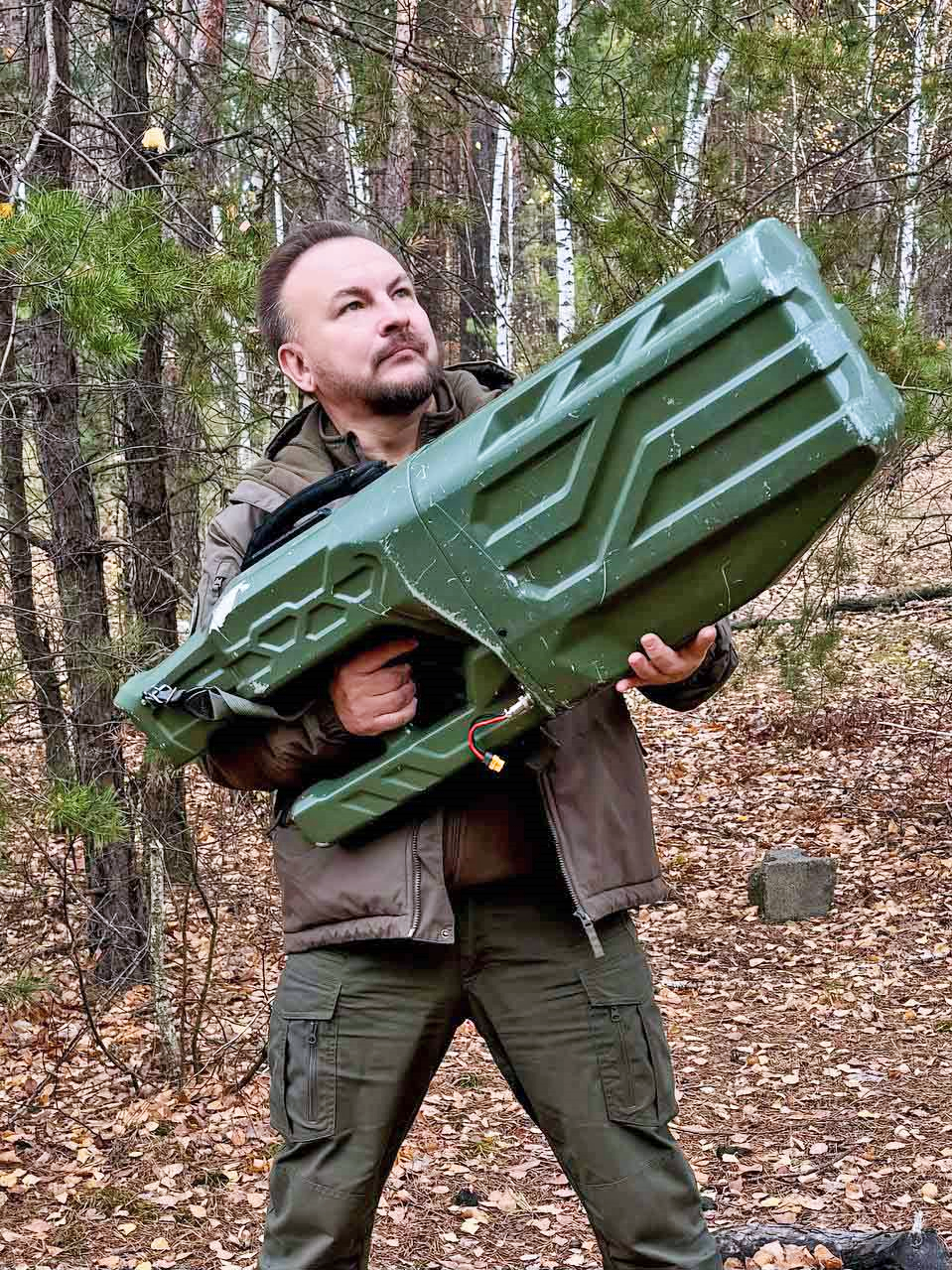
     Serhii Beskrestnov, a Ukrainian electronic specialist, poses with a trophy Russian PARS-S “Stepashka” anti-drone rifle. This example was captured from Russian forces late in 2024. Designed and built by the Russian company RUSGEOCOM, the PARS-S is just one of a number of Russian drone jamming EW (Electronic Warfare) apparatus. The PARS-S is meant for deployment by infantrymen, giving them a measure of defense against Ukrainian FPV drones. Beskrestnov was involved in the dissection of the captured PARS-S in order to determine the EW rifle's capabilities. A similar looking EW rifle (made by LokMas), the “Ступор” (“Stupor”), entered the market in 2017 and some found their way into Russian service though in at least one 2022 encounter with drones operated by the Ukrainian 30th. Mechanized Brigade “Konstanty Ostrogski”, the “Stupor” failed to down any of the drones.

     The PARS-S first appeared in 2023 and has a combat weight of 21 pounds and it can be deployed with mobile infantry, being carried via a nylon strap by a EW operator, or set up in a static position using a tripod. RUSGEOCOM promotional material states the PARS-S can jam any consumer drone model out of the box but can be upgraded to tackle FPV drones. In fact, the rather large size of the PARS-S is because inside, there is enough internal space to fit up to four additional antennas which could operate against multiple drone frequencies. Output of the power supply is 50 watts which permits an endurance of up to 2 hours of operation. This capacity is assumed to be with a single antenna. Maximum range, in ideal conditions, is 7 miles.

     However, when the large outer casing was opened to examine the PARS-S' innards, it was found that some of the internals had been built in China and was evidence that Chinese manufacturers were (and are) supplying Russian military industry with components despite sanctions. This is proof that despite them, China is circumventing sanctions. Another discovery was the poor quality of the installation of the internal parts. Beskrestnov noted that instead of utilizing more robust and secure means to install critical components, voluminous amounts of polyurethane construction foam (that has adhesive properties) was utilized to secure parts such as the battery packs and the antenna. In addition, the placement of the components was without rhyme or reason. With such shoddy internal construction, there is some question on how well the PARS-S can withstand the rigors of the front line battlefield over a period of time. In addition, it casts some doubt on RUSGEOCOM's claims on the capabilities of the PARS-S.

Photograph via Telegram. 

Wednesday, January 15, 2025

Russo-Ukrainian War: Damaged Russian 48Ya6-K1 Podlet K1 Radar System

Source: Ukraine_Defence (Instagram)

     On October 23, 2024, a joint mission between the Defense Intelligence of Ukraine and Special Operations Forces located and targeted a Russian 48Ya6-K1 Podlet K1 long-range, high-altitude surveillance radar situated near Cape Tarkhankut, Crimea. The photograph shows the result of the  drone strike. Meaning “Approach”, the Podlet system entered Russian service in 2018 (at a cost of $5.5 million U.S. dollars per unit) and it is designed to detect fast moving targets flying at low altitude. As such, the Podlet plays a key role in providing advance warning to Ukrainian cruise missile attacks (which usually fly at low altitudes) and the system is able to support air defense missile systems such as the S-300 (NATO reporting name SA-10 Grumble) and S-400 (NATO reporting name SA-21 Growler). Alas, as shown, Podlet is not infallible and so far, the Ukrainians have destroyed three Podlet radar vehicles and damaged two others (which includes this one).

     The actual extent of the capabilities of the Podlet's radar suites are not completely known though with the capture of a complete Podlet system in Syria in late 2024, the Podlet's performance may soon be revealed. What is known is that the main detection radar of the Podlet K1 is a 3-coordinate, S-band, phased-array radar which utilizes a circular scan search pattern. It is believed that the maximum detection range is 186 miles (in optimal conditions) and can reach an altitude of 6 miles. The Podlet also has two IFF (Identification Friend or Foe) arrays below the main radar array. One operates in the international standard SIF Mark XII (Selective Identification Feature) (utilized by NATO military aircraft and civilian aircraft) while the other operates in the Russian IFF national standard. Finally, there is a antenna which functions as a counter to electronic jamming, allowing the main detection radar to maintain operability in EW (Electronic Warfare) environments.

     The Podlet is usually supported by a generator truck to provide power and a C2 (Command and Control) vehicle to deliver target data to subordinate air defense units and command. Podlet is a primary component of Russian air defense in the Russo-Ukrainian War, being capable of tracking Ukrainian cruise missiles such as the R-360 Neptune and Western supplied cruise missiles such as the British Storm Shadow.