Showing posts with label siege. Show all posts

Thursday, September 25, 2025

300-Pounder (10") Parrott Rifle, Battery Strong, Morris Island: Down But Not Out

Source: Library of Congress

     Situated on Morris Island in South Carolina, its barrel broken, is one of only three 300-pounder Parrott rifles operated by Union forces during the Civil War. Part of Battery Strong, this particular Parrott rifle saw action during the Second Battle of Charleston Harbor which ran from July 18, 1863 until September 7, 1893 where it participated in the bombardment of Fort Wagner (also on Morris Island) which was defended by Confederate troops who had already defeated two Union assaults which attempted to take the fort.

     The Parrott rifle, designed by Captain Robert Parker Parrott, was heavily used by both Union and Confederate artillery forces. The 10-pounder Parrott rifle first appeared in 1860 and by 1862, larger Parrott rifles had appeared, to include the 20-pounder Parrott rifle (used as a field gun) and 30-pounder. In time, heavy artillery for siege warfare and bombardment saw the 100-pounder, 150-pounder, 200-pounder, and the rarest of them all, the 300-pounder Parrott rifle enter service by 1863.

     The Parrott rifle, regardless of caliber, was made of cast iron and this was chosen to extend the life of the rifling within the barrel. However, cast iron was brittle and was prone to splitting or cracking under the pressure created by the gasses of detonating gun powder. To reduce this risk, Parrott rifles had a wrought iron band around the breech. Parrott rifles were inexpensive, the 10-pounder only costing $187 to produce, and the Parrott rifle could be built quickly. Not surprisingly, the common 10-pounder and 20-pounder Parrott rifles were in widespread Union service. Despite the banding, the Parrott rifle was still susceptible to barrel bursts or damage.

     The 300-pounder (equivalent to a 10” caliber) had a length of 13 feet and a combat weight of 13.5 tons. Two primary shells were fired, one a sabot shell while the other was called a bolt. The sabot shell, a high-explosive munition, featured a metal ring (sabot) around the base of the shell and it was this ring that engaged the rifling within the barrel. Two fuzes were used, one being the Parrott time fuze while the other was a impact fuze. The Parrott time fuze consisted of a Zink plug in the nose of the sabot shell and within was a length of paper. The time delay until the shell exploded was derived by cutting the paper to a specific length. The impact fuze consisted of a percussion cap that was placed in the shell's nose and when the shell hit the target, the cap deformed and created a flame that set off the shell's charge. The bolt was a solid projectile and was mainly used to bludgeon through the armor of ironclad ships though it could also be used to smash into the stone and masonry walls of fortifications and shatter it. These shells had a weight between 222 to 300 pounds each and the typical powder charge weighed 26 pounds. The 300-pounder was muzzle loaded and though the crew size is not known, it was sizable. The 100-pounder Parrott rifle, as an example, required a crew of 17 men. With the barrel at a 30 degree elevation, the 300-pounder could hurl either a shell or bolt to a range of 5 miles.

     Returning to the 300-pounder in the photograph, on August 20, 1863, a shell burst towards the end of the barrel, blowing it apart. Exactly what unit was operating the Parrott rifle isn't known but it was either attached to a detachment from the 7th. Connecticut Infantry Regiment or was crewed by men from the regiment. This is because one Captain Sylvester Gray, who served with C Company, 7th. Connecticut, ordered the crew to take up tools and chisel and file away at the jagged end of the barrel until it was clear of any protrusions. With the remaining barrel unobstructed, the crew brought the Parrott rifle back into action with little loss in accuracy. 

     Fort Wagner held out, enduring near daily bombardment for two months, until September 6, 1863 when the remnants of the Confederate men within the fort (some 400 troops) abandoned it along with Morris Island, ceding it to Union forces.

Photograph taken by Philip Haas/Washington Peale.

Sunday, July 13, 2025

28cm Haubitze L/12: Vintage Siege Howitzer


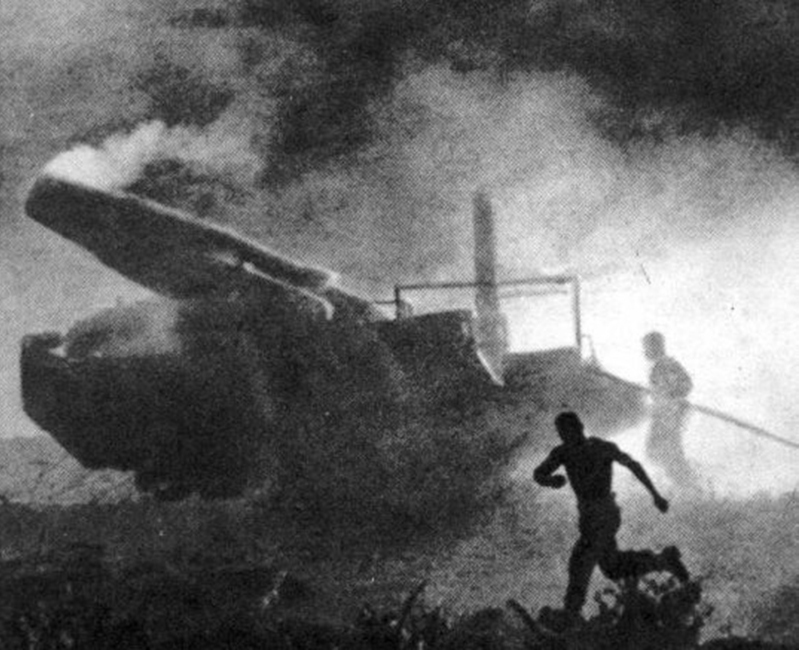
     On June 2, 1942, the Germans launched Operation Störfang (Sturgeon Catch) to take the Russian held port city of Sevastopol once and for all. Rather than launch conventional attacks as before which got them nowhere, the Germans instead elected for siege warfare, intending to pound the defenders into submission using heavy artillery before sending in ground forces. To do this, the 306. Artilleriekommando der Armee (Army Artillery Command) assembled the biggest siege guns and heavy artillery that could be had under the 11. Armee. All together, nine artillery battalions and three heavy and railroad artillery batteries came together, including elements from Artillerie-Bataillon 672 which fielded the massive 80cm Schwerer Gustav railway gun, Schweres Mörser-Bataillon 833 which operated two of the huge 60cm Karl-Gerät self-propelled siege mortars, and Schwere Artillerie-Batterie 459 that operated the sole remaining Krupp built 42cm Gamma-Gerät siege gun. Also in that number was Artillerie-Bataillon 744 and this unit and the guns it was equipped with is the subject of the photograph.

     Obscured by gun smoke and dust kicked up after firing is one of two 28cm Haubitze L/12 ( H L/12) heavy siege howitzers operated by Artillerie-Bataillon 744 during Operation Störfang. The gun was originally designed as a coastal howitzer (Küstenhaubitze) that was to be placed near critical coastal infrastructure and it was designed to fire projectiles at a high-angle so as to come down onto the thinner armor of a warship's decking rather than the much thicker belt armor (meaning, the sides). As a coastal defense gun, it was mounted on a turntable set into concrete and to protect the gun and crew, it had a 60mm thick armored dome fitted to it. The entire assembly was called the Mittelpivotlafette C/92 (Center Pivot Mount C/92). The H L/12 entered service in 1892 with a four gun battery being deployed in Tsingtao, China to defend the German colony there while another battery protected the ports of Wilhelmshaven and Blankenberge in Belgium. The only other user of the howitzer was Portugal who bought several of the guns in 1902 to protect the port of Lisbon. While the exact number of howitzers built by Krupp isn't known, some survived World War One and remained in the hands of the Reichswehr and ultimately it is believed nineteen examples were still on inventory at the start of World War Two. Long by this time, the howitzer had passed into obsolescence when the ranges of main guns mounted on warships exceeded that of the howitzer. Still, the artillery forces of the Wehrmacht lacked heavy siege guns and so a small number were pulled from static defensive locations in order to deploy them in the field. To do this required significant manpower, effort, and time.

     To transport the H L/12 required four loads: the barrel, the cradle, the gun mounting, and the components of the wooden ground platform. Once a suitable firing position was selected, a pit was dug and once that was completed, the wooden platform was assembled within the pit. After the platform was completed, the gun mount was fitted and secured down on the platform then the gun cradle and finally the barrel itself was installed. All together, to set up a single howitzer took between three to four days. The length of the H L/12 was 11.1 feet and the combat weight was 49.5 tons. The gun mounting provided a full 360 degree rotation thanks to a turntable situated on the bottom of the mounting. The maximum elevation of the gun was 65 degrees but the mounting provided no gun depression. The H L/12 used a horizontal sliding block breech and was percussion fired. Recoil absorption was by way of two hydraulic-pneumatic recuperator cylinders with additional absorption coming from the inclined plane of the gun mounting. The howitzer only fired one type of ammunition, the 28cm Sprenggranate L/3.5 high-explosive shell that weighed 772 pounds. To effect the maximum range of 6.5 miles, a seven-part powder charge that weighed 38 pounds was used. The H L/12 was not overly accurate and the effective range was a bit less at 6.2 miles. Against ships, the shell was able to penetrate 100mm of desk armor at a 63 degree angle. To facilitate loading, a crane was fitted to the gun mount and a trained crew could fire one round every one to four minutes. While the lack of accuracy of the H L/12 was an issue against mobile warships, against stationary targets like a city, the howitzer was more than effective in delivering its share of devastation.

     All told, the artillery amassed under 11. Armee dropped 46,750 tons of ordnance on Sevastopol and when the Germans took the city on July 4, 1942, only eleven buildings still stood without damage following both the artillery bombardment and the aerial bombing campaign. Although a German victory, the Germans suffered 27, 412 casualties and the Romanians 8,454 casualties in comparison to 118,000 Soviet casualties.

     The H L/12 howitzers would appear again in combat, this time during the Warsaw Uprising which commenced on August 1, 1944. There, the howitzers contributed to the purposeful destruction of Warsaw during the combat (which ended on October 2, 1944) and afterwards. By January 1945, some 85% of Warsaw was destroyed. The scale of the destruction was immense with 10,455 buildings, 923 historical buildings, 25 churches, 12 libraries, 81 primary schools, 64 high schools, and 2 universities being razed to the ground.