Friday, July 23, 2021

Enlisted Man: 15th. Signal Training Regiment


     A studio portrait of an enlisted man in the Army Service Forces which is denoted by his shoulder patch. Specifically, he was part of the Signal Corps which made up one of the seven technical services which were encompassed by the Army Service Forces beginning in 1942. That he was Signal Corps, and that he was an enlisted man, is evidenced by the pair of branch insignia on the upper portion of his jacket’s collar. 

     His unit was the 15th. Signal Training Regiment and this can be told by examining the distinctive unit insignia (DUI) pinned to the collar below the branch insignia. DUI were often enameled and so this reflected the flash which washed out the nearest DUI to the camera. Enough of the other DUI was visible to identify the unit. The unit motto, given on a scroll underneath the crest, read “FIDELITER SERVIMUS” which means “Faithful Service.” The unit was activated on December 1, 1940 as the 15th. Signal Service Battalion but on December 14, 1942, the unit was redesignated as the 15th. Signal Training Regiment. On May 31, 1945, the unit was disbanded but on September 23, 1986, it was reconstituted as the Headquarters and Headquarters Detachment, 15th. Signal Brigade and currently serves under TRADOC (United States Army Training and Doctrine Command) at Fort Gordon, Georgia. 

     The award on his left jacket pocket is a marksman qualification badge and though it is extremely difficult to read what is on the device’s clasp, given the length of the word, he likely earned it in RIFLE. 

Thursday, July 22, 2021

Panzerkampfwagen VI Ausf.B Tiger II "11": Abandoned in Châteaudun


     In April 1943, Panzer-Versuchs-Ersatz-Abteilung (Funklenk) 300 (300th. Armored Experimental & Replacement Battalion [Radio Steering]) created 1.schwere Panzer-Kompanie (Funklenk). Units designated as Funklenk, in addition to regular tanks, were equipped with Schwerer Ladungsträger (Heavy Explosive Carrier) Borgward B IV remote-controlled demolition vehicles. In August 1943, the unit would be redesignated as Panzer-Kompanie (Funklenk) 316. By September 1943, the unit was attached to Panzer-Lehr-Regiment 190 for training. On February 19, 1944, the unit was to be equipped with Tiger II tanks. In the meantime, unit crews trained in Tiger I tanks. By April 1944, the unit had five Tiger II tanks and three refurbished Tiger I tanks on strength. Given that the Panzer-Lehr Division elected to not equip one of its Funklenk companies with tanks, it instead equipped it with assault guns and transferred the tanks off their books and onto the books of Panzer-Kompanie (Funklenk) 316. 

     On August 13, 1944, the unit was deployed to Châteaudun, equipped with only the five Tiger II tanks of which Tank “11” was one. The tanks were situated around the city, overlooking strategic points in which it was felt the U.S. 3rd. Armored Division would approach. Tank “11” was positioned along the Place de Mail (now Promenade du Mail), observing north out over the Loire River. On August 15, advance elements of the 3rd. Armored Cavalry Division were engaged by Tank “12” near the junction of Routes N10 and N824. One Jeep and one M8 armored car were destroyed and their crews captured by supporting German infantry. Tank “12” withdrew into the city along Rue de Varize. The following day, U.S. artillery fired on Tank “13” which had been spotted but to no effect. Tank “12” again battled U.S. forces and halted their advance. However, it was clear that the U.S. forces would not be halted for long and so the unit began to withdraw on August 17 under the cover of darkness. Tank “12” and Tank “13” were left behind with Tank “12” being set on fire. Tank “02”, Tank “10”, and Tank “11” moved back to Boulevard Kellerman where Tank “11” broke down and was abandoned. 

     The remaining tanks moved east along Route N155 into Varize when Tank “10” broke down. It was towed for a short distance by Tank “02” before being scuttled by its crew. The last tank made for Janville but mechanical failure caused the tank to veer sharply and run over a tree before stopping. It was abandoned on August 18, 1944 and so ended the brief history of the Tiger II tanks of Panzer-Kompanie (Funklenk) 316.

Char B1 (n° 227) “Bordeaux”: Mine Victim near Mareuil-Caubert


     Char B1 “Bordeaux” (n ° 227), following its construction, was delivered to the 510e RCC (Régiment de Chars de Combat) stationed near Nancy, France in 1938. By September 1939, “Bordeaux” was transferred to the 15e BCC, 1ère Compagnie (Bataillon de Chars de Combat; 1st. Company, Combat Tank Battalion). Once again, this time on May 18, 1940, the tank was with the 348e Compagnie Autonome de Chars de Combat (CACC; Autonomous Company of Combat Tanks) under the command of Second Lieutenant Fournier. His crew consisted of driver Sergeant Chief Rivoal, gunner/assistant driver Corporal Jacquet, and radioman Corporal Marchand. 

     On June 4, 1940, “Bordeaux” was one of many French tanks assembled to push towards Mont de Caubert, a spur of land near Mareuil-Caubert, in the closing actions of the Battle for Abbeville. With almost no intelligence on German forces in the area, French and British forces jumped off at 3am, not wishing to wait for French armor which had not made the assembly area by the time the attack was to commence. In time, French tanks arrived and advanced but ran into a minefield off the Blangy–Abbeville Road. It was also a kill zone for German anti-tank guns and artillery. 

     “Bordeaux” was one of the tanks that had struck a mine, blowing off its left track. Given the circumstances, repair was impossible and Fournier ordered the abandonment of the tank. In all, 30 Char B1 tanks and some 120 other tanks (of various makes) took part in the combat. When it was over, only 6 of the Char B1 survived and some 60 other tanks made it through the battle which was a victory for German forces, the Allies being unable to dislodge the enemy from Mareuil-Caubert and the surrounding area.

The M2A2 Light Tank: 24th. Infantry Division Line-Up

(U.S. Army Signal Corps)

     In 1933, the prototype T2 light tank was built. It utilized a suspension system similar to the British Vickers 6-ton, a tank which was influential in regards to tank development, especially in Russia and Poland. However, it was seen that the weight of the tank was too much for the suspension and so vertical volute suspension was used instead. The redesigned tank became the T2E1 and after a period of evaluation, the tank was standardized as the M2A1 light tank in 1935. Source depending, nine to nineteen M2A1 tanks, to include the initial prototype, were built. The M2A1 had a fixed turret, meaning, it could not rotate, and was armed with one .50cal. and one .30cal. Browning machine-gun. The M2A1 was quickly superseded by the M2A2 and the biggest change was the replacement of the fixed turret with two, rotating turrets. The armament was the same save the .50cal. machine-gun was in the left turret with the .30cal. machine-gun in the right turret. Each turret had an effective traverse of 270 degrees otherwise the guns would foul each other. The M2A2 was in production from 1936 to 1937 when an improved model, the M2A3, appeared in 1938. The improvements consisted of longer stroke springs for the suspension and extending the distance between the two bogies to enhance the ride, increasing armor protection, a slightly longer hull, better engine cooling, and other minor improvements. However, the turrets remained exactly as the earlier M2A2. The majority for the M2A2 and M2A3 tanks were powered by a 250hp Continental W-670 engine which gave the tank a top speed of 30mph on roads and around 18mph cross-country. For armor, the maximum thickness was 16mm with the minimum being 6mm. The .50cal. machine-gun was provided with a little over 2,000 rounds of ammunition while the .30cal. machine-gun was supplied with 7,185 rounds. By 1940, the M2A1, M2A2, and M2A3 light tanks were declared obsolete though they remained in service as training tanks early into World War Two. The twin turreted tanks had the unofficial nickname of “Mae West” which referred to the turrets representing the ample bosom of the actress who, at 4'11, had a 32C bust which, for the day, was a bit above the average.

     The M2A2 tanks in the photograph belong to the 24th. Infantry Division, known as the “Victory Division”, and this is told by the insignia which consisted of a green taro leaf outlined in yellow on a red background surrounded by a black circle. This was an homage to the unit's previous incarnation as the Hawaiian Division. It is likely the tanks belonged to the unit's 24th. Reconnaissance Troop as other photographs show the crossed sabers of the cavalry on the turret sides. Also just visible on the front of the hull was the armored forces insignia which consisted of a World War One tank over a pair of crossed rifles. The division took part in the defense of Oahu, Hawaii on December 7, 1941 and it would remain on the island until May 1943 when it deployed to Australia to train before going into combat during Operation Reckless, the landings on Japanese held Dutch New Guinea which kicked off on April 22, 1944. Later, the division took part in battles on Leyte and Luzon, Philippines and would later occupy Japan following the Japanese surrender.

     The only M2 light tank series to see actual combat were M2A4 models which reverted to a single turret armed with a 37mm gun, the last of the 365 built being completed in March 1941. Some fifty of the tanks were employed in Guadalcanal in 1942 by the 1st. Tank Battalion, U.S. Marine Corps when they landed on the island on August 7, 1942. There are claims that some M2A3E3 (which used a Guiberson diesel engine) tanks saw combat in Burma. The M2A4 led directly to the M3 light tank which saw extensive action in all theaters of the war. 

     As for the 24th. Infantry Division, it was inactivated on August 1, 2006 after seeing combat in the Korean War and the Gulf War. Given the unit's extensive history and battle accolades, it remains second on a list to be reactivated if the U.S. Army requires it.

Wednesday, July 21, 2021

Oskar Josef Bschließmayer: Pacifist in the Wehrmacht

Oskar (left) with actor Wilfried Seyferth in the 1951 film Decision Before Dawn.

    In December of 1941, Oskar Josef Bschließmayer was drafted into the Wehrmacht and was sent for training as a cannonier and that it was hoped he would soon rise to become an officer. Bschließmayer, however, was a pacifist and had no love for the ideology of National Socialism. Knowing that the war on the East Front would only continue to worsen, Bschließmayer set out to ensure that he would amount to nothing in the eyes of his superiors. During training, he would purposely fail at horsemanship (at the time, much of the Wehrmacht’s artillery still relied on horses for mobility) and during artillery training, he would intentionally misread and make mistakes with the range finders. His ability to play the part of an incompetent was no doubt due to his skill as an actor for which he was prior to being drafted. Eventually, his efforts paid off and Bschließmayer was expelled from training school. Nevertheless, he was still sent to an artillery regiment reserve unit in Vienna where he was a cook and janitor. 

     In 1944, while still deployed in Vienna, he married actress Elisabeth Kallina in secret. This was because Kallina was half-Jewish. Soon after, they had a daughter, Eleanore. On December 8, 1944, Bschließmayer and his family deserted from the regiment and hid inside a dilapidated shack within the Wienerwald (Vienna Wood). On April 2, 1945, the Soviet 2nd. and 3rd. Ukrainian Fronts launched their attack on Vienna which forced them to abandon their hiding place and flee in the face of the Soviet forces. They ran right into Bschließmayer’s regiment but in the chaos, they were able to escape unnoticed out of Vienna and once more enter into hiding. 

     Following the war, Bschließmayer would return to acting, assuming once more his stage name of Oskar Werner. His first Hollywood film appearance was as ex-POW Karl “Happy” Maurer in the 1951 war film “Decision Before Dawn” and the photograph is a still from the movie showing Werner in the disguise of a Luftwaffe Feldwebel (equivalent to a U.S. Staff Sergeant) medic. Barely visible is the white armband with the Red Cross on it and on his lower right sleeve is the Luftwaffe Sanitätspersonal (medical personnel) trade/proficiency badge. Historically, the badge was worn on the left lower sleeve. He is shown speaking with SS-Schütze Heinz Scholtz (played by Wilfried Seyferth) who was portraying a dispatch rider in the film. Werner would continue to feature in European films and a handful of U.S. movies, notably as Guy Montag in the 1966 film version of Ray Bradbury’s critically acclaimed novel “Fahrenheit 451.” 

     Werner died on October 23, 1984 from a heart attack. 

Flieger: Latvian Youth Organization


      A member of the Latvju Jaunatnes Organizacija (LJO), or Latvian Youth Organization. The LJO, under direction of German leadership, was formed in April 1943. While nominally voluntary, by July 1944, boys and girls were being conscripted into the LJO. The LJO had two functions. One was to provide Landdienst (Land Service) workers and the other Luftwaffe Helfer (Helpers). 

     Although there was a regulation uniform and special insignia for the LJO, in practice, it was rarely followed and there was much variation in the uniforms as well as insignia worn. LJO members were to wear a LJO brassard but more often than not, they were not well constructed and fell apart. In their place, some LJO youth wore the same Latvian sleeve shield as issued to Latvian volunteers in the German Heer (Army) and Luftwaffe. 

     This Flieger (Private) likely shed his brassard and replaced it with the Luftwaffe pattern Latvian sleeve shield and he wears full Luftwaffe rank and insignia rather than the LJO accouterments. The uniform itself is Luftwaffe though his shirt is non-Luftwaffe, being a light gray rather than blue. The color of the collartabs was likely red as worn by Luftwaffe artillery personnel. 

     The majority of the LJO Luftwaffe Helfer served under Luftflotte 1, the boys (and girls as well) commanded by Hauptmann Edgars Rempe and Leutnant Indulis Kažocinš.

The M-1978 Koksan: North Korea's 170mm Self-Propelled Gun

A former Iranian M-1978 captured by Iraq during the Iran-Iraq War being towed away by U.S. Marines.

     The M-1978 “Koksan” is a rather unusual self-propelled gun (SPG) in a number of aspects. Built by the Second Machine Industry Bureau of North Korea, the SPG uses the chassis of the Chinese built and supplied Type 59 main battle tank (itself a Chinese version of the Russian T-54A tank) and mates it with a 170mm gun. The gun itself is a bit of a mystery given the caliber. Some sources say it was derived from a Russian naval gun except that the Russians never used any such caliber. The closest is the 180mm M1931/M1932 pattern naval gun. Other sources say the gun is some form of copy or version of the World War 2 German 170mm Kanone 18 or at least designed to fire captured stocks of 170mm ammunition supplied by Russia (which doesn’t seem completely plausible). 

     However the North Korean military arrived at the 170mm, the SPG first appeared to Western eyes in a military parade in 1978 held in Koksan County, located in North Hwanghae Province. Since the actual designation for the SPG is not known, Western intelligence analysts gave it the name M-1978 Koksan after the year and place it was first seen. The Koksan was one of the first weapon systems North Korea exported and the only foreign buyer was Iran who purchased a number of them in 1987 and they saw action during the Iran-Iraq War (September 22, 1980 to August 20, 1988), shelling Kuwaiti oil fields using rocket-assisted rounds which made them immune from Iraqi counter-battery fire. During the war, Iraqi forces captured several of the M-1978 and emplaced them as war trophies. 

     The one in the image was located near the University of Anbar in Ramadi, Anbar, Iraq and is seen being towed away by U.S. Marines in 2008. The M-1978 remains in North Korean service and some sources say surviving Iranian M-1978s also remain in service with Iranian artillery forces.

Tuesday, July 20, 2021

Sergeant Stanley Martin Lieber: 1st. Motion Picture Unit


     Because of the Japanese attack on Pearl Harbor in December 1941, early in 1942, Stanley Martin Lieber enlisted in the U.S. Army and entered the Signal Corps as a lineman. Posted stateside, Lieber maintained and serviced communication equipment and effected repairs to damaged telegraph/telephone lines and poles. Later, Lieber would transfer to the 18th. Army Air Forces Base Unit, better known as the 1st. Motion Picture Unit (FMPU) which was housed in Culver City, California. 

     The FMPU’s mission was to produce propaganda films, create training films and documentation, and also serve as the sole training provider for combat photographers and cameramen who would be deployed to the frontlines. Training, to include regular infantry combat instruction, for these men was conducted at Page Military Academy which was in nearby Los Angeles, California. Lieber was tasked with the writing of military manuals, scripting for training films, and illustrating. Lieber received the MOS (Military Occupational Specialty) of 288 (Playwright) though other sources list his MOS as 286 (Motion Picture Production Technician). Lieber would be discharged from the Army in late 1945 and with the war over, the FMPU was disbanded in December 1945. By the time of his discharge, Lieber had achieved the rank of sergeant and was decorated with the World War II Victory Medal and the American Campaign Medal. He also earned the right to wear the Honorable Service Lapel Button which was given to honorably discharged servicemen. It was better known as the “Ruptured Duck” due to the appearance of the oft said poorly rendered eagle which made up the button or pin. 

     Because of his service and significant post-war contributions, Lieber was inducted into the Signal Corps Regimental Association and made an honorary member of the 2nd. Battalion, 3rd. Infantry Regiment in June 2017. The 3rd. Regiment, nicknamed the “Old Guard”, is the oldest active duty unit in the Army, having been formed in 1784. Lieber would pass away in November 2018. 

     Stanley Lieber is much better known to us as comic creator Stan Lee.

SA-Sturmmann: SA-Standarte Feldherrnhalle

(Author's Collection)

     Formed in 1935, SA-Standarte Feldherrnhalle was one of the elite units within the Sturmabteilung (SA). The unit derived its name from the Feldherrnhalle, or Field Marshall's Hall, that had been erected in Munich, Germany by King Ludwig I of Bavaria to honor the Bavarian Army. Commissioned in 1841, the Feldherrnhalle was completed in 1844 and is situated on the Odeonsplatz in Munich. It features the statues of two famous Bavarian military leaders: Johann Tserclaes, Count of Tilly who commanded the Catholic League's military forces during the Thirty Years' War (1618-1648) and Karl Philipp von Wrede who went against Napoleon Bonaparte at the Battle of Leipzig in October 1813. A third statue was added in 1892 that commemorates the Franco-Prussian War of 1870. The monument became associated with the Nationalsozialistische Deutsche Arbeiterpartei (NSDAP; National Socialist German Workers' Party) when, on November 9, 1923, NSDAP marchers clashed with Bavarian State Police following the coup d'état attempt by NSDAP leader Adolf Hitler and some 600 SA men. Hitler and his SA troops surrounded the Bürgerbräukeller beer hall where Gustav Ritter von Kahr, the Bavarian state commissioner, was holding a speech. It was here Hitler sought to gain governmental support for the putsche (violent overthrow of a government) and while he stirred up the people in the hall with his rhetoric and tacitly had Kahr's support, the putsche was escalating within Munich with buildings being seized and sporadic firefights between Reichswehr troops and state police. It came to a head on November 9 when, the putsche petering out, the SA men marched in the streets and decided to head for the Bavarian Defense Ministry building. They were met in front of the Feldherrnhalle by 130 men under the command of State Police Senior Lieutenant Michael von Godin. Shots rang out and four policemen and sixteen SA men were dead and with them, the Beer Hall Putsche was over.

     SA-Standarte Feldherrnhalle was headquartered in Berlin with, at its maximum strength, nine battalions (Wachsturmbann) spread across Germany with the tenth battalion, X. Wachsturmbann, stationed in Warsaw, Poland. The primary mission of SA-Standarte Feldherrnhalle was to provide security for SA, state, and NSDAP offices. By February 1939, much of the manpower of SA-Standarte Feldherrnhalle was absorbed into the Luftwaffe to fill out fallschirmjäger (paratrooper) units while another portion became Infanterie-Regiment 271 under the 93. Infanterie-Division. What was left of SA-Standarte Feldherrnhalle continued to operate in a lessened capacity until the close of the war. In 1942, Infanterie-Regiment 271 was renamed Infanterie-Regiment “Feldherrnhalle” in honor of the original SA-Standarte Feldherrnhalle. The unit was withdrawn from the East Front in the spring of 1943 and was used to form 60. Panzer-Division (later renamed Panzergrenadier-Division “Feldherrnhalle”) which was subsequently crushed by the Soviets during fighting along the Dnieper River in 1944. Several other units carried the “Feldherrnhalle” honorific, including Panzer-Brigade 106 and 110 “Feldherrnhalle”. Panzer-Brigade 110 was absorbed into 13. Panzer-Division which was then renamed Panzer-Division “Feldherrnhalle”. The latter division along with Panzergrenadier-Division “Feldherrnhalle” were combined to form Panzer-Korps “Feldherrnhalle” that saw combat in Hungary, Czechoslovakia, and finally Austria.

     The photograph shows a SA-Sturmmann of SA-Standarte Feldherrnhalle. The unit had its own unique collar tab color, being carmine (a deep red color) with silver threaded borders. On the right collar tab was the “Kampfrune” (literally, “Fighting Rune”) with the circular portion of the Kampfrune consisting of the emblem of the SA. The left collar tab denoted his rank. Not visible was the “Feldherrnhalle” cuff title which was a 27mm wide brown band with either silver threading or gray cotton borders with “Feldherrnhalle” written in Sütterlinschrift (Sütterlin Script) using silver-aluminum thread. The cuff title was worn on the lower left sleeve of the uniform. In some cases, the SA man could request the wearing of a dark green oval with the “Kampfrune” centered on it in place of the cuff title as it was worn in the same location. The shoulder boards appear to be the second style which was brown with white stitching and if so, that dates the photograph to at least 1938. Men of the SA-Standarte Feldherrnhalle had their own special decals for the stahlhelm (steel helmet) which consisted of a white shield bordered in black with a white circle bordered with red within which was a black swastika on the right side of the helmet and on the left, a red shield bordered in white with a simplified front face of the Feldherrnhalle monument in white with three black arches to highlight the statues and underneath it was a Wolfsangel rune in white.

     In the German Heer (Army), the units derived from SA-Standarte Feldherrnhalle were allowed to continue to wear the SA cuff title but sometime in 1943, a machine-woven variant was produced and issued, likely as stocks of the original SA cuff title had dwindled. The Kampfrune emblem continued to be worn but in a modified form that consisted of three horizontal Wolfsangel runes superimposed over the single vertical Kampfrune with the SA emblem in the center. This was worn as a metal cipher on the shoulder boards. Also in contrast to the Heer, the SA standard bearer gorget was worn and in parades and other formal occasions, the standard was the same as that used by SA-Standarte Feldherrnhalle which consisted of the “Deutschland Erwache” vexillum standard with a rectangular plaque reading “Feldherrnhalle” above the standard and below the metal eagle and wreathed swastika.


Ilio Capozzi: Frogmen Commando Corps

(Photograph by Life Magazine)

     When civil war broke out in the Dominican Republic on April 24, 1965, one of the more interesting personages fighting on the side of the Constitutionalist faction was the Italian, Ilio Capozzi (sometimes written as Cappoci). Capozzi's background is hazy but the consensus is that during World War Two, he served with Decima Flottiglia Motoscafi Armati Siluranti (Decima Flottiglia MAS) which was an elite unit of the Regia Marina (Italian Royal Navy) consisting of highly trained commando frogmen and naval personnel. Following the war, Capozzi is said to have joined the French Foreign Legion (FFL) and during his time with the FFL, saw action in the First Indochina War (1946-1954) and later in the Algerian War which ran from 1954 to 1962. Capozzi, in 1956, answered a call by the dictator of the Dominican Republic, Rafael Leónidas Trujillo Molina, seeking experienced soldiers to provide instruction to a new unit Trujillo wanted to create, the Cuerpo de Comandos de Hombres Ranas (Frogmen Commando Corps) as part of the Dominican Republic Navy. Capozzi was not the only Italian enticed and other former Decima Flottiglia MAS veterans such as Victorio Tudesco and Enzo Lobasto joined Capozzi. Many other experienced and decorated Italian veteran commandos and instructors would assemble at the naval base located in Las Calderas. Once the cadre was in place, the first selections of personnel for the unit commenced in August 1957. The training was extensive, dangerous, and rigorous. A modern day analogy would be the United States Navy Sea, Air, and Land (SEAL) Teams. Instruction included demolition (sea and land), small unit operations (for example, intelligence gathering), sabotage techniques, establishment of beachheads, survival in all climates, and being able to operate on little to no support. About 2,000 men were selected for the training but in the end, only 108 of them made it through, forming four platoons. The unit was commanded by Vice Admiral Manuel Ramón Montes Arache.

     When the civil war erupted, the Cuerpo de Comandos de Hombres Ranas joined the Constitutionalist faction that supported the deposed Juan Emilio Bosch Gaviño. Situated in Santo Domingo, the Cuerpo de Comandos de Hombres Ranas established a hasty training facility to rapidly instruct civilian Constitutionalist faction rebels in urban guerrilla combat techniques. The forces of the Constitutionalists outnumbered the Loyalist faction's troops that supported acting President Donald Reid Cabral though the latter enjoyed more armored support and air power. At 10:30am on April 25, Constitutionalist forces, including elements of the Cuerpo de Comandos de Hombres Ranas, stormed the presidential palace in Santo Domingo, arresting Reid. This assault, though, was the last battle for Capozzi as he was killed during the attack. It was the U.S. intervention that commenced on April 30 that saw the end of the Constitutionalist uprising which had been on the verge of victory. The arrival of U.S. Army and U.S. Marine forces would see a ceasefire go into effect that very night. Some sources state Capozzi died on May 19, 1965, also while attacking the presidential palace. I was not able to find a definitive accounting of the combat that took place commencing on May 13 when Loyalist forces broke the ceasefire to attack Constitutionalist forces within the Santo Domingo area. It is possible that the Constitutionalists sought to retake the palace which was within the demilitarized zone that divided the two factions.

     The photograph is one of many featuring Capozzi. His rank is unknown, sources citing he was a Captain while others state he was a Colonel. He is wearing French battle dress made with the U.S. M1942 “Frog Skin” camouflage pattern which was widely utilized by the U.S. Marines during World War Two and for a short period of time by the U.S. Army in the European Theater before its use was discontinued. Following World War Two, the U.S. sold the camouflage pattern to the French who utilized it in their uniforms through the 1950s with much of the production going to the French Foreign Legion, specifically the 1st. Foreign Parachute Regiment and 2nd. Foreign Parachute Regiment that saw combat in the First Indochina War. The helmet he wears is the U.S. M1 “steel pot” but it has been refitted with the French TAP/EO system as used by French parachutists. While not definitive evidence, the fact he has such equipment suggests Capozzi may have served in one of the two regiments. His web gear is a mixture though the majority is U.S. Army issue. Of note is his rifle, a 7.62mmX51mm ArmaLite AR-10. Numerous Central American countries purchased the AR-10, including Guatemala and Nicaragua. Capozzi, however, is said to have used a Cuban AR-10, Cuba having been another buyer. The grenade on his belt appears to be a U.S. M26 fragmentation grenade. Capozzi also carried a pistol sidearm and the brown leather magazine pouch is visible on his left hip along with a fighting knife. Behind the magazine pouch is the U.S. issue pouch (he had two) that he carried his extra AR-10 magazines in. The civilian rebel he is chatting with is armed with a .30cal. Cristobal M2 carbine.


Private Lemuel Engle: Company K, 148th. Indiana Regiment (Infantry)

(Photograph taken by the author)

     The Civil War isn't my specialty but on a recent business trip, a cemetery was visited which resulted in a few interesting soldier graves. I won't divulge the location as many of the headstones have been vandalized and even outright stolen. This marker is for Private Lemuel Engle who served in Company K, 148th. Indiana Regiment (Infantry). He mustered into the unit on February 23, 1865 at the age of 24. Much of the men taken into the regiment came from the 6th. Congressional District of Indiana and the regiment was formed in Indianapolis and was fully mustered on February 25, 1865 with a strength of 1,027 men. The unit was considered a "One Year Regiment." Within three days, the regiment was dispatched to Nashville, Tennessee. Bear in mind that by this time, the Confederacy was all but pushed out of the area following the Union victories during the Franklin–Nashville Campaign which ended in December 1864. Thus, when the 148th. Indiana Regiment arrived, it served as a garrison force in the central Tennessee area under the overall command and control of the Army of the Cumberland which was, at this time, commanded by Major General George H. Thomas. 

     The 148th. Indiana Regiment ceased to be on September 5, 1865 when it was stood down. PVT Engle was released from duty on that day. For the just over 6 months of the unit's existence, it had 75 desertions of which Company K accounted for ten of those men. The unit had 36 fatalities of which Company K accounted for two of the deaths. Both men, PVT William Harper and PVT John Henderson, died on July 22 and August 16, 1865 respectively in Pulaski, Tennessee. Pulaski, about 73 miles south of Nashville, was the site of Fort Hill though some current historians don't think such a fort existed. However, records show that at least by 1862, some sort of fortified position was established by Union troops in Pulaski and given the name Fort Hill. It is possible that unit(s) of XIV Corps, who encamped in Pulaski for some months in 1862, could have erected the fortified position upon the hilltop. Pulaski, however, was also the site of several Union hospitals and according to records, 34 of the 36 deaths from the 148th. Indiana Regiment were due to illness of some form. 

     Interestingly, Engle was mentioned in Volume E of the 1912 U.S. Senate Reports where he was requesting an increase in his pension from $12 (granted in 1907) to $24 due to deteriorated health. By this time, he was 71. He would die in 1921 at the age of 80.

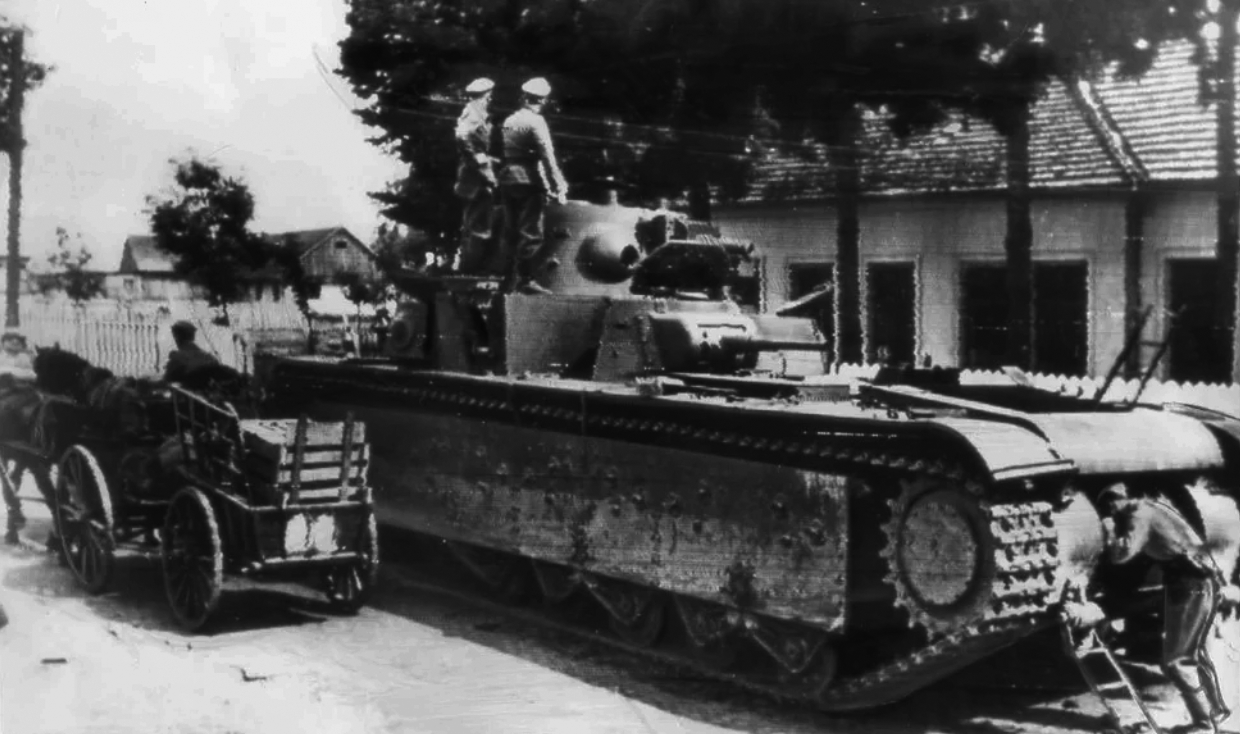
Soviet T-35 Heavy Tank: Abandoned in Gorodok

     Photographed by a kriegsberichter (war correspondent) attached to the 257. Infanterie-Division, a T-35 (chassis 744-62) belonging to the Soviet 67th. Tank Regiment sits abandoned in the village of Gorodok along the T1425 road. On June 26, 1941, the tank was reported as broken down due to its clutch friction discs having burnt out. It was intended that the tank be towed away for repairs and tow ropes were deployed (not visible in this photograph) but the tank was abandoned instead, apparently in haste as only one of the two ropes was attached to the hull front’s two rings. Still, the crew stripped the tank of its machineguns before departing the area between June 27-30, 1941. This hasty departure was perhaps due to the continued advance of Army Group South (which contained the 257th.) through the region. 

     This T-35 is notable as being one of the last six T-35 tanks built in 1939 before production ceased. It features the final modifications to the design, the most obvious being the conical shaped turrets which afforded better protection due to its sloped armor. 

     After sitting in the road for months, by February 1942, the derelict tank had been pushed off the road where it continued to attract the photographer’s eye. Photographs of the T-35 in the summer of 1942 show the tank missing all of its tracks (possibly taken by tank and assault gun troops to affix to their vehicles for added armor). The ultimate fate of this tank is unknown but presumably it was scrapped.

Jagdtiger "332": Thunderbolt Victim near Forstheim

(U.S. Army Signal Corps)

     Jagdtiger “332” of 3rd. Kompanie, Schwere Panzerjäger Abteilung 653 (3/s.Pz.Jg.Abt.653). 3rd. Kompanie, commanded by Knight’s Cross holder Oberleutnant Franz Kretschmer, on March 14, 1945, were positioned some 12 kilometers away from the U.S. bridgehead over the Moder River. That night and into the early morning hours of March 15, 3rd. Kompanie engaged U.S. M4 Sherman tanks who were caught moving in a column formation. The front and rear Shermans were knocked out by the Jagdtigers who then continued the attack, focusing on the remainder of the Shermans which were trying to get off the road. U.S. artillery was called in to pound the Jagdtigers but the veteran Kretschmer had already ordered the Kompanie to withdraw. Later in the morning of March 15, U.S. forces resumed the attack, pushing towards the town of Morsbronn. Again, they met 3rd. Kompanie who inflicted severe damage to the advancing troops. In the afternoon on March 15, 3rd. Kompanie received orders to go on the offensive and push U.S. troops off a ridge near Forstheim. 

     No doubt Kretschmer thought the orders unwise at best as the Jagdtiger was not a vehicle designed for offensive operations and the attack was in daylight, no less. Nevertheless, he followed orders and after covering less than 2 miles, U.S. Army Air Force P-47 Thunderbolts arrived and unleashed rockets upon the advancing Jagdtigers. “332” was struck on the right side, damaging the running gear and the crew abandoned the vehicle. Overall, s.Pz.Jg.Abt.653 was able to hold the U.S. troops at bay until the unit was withdrawn from the area on March 17, 1945. This time allowed the crew of “332” to return to their stricken vehicle, set demolition charges, and blow the Jagdtiger up as recovery was not possible.

     During the combat, Kretschmer was wounded by artillery fire on March 16 while commanding Jagdtiger “301”. So severe was the concussion suffered that Kretschmer was no longer able to command the unit and was relieved by Leutnant Herman Knack. Kretschmer would survive the war, spending a brief time as a POW. He would pass away on May 28, 1987, survived at the time by his wife and three children.