Showing posts with label engineer. Show all posts

Sunday, November 16, 2025

Russo-Ukrainian War: The BTS-4 ARV

Source: Arslom Xudosi

     Early on in the Russo-Ukrainian War, the Russian Federation forces were utilizing elderly equipment and this is evidenced here. Photographed on March 31, 2022, an abandoned Russian BTS-4 armored recovery vehicle (ARV) fell into Ukrainian hands, a soldier posing with the trophy. BTS stands for Bronetankoviy Tyagach Sredniy which translates as Medium Armored Tractor and the BTS line of ARVs started with the BTS-1 which was simply a T-54 tank with the turret replaced with a cargo platform. The BTS-2 appeared in service in 1955 and was essentially the BTS-1 but with a collapsible 3-ton capacity jib-crane and a rear mounted winch added to the hull.

     However, this particular vehicle, in some reporting, is said to be a BTS-4A when, in fact, it is not. It is a BTS-4 which does not use the T-54 chassis but instead, uses older T-44 chassis. The BTS-4A, like the BTS-1 and BTS-2, uses the T-54 chassis. The differences are very subtle as the final T-44 modernization, the T-44M, used a lot of components from the T-54 to include the tracks and running gear (idler, bogie wheels, and drive sprocket). From this left side view, the main indicator it is a BTS-4 and not a BTS-4A is the curved dip in the plate behind the front mudguard. On a BTS-4A, it would be flush with the rest of the fender. Another possible indicator of a BTS-4 is the reinforcement on the rear spade's edge. The BTS-4 entered Soviet service in 1965. As mentioned, the BTS-4 is built using the chassis of T-44 medium tanks. The T-44, whose design started in 1943, entered Soviet Army service in November 1944 though it did not participate in World War Two. The T-44 had a brief frontline service life with the T-54 entering service in 1948 and quickly replacing the older tank by the early 1950s. The last major model, the T-44M, appeared in 1961.

     The 31-ton BTS-4 is powered by a V-54-E diesel engine that develops 520 horsepower and this provides for a maximum road speed of 31 miles per hour. In first gear, the top speed is 4.3 miles per hour. Enough fuel is carried (261 gallons worth) to give the BTS-4 an operational range of no more than 310 miles but if towing a tank, the range drops significantly to a maximum of 124 miles.

     Like the BTS-2, the BTS-4 is fitted with a collapsible jib-crane. In the photograph, the column portion of the crane is seen laying between the commander's cupola and the cargo platform. The column fits into a base on the right side of the vehicle and the assembled jib-crane has a traverse of 230 degrees. The boom arm is stored on the right side of the vehicle, along the hull side. Operation of the crane is completely manual. The total load capacity of the crane is 3.3 tons. At maximum extension (9.8 feet), the crane could hook lift a maximum of 2.8 tons while at minimum extension, it could manage 4.6 tons. Also like the BTS-2, the BTS-4 has a rear mounted winch (in the photograph, the apparatus between the open radiator grill and the spade) which has a maximum traction force of 25 tons. The winch is mechanically driven, being connected to the engine via a gearbox. By using block and tackle, the traction force can be increased to 50 or even 75 tons depending on the method used. Total length of the winch cable is 656 feet. Again like the BTS-2, a cargo platform is situated almost in the center of the BTS-4. It has fold-down sides (missing in the photograph) and has a maximum capacity of 4.4 tons. Usually, spare parts, additional tools, and other equipment would be carried. Other common equipment carried is four tow cables and at least two rigid tow bars. Finally, both the BTS-2 and BTS-4 have a rear mounted spade (sometimes referred to as a coulter in some sources). The spade, which is manually winched up or down, is used primarily to give the BTS-4 traction when conducting winching operations. Other equipment seen on the BTS-4 is night vision devices for the crew, a GPK-48 gyroscopic compass, a R-113 radio, and a wooden unditching beam (which, curiously, is secured to the snorkel in the photograph rather than the right hull side of the vehicle).

     Unlike the BTS-2, the BTS-4 added one new piece of equipment. This would be the long “chimney” snorkel which, here, is in traveling position. When in use, the snorkel would be hinged forward and secured to the raised commander's cupola. Without the snorkel, the BTS-4 can wade through no more than 4.3 feet deep water. But, with the snorkel, the BTS-4 can wade into as much as 16 feet deep water that permits it to cross water obstacles but also recover disabled vehicles from deeper depths.

     The BTS-4 has a crew of two, consisting of the commander (who doubles as the radio operator and crane/winch operator) and the driver (who is also a mechanic). As the hull is that of a T-44, the crew enjoys 90mm of frontal rolled homogeneous armor (RHA) with the upper glacis having a 60 degree slope angle and the lower glacis having a 45 degree slope. The hull sides have 75mm thick armor but lack any sloping. The rear of the hull supports between 30mm to 45mm of armor with the hull top having 20mm of armor and the hull bottom having only 15mm thick armor. The BTS-4 has no defensive armament and relies solely on small arms and any grenades carried by the crew.

Monday, June 23, 2025

Russo-Ukrainian War: The IRM Zhuk

Source: Reddit

     Engineering vehicles, while not glamorous nor getting the limelight of photographic coverage, are an important component of ground forces and the Ukrainian Army is no exception. This particular vehicle, photographed sometime in early June 2025, is fairly rare in Ukrainian service though it has a rather unique purpose. Called the IRM Zhuk, the IRM stands for Inzhenernaya Razvedyvatel'naya Mashina (Engineer Reconnaissance Vehicle) while Zhuk means “Beetle”. A Soviet-era vehicle, the IRM entered production in 1980 and by 1986, only 50 IRMs rolled off the line. What makes the IRM rather unique is that it is optimized for route reconnaissance. U.S. Army manual FM 3-90 Tactics defines route reconnaissance as an “operation to obtain detailed information of a specified route and all terrain from which the enemy could influence movement along that route.” Where able, the U.S. Army would deploy engineer reconnaissance as they have the expertise to evaluate the terrain, bridges, tunnels, roads, trails, gap/water crossings, and other infrastructure to determine not only enemy potential to target assets on the route but also if the selected route is capable of being traversed by follow-on units. To that end, the IRM Zhuk is outfitted to accommodate such a task.

     The 19-ton IRM is based on the BMP-1 Infantry Fighting Vehicle but has a lengthened hull with seven road wheels per side rather than the BMP-1's six road wheels. Power comes from a UTD-20 inline 6-cylinder, water cooled diesel engine that generates 300 horsepower and this provides a top road speed of 32 miles per hour. The IRM is amphibious and mounted on the rear hull are two, 3-bladed propellers within cowls. In calm water, the IRM has a maximum water speed of 6 miles per hour. There is a trim vane on the hull front to keep water off the upper hull. With 158 gallons of fuel, the maximum operational range is 310 miles.

     For protection, the IRM uses all-welded, steel armor but the exact level of defense is not easily obtained but it is thought the maximum thickness is 19mm. This provides the six man crew (commander, driver, and four engineers) with a measure of defense against some small arms and shell splinters. Other protective measures include a NBC (Nuclear Biological Chemical) overpressure-type system (with scrubber) and smoke screen generator. The latter is accomplished by injecting diesel fuel into the exhaust where the fuel vaporizes on the hot exhaust, condenses, then cools which forms a white smoke cloud. Finally, the IRM is equipped with automatic fire extinguishers.

     The only defensive armament consists of a turret mounted 7.62mm PKT machine-gun which is provided with 1,000 rounds in 50-round ammunition belts. Aiming is manual and done using iron post sights. The crew, of course, can utilize their own small arms to defend the vehicle.

     Of course, as a engineering reconnaissance vehicle, the IRM has a lot of tools to perform its tasks. Firstly, the IRM is equipped with a TNA-3 inertial land navigation system. The TNA-3 uses accelerometers and gyroscopes to determine the vehicle's position, orientation, and velocity. A benefit is that inertial navigation systems are independent of GPS and thus not susceptible to GPS jamming and can operate where GPS isn't available. Next, the IRM is fitted with a RShM-2 mine detector which is able to pick up ferromagnetic objects up to a depth just shy of 1 foot. The apparatus is mounted on hydraulically operated arms, one per side of the hull (the right side arm is visible here in the stored position). The arms can be deployed to the front of the vehicle in less than 3 minutes. When using the mine detector, the IRM can drive no faster than 3 miles per hour. If an object is detected, the IRM is automatically brought to a halt. Kept inside the IRM are three hand-held mine detectors; the RVM-2M, IMP-2, and RVM-2. In order to accurately test water depth at river crossings, the IRM has a EIR echo-sounder which can give depth values up to 65 feet. The EIR is paired to a recorder for data retention. To compliment the EIR, the IRM has three sonar transducers which work by sending out sound waves and then detecting the returning echoes. For measuring the azimuth for the purposes of determining both horizontal and vertical terrain angles, the IRM has a PAB-2AM aiming circle. For surveying from within the vehicle, the IRM has an extendable PIR-451 periscope for the commander which includes a DSP-30 rangefinder. Other equipment includes an AGI-1S horizon indicator and a man-portable PR-1 penetrometer. The latter, used by a dismounted engineer, tests for soil crossability and when coming upon ice, the AGI-1S has a ice drill and ice stake to determine ice thickness. For communication, the IRM has a integral R-147 radio set while two portable R-147 sets are kept in store if needed. Finally, the IRM is equipped with TNP-370, TNV-25M, and TNPO-160 periscope observation blocks.

Sunday, February 23, 2025

Russo-Ukrainian War: Minenräumpanzer Keiler

Source: inukraine.official on Instagram

     A crewman of a Ukrainian Minenräumpanzer Keiler (MiRPz Keiler; Mine-Clearing Tank “Boar”) hams it up for a smartphone video (posted in July 2024) of which this is a screenshot from. In January 2023, Germany provided Ukraine with four MiRPz Keiler vehicles. The MiRPz Keiler is not new and it is actually a heavily modified M48A2 Patton medium tank (specifically, the German upgraded Kampfpanzer M48A2GA2), the M48 having been in service with the Bundeswehr before being retired in 1993. Only 24 Keiler vehicles were converted between 1996 and 1998. MaK GmbH and Thyssen Henschel Wehrtechnik were responsible for the development and production of the Keiler.

     The 53-ton Keiler is powered by a MTU MB 871 liquid-cooled, turbocharged diesel engine that develops 986 horsepower and which is mated to a Renk HSWL 284 M 6-speed transmission (4 forward, 2 reverse). This replaced the Keiler's original Continental AVI-1790-8 606 petrol engine and Allison GMC CD-850-5 transmission as part of a Keiler modernization program that occurred in 2015. The MB 871 engine can propel the Keiler along roads at a maximum speed of 30 miles per hour and top reverse speed of 15 miles per hour. Enough fuel is carried to provide for a maximum cruise range of 370 miles.

     Because the Keiler retains the hull of the M48A2CGA2, the crew is protected by 101mm to 120mm thick frontal armor, 76mm thick side armor, 44mm to 51mm thick rear armor, 44mm thick floor armor, and 57mm thick top armor. As for armament, the Keiler has none outside of any small arms the 2-man crew has with them. The Keiler does have 76mm smoke grenade launchers arranged in a single bank of 16 launchers arranged in two, 8 launcher rows. The bank is mounted on the left side of the rear engine deck. Each grenade has a range of 165 feet and all sixteen grenades create a smoke screen in a total arc of 90 degrees.

     Of course, the main piece of apparatus on the Keiler is its flail. The reason for the flat superstructure is to accommodate the flail which is positioned horizontally over the hull when in travel mode. When the flail is deployed for use, the arm that supports it swings 110 degrees to the front and then lowers the flair onto two hydraulic rams which control the up and down motion of the flail. These rams stick out like the tusks of a boar, hence the vehicle's name. Once the flail is in place, a shield fitted to the front lower glacis plate of the Keiler is lowered so that it barely touches the ground. The shield serves two purposes with the first being to protect the rams from mine detonations and the second is to act as a spade to prevent the Keiler from tipping forward as it becomes front heavy with the flail deployed. 

     The flail has two shafts, each fitted with twelve quick-connect chains ending in 53 pound, bell-shaped weights. The Keiler's MB 871 provides drive power to the flail, spinning it at 400 revolutions per minute. This, however, has the side effect of consuming a lot of fuel which can limit the operational range of the Keiler or reduce its operating time when mine clearing. The weights strike the ground at a speed of 125 miles per hour and any mine struck with either detonate or be so damaged from the impact that it is unusable. Nevertheless, a sapper would have to come remove it due to the explosive that remains. The Keiler is said to have a near perfect detonation rate. The flail clears a path 15.5 feet wide and can clear to a depth of 10 inches. During operation, and terrain depending, the Keiler's top clearing speed is 1.25 to 2.5 miles per hour. Due to damage incurred during flailing, every 1.9 miles, the chains need to be replaced to maintain effectiveness. A total of six spare chains and weights are carried atop the hull by the engine deck.

     On the back of the Keiler is a CLAMS (Clear Lane Marking System) built by IMI (Israeli Military Industries) and it deploys a marker flag in the center of the cleared path. The CLAMS can be set to deploy markers automatically or manually. If automatically, the CLAMS can be set to drop a marker every 6, 12, 24, 26, or 48 meters.

     The driver, given his position in the front of the vehicle, is provided with a reinforced hatch to withstand the overpressure wave of exploding mines. Also, because his vision blocks typically get obscured by kicked up soil, he is provided with a gyroscope that keeps him on course.


Monday, February 10, 2025

Russo-Ukrainian War: The DOK-ING MV-4

Source: ArmyInform

     In August 2023, the Estonian Rescue Association (Päästeliit) donated a single DOK-ING MV-4 demining vehicle to Ukraine along with other equipment such as metal detectors to help civil Ukrainian sappers in locating and destroying Russian mines. DOK-ING, a Croatian company, specializes in remote controlled vehicles and was founded in 1992. The MV-4, shown here, is one of two mine clearing vehicles the company offers with the other being the larger MV-10. As of January 2024, Ukraine had fourteen MV-4 vehicles in service.

     Power for the 6-ton (base weight) MV-4 comes from a Perkins 1106 C-E70 TA 6-cylinder, water-cooled, turbocharged diesel engine. The motor produces 250 horsepower but the MV-4 is not built for speed. Maximum speed is 4 miles per hour and for this reason, the MV-4 is transported to the work area by a trailer truck. During demining operations, the speed varies based on the conditions but ranges from as slow as .3 miles per hour to a little under 1 mile per hour. Fuel capacity is 18 gallons of fuel though fuel consumption depends on what the MV-4 is being used for and the terrain it is working on. As such, the consumption can be as little as 1.8 gallons per hour up to 6.6 gallons per hour.

     The MV-4 can be fitted with an array of mine clearing equipment but here, a segmented roller is being used. The apparatus consists of 12 individual rollers whose weight causes mines to detonate when the roller passes over them. The clearing width is 6.8 feet. The reason for having multiple rollers is that when a roller (or rollers) is damaged by a mine, it can be easily (and less expensively) replaced rather than having to replace the entire roller had it been a single roller drum (such as those found on steam rollers).

     Other demining apparatus include a flail and a tiller. The flail consists of a rotating drum to which are attached 34 chains ending in metal balls. As the flail spins at 900 revolutions per mine, the ends of the chains strike the ground and upon hitting a mine, cause the mine to detonate. Like the rollers, damaged chains can be individually replaced. The flail can clear a path 5.9 feet wide and trigger mines buried up to 11 inches deep.  The tiller, like a garden tiller, churns up the ground and will either unearth buried mines or detonate them. Like the flail, the tiller clears a 5.9 foot wide path but can reach down to 1.1 feet. Mines not detonated but exposed are dealt with by sappers.

     Being remote controlled, the operator can be just under 1 mile away from the MV-4 though this is the maximum and assumes an unblocked line of sight to the vehicle. Atop the MV-4 is the fully controllable camera system which includes low-light capable cameras, a infrared light, and regular lights to give the operator the best view possible. Other cameras are located on the hull to further provide views during operation. One of them can be seen in the photograph, just under the side light.

     To provide a measure of protection, the entire hull is built using Hardox® 450 steel produced by SSAB (Svenskt Stål AB) with thickness ranging from 6mm to 20mm. This protects the engine and other critical systems from mine blasts and low caliber small arms.

     The MV-4 is used by the Russian Federation as the Uran-6 and the U.S. Army deploys the MV-4 as the M160.

Monday, September 6, 2021

Obergefreiter: Panzer-Lehr-Pionier-Bataillon 130

(Author's Collection)

     Sturmpioniere (combat engineers; literal translation assault engineers) of 2nd. Kompanie, Panzer-Lehr-Pionier-Bataillon 130 make ready to launch an attack against an enemy position...or, it could very well be a training exercise. The main subject of the photograph, an Obergefreiter (the equivalent to a Lance Corporal), as denoted by the two chevrons on his feldbluse's sleeve, makes ready with a Nebelhandgranate (fog hand grenade). This was a modification to the standard M24 Stielhandgranate (stick hand grenade; better known as the "potato masher") in which the explosive warhead was replaced with one which generated smoke. To ensure there was no mistaking the smoke grenade for the M24, it had white bands around the warhead and also in white, the initials Nb.Hgr.39B which stood for the grenade name and the model which was M39B. If that was not enough, many examples had a white band around the shaft and grooves cut into the bottom which allowed the soldier to know which grenade was which by feel if he could not see or was in darkness as the regular M24 grenade did not have such grooves. The smoke issued from vents along the bottom of the warhead. 

     Of interest is the fact he is armed with Karabiner 98a rifle. This was a rifle designed in 1908 as the 98AZ and in 1914 when Germany went to war, it was issued to cavalry, telegraph/telephone operators, artillery troops, transport drivers, and pionieres. These rifles would again go to war in 1939 with the only real modification being grasping grooves in the stock and a new designation (98a). The key identifier is the stacking hook seen underneath the barrel. 

     On his back is the backpack portion of the full Pioniersturmgepäck (Engineer Assault Pack) and this backpack housed the soldier's mess kit (kochgeschirr), shelter half (zeltbahn) and accessories, two Nebelhandgranaten, and one 3kg explosive charge. If need be, the two smoke grenades could be replaced with another 3kg charge. The remainder of the Pioniersturmgepäck is hidden by his body but consisted of two special pouches which held his rifle ammunition (40 rounds total), his gas mask, and a stock of Model 1939 Eihandgranaten ("egg" grenades). In some cases, Stielhandgranaten were carried despite not fitting fully within the pouches or one to two 1kg explosive charges could be carried along with another 3kg charge. That these men belong to 2nd. Kompanie, Panzer-Lehr-Pionier-Bataillon 130 is from another photograph of the same Obergefreiter in which his shoulderboard is visible showing the embroidered "L" for Lehr (which meant "teach") and the number "2" which was for 2nd. Kompanie.

     Much of the initial Panzer-Lehr-Division (which formed in December 1943), of which Panzer-Lehr-Pionier-Bataillon 130 belonged, was made up of instructors, training cadre, and demonstration units which gave the division an elite status from the beginning due to their high level of training and ability. By March 1945, Panzer-Lehr-Division had been ground down to a mere 300 men and 15 tanks and on April 15, what remained after further losses, surrendered to the U.S. 99th. Infantry Division.
 

Thursday, September 2, 2021

Staff Sergeant James A. Baptiste: F Company, 365th. Engineer Battalion


      A studio portrait of Staff Sergeant James A. Baptiste, taken on March 3, 1947. Baptiste served with F Company, 365th. Engineer Battalion, which was a Negro unit. The 365th. Engineer Battalion was deployed to the European Theater and according to Department of the Army Pamphlet (DA PAM) 672-1 Unit Citation and Campaign Participation Credit Register dated July 6, 1961, it participated in the Normandy, Northern France, Central Europe, and Rhineland campaigns. The unit also received, according to the pamphlet, occupation credit for serving in occupational duty in Germany from May 2, 1945 to September 4, 1945.

     Given the date of the photograph, Baptiste survived the war. He was from Algiers, a section of New Orleans, Louisiana. Designated as the 15th. Ward (out of 17 wards that make up New Orleans), Algiers is the only Orleans Parish community that sits west of the Mississippi River. It is also the second oldest portion of New Orleans. His residence was listed as 1114 Whitney Avenue though today, assuming Google Maps is accurate, that location is shown as the intersection of Whitney Avenue and Newton Street. Still, if his residence was in that general location, it is no longer standing, having made way for small businesses on each corner of the intersection.

     For a uniform, Baptiste is wearing the summer cotton khaki uniform shirt and would have had matching khaki trousers. The color of the uniform was designated as “Khaki Shade No.1”. Had he been wearing the necktie, the end of it was often tucked between the second and third button. Interestingly, Baptiste has retained his enlisted soldier's visor cap which ceased being issued to enlisted soldiers by the close of 1941 and so this suggests Baptiste enlisted prior to that date or he privately purchased the cap as it remained a very popular item for enlisted men. Of note is that Baptiste apparently removed the stiffening within the cap, giving it a “crushed” look. This made the cap look more field used rather than something picture perfect for garrison wear and thus conveyed that the wearer was an experienced veteran of which Baptiste, given his service, was.

     Another bit of history is that it is very likely Baptiste and the men of the 365th. Engineer Battalion trained at Camp Forrest which was located in Tullahoma, Tennessee. This was the largest U.S. Army training base during World War Two and served as training grounds for infantry, artillery, engineers, signals/communications, and cooks. The base ceased to be in 1946, having been declared surplus. What could not be sold off and carried away was removed and left only concrete foundations, chimneys, and roads. In 1951, the property became the home of what is today the Arnold Engineering Development Complex (AEDC).

Wednesday, July 14, 2021

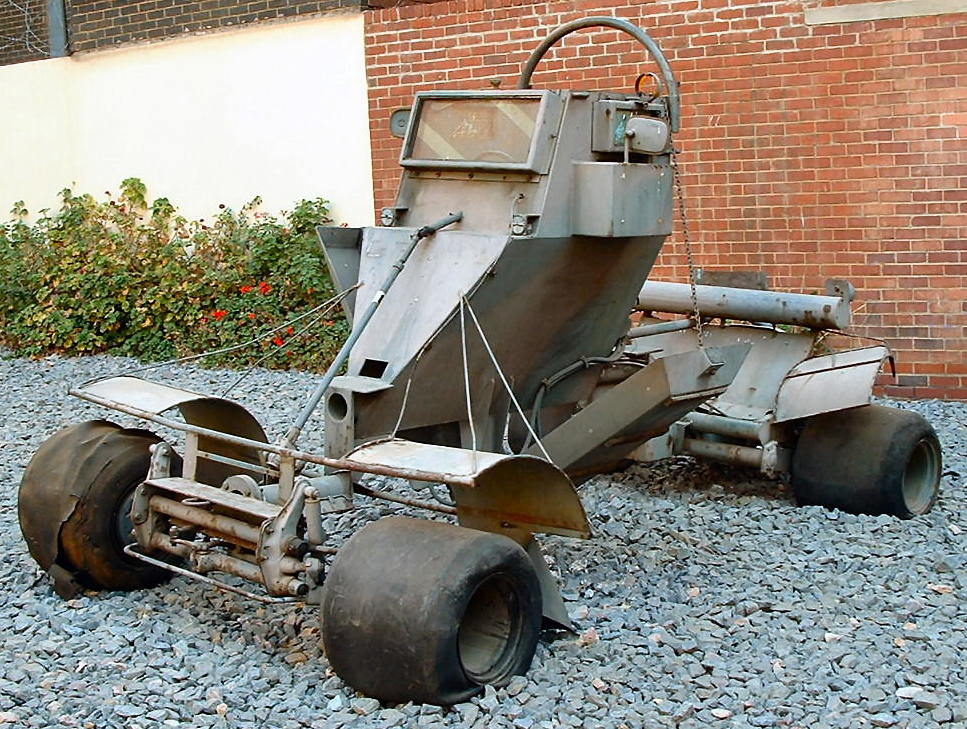
The Rhodesian Pookie: Expediency Turned Excellence

A surviving Pookie on display at the South African Police Service Museum in Muizenberg, Cape Town, Western Cape. The mine-detector "wing" pans are shown in the stowed position. Photograph by Steve Barrow.

      Desperation has often proved to be catalyst for solutions to a problem. During the Rhodesian Bush War which raged for 15 long years from July 4, 1964 to December 12, 1979, the guerilla forces of the Zimbabwe African National Liberation Army (ZANLA) and the Zimbabwe People's Revolutionary Army (ZIPRA) waged a campaign of mining roads as a means of limiting or cutting off roads, isolating Rhodesian Security Force garrisons, and also as a means to instill fear in any user of roads, civilian or military, by way of casualties and deaths caused by the mines. Rhodesian Security Forces took numerous steps to try to curb the mine campaign by interdicting supply lines of the guerillas, paving roads using tar (which made burying mines more difficult), and improving mine detection methods. In time, it was seen that finding every buried mine simply wasn’t possible and so another avenue was to improve the survivability of military vehicles that struck a mine. At first, improvised methods were used and while there was an improvement in survival, it was seen that the mine’s explosion was essentially trapped beneath the flat surface of vehicles (such as trucks) which caused severe damage. From this, vehicles began to be purpose built using V-shaped bodies which dissipated the explosive force of the mine away from the vehicle. It was seen that crew/passenger survivability improved significantly and that vehicles could be repaired rather than scrapped. 

     Still, the means to detect mines continued and using the new mine resistant vehicle technology, automotive engineer Ernest Konschel designed the Pookie (named after the Galago, a nocturnal primate) mine-detection vehicle. The driver sat in an armored monocoque capsule which was connected to the frame by shear bolts and the armor was proof against small arms fire. The frame utilized the front and rear suspension units from a Type Two Volkswagen Kombi as the units exerted less downward force than conventional coil springs. For wheels, the Pookie was fitted with used Formula 1 racing tires as their width was often wider than holes used to bury mines. For power, the Pookie used a 1,600cc Volkswagen engine and carried 40 liters of fuel. On each side of the Pookie was a “wing” which contained a Milton detection pan. In all, the Pookie had a ground pressure of 3lbs. per square inch which was less than that of a human which meant it could drive over a mine (even anti-personnel mines) and not detonate it. 

     Sixty-eight Pookie vehicles were built (some sources say seventy-six) starting in 1976 and were quickly deployed and by 1980, Pookie drivers located some 550 mines without a single loss to them. Twelve vehicles were damaged from rocket fire and also command detonated mines. Only a single driver was killed when the capsule was hit by an RPG. The Pookie would later be fitted with the “Spider”, a 24-barrel, 12-guage rotary shotgun system as a means to respond to guerrilla ambushes. The driver, using a chain rip cord, could ripple fire the barrels, throwing buckshot across a 270 degree arc. So devastating was this weapon that guerillas would often let the Pookie pass (as it typically led convoys) before launching their ambush. In 1999, MineTech (a British company) built a number of vehicles which looked much like the Pookie except for using different engines and other enhancements. These were deployed by private “de-mining” contractors in Afghanistan and Somalia.