Showing posts with label war. Show all posts

Wednesday, January 8, 2025

Russo-Ukrainian War: 2A36 Giatsint-B 152mm Howitzer (13th. Khartiia Brigade)

Source: Sofiia Gatilova (Reuters)

     A gunner from the 13th. Khartiia Brigade laying his towed 2A36 Giatsint-B (“Hyacinth”) 152mm howitzer against Russian targets. The photograph was taken somewhere in Kharkiv Oblast on January 6, 2025. Accepted for service by the Soviet Army in 1976, the 2A36 replaced the M-46 130mm field gun. Before the true designation was known to the West, the howitzer had the NATO reporting name of M1976. Designed by Yuri Kalachnikov and built by Uraltransmash, between 1,500 and 2,000 examples (source depending) were produced between 1976 and 1989. Russia, in February 2024, had 600 in service while Ukraine is reported to have at least 75 2A36 howitzers within its military.

     The 2A36 uses a split trail carriage that features a gun shield for the crew and four wheels to help disperse the ground pressure of the 10.5 ton weapon. The gun shield offers minimal frontal protection against some small arms calibers and shell fragments. To assist the tow vehicle (typically a KrAZ-260 6x6 truck) in stopping, the carriage wheels feature brakes. Top tow speed on roads (assuming the KrAZ-260) is 50 miles per hour while off-road, it drops to 28 miles per hour. The gun mounting permits an elevation of 57 degrees and a maximum of 25 degrees of traverse before it becomes necessary to move the howitzer. Crewed by eight men, the loader is assisted by way of a loading tray and a chain-driven hydraulic rammer. This permits a trained crew to fire 6 rounds every minute. The breech is of the horizontal sliding-block type while recoil is handled by a multiple-slotted muzzle brake on the end of the barrel, a buffer, and a recuperator. 

     The 2A36 can fire an array of ammunition but in the photograph, a OF-29 (ОФ-29) HE-Frag (High-Explosive Fragmentation) projectile is ready for loading. This would be followed by the cartridge case that contains the propellant. In the nose of the projectile is a fuze. The OF-29 is spin stabilized, has a boat-tail base for aerodynamics, and two copper driving bands which impart a seal in the barrel and ensure engagement of the barrel's rifling. With a full charge, the OF-29 has a maximum range of 15 miles. Indirect fire sighting is usually accomplished with a PG-1M panoramic telescope. The 2A36 can engage in direct fire though the maximum range is limited to 1.2 miles. An OP-4 series sight would be utilized for direct fire. Using RAP ammunition (Rocket-Assisted Projectile), the 2A36 can achieve a maximum range of 27 miles. A drawback of the 2A36 is that it because of its later design (relatively speaking), it cannot make use of 152mm projectiles that are used in earlier howitzers, some of which remain in service to this day. An example is the D-20 152mm howitzer (NATO reporting name M1955) which, despite its age, continues to see combat.

Sunday, July 23, 2023

Russo-Ukrainian War: Abandoned 2K22 Tunguska


     One of the more curious aspects of the war is the lack of Russian air power in the skies. In a November 2021 report from Flight International, the Ukrainian Air Force fielded 37 Mikoyan MiG-29 Fulcrum multi-role fighters, 12 Sukhoi Su-24 Fencer attack jets, 17 Su-25 Frogfoot attack/close air support jets, and 32 Su-27 Flanker multi-role fighters. Against these 98 combat aircraft (Ukraine has no bombers any longer), the Russians have arrayed at least 300 combat aircraft in the region. Yet, even now, Ukrainian pilots are still able to sortie against Russian ground targets and engage in low-level aerial combat with what Russian aviation is about in the sky.

     So why is this the case? There are many opinions out there. The first is a lack of PGMs (Precision Guided Munitions) coupled with the inability to accurately deliver said ordnance. The latter is due to inadequate pilot training. It is believed that Russia's inventory of PGMs is very low and thus if any strikes were to be carried out, it would be done with unguided bombs and rockets. By having to use such munitions, it forces the aircraft into range of Ukrainian surface-to-air missiles, especially man-portable ones.

     Another factor is the fear that Russian ground forces will shoot first and ask questions later. Considering that a decent portion of Russian troops are conscripts, this fear is very much valid. Combine this with the fact the Ukrainian Air Force flies the same exact types of aircraft the Russian Air Force does, the risk is very real and the last thing the Russian Air Force wants is lost planes due to friendly fire.

     Finally, some think that the typical Russian pilot lacks flight hours, and thus the needed skill to engage in actual combat successfully, in comparison to Western pilots. On average, a Russian pilot gets under 100 hours in the cockpit every year while, for example, U.S. Air Force pilots can get up to 240 hours each year.

     The photograph here shows an abandoned 2K22 Tunguska somewhere around Kharkiv. The 2K22 is the replacement for the ZSU-23-4 Shilka, a rather lethal self-propelled anti-aircraft gun (SPAAG) that entered service in 1960. So lethal was the Shilka that many NATO nations stated in their infantry combat doctrine that any time a ZSU-23-4 was spotted in a column being ambushed, it was to be destroyed immediately before any other target as the quadruple 23mm cannons would quickly put an end to the attack. Although the Russian Marines still deploy the Shilka, the Russian Army uses the 2K22.

     The 2K22 is built on a GM tracked chassis, powered by a V-46-6-MS turbocharged, V-12, fuel-injected, water-cooled diesel engine developing between 780 to 840 horsepower. This gives a top road speed of 40 miles per hour and enough fuel for a 310 mile operational range. The SPAAG is equipped with the Hot Shot (NATO code-name) system that combines a parabolic E-band target acquisition radar (what we see in the folded position in the photograph) with a J-band monopulse tracking radar fitted in the center of the turret front. The target acquisition radar has a 360 degree field of view, can detect aerial targets out to 11 miles and flying as low as 50 feet off the ground. It can track targets starting within 10 miles at an altitude of 2 miles or less. Engagement can occur when the target speed is 1,640 feet per second or less with the response time of the weapon systems being 6-8 seconds. The Hot Shot system is all-weather, day and night.

     Speaking of weapons, the 2K22 is fitted with two 2A38M 30mm guns with each gun provided with 1,904 rounds of ammunition. Underneath each gun is a battery of four 9M311 surface-to-air missiles (NATO code-name SA-19 Grison), for a total of eight ready-to-fire missiles. The combined fire of both cannons is 3,900 to 5,000 rounds per minute but the usual is brief bursts of 83 to 250 rounds target depending. The maximum effective range is 2,000 meters while with the 9M311, the maximum range is between 5 miles to 6.2 miles. The missiles cannot be fired while the 2K22 is on the move though the guns can when set to full automatic computer controlled engagement. If need be, the gunner is provided with a stabilized sight for manual engagement, using the radar for range data.

     The 2K22's armor protects the four man crew from small arms fire and shell fragments but it is incapable of surviving hits by anything heavier. It is well equipped with good ventilation, heating system, NBC (Nuclear Biological Chemical) system, automatic fire suppression, night vision, extensive communication equipment, and navigational systems.

     The Ukrainian Army had, in a 2012 report, 70 Tunguska on strength but built on a 2S6 chassis rather than a GM chassis. How many remain in service now is unknown. It is believed that this example may have ultimately been destroyed by Ukrainian forces. This assumes the Russians rendered the 2K22 unusable prior to abandoning it.

Originally posted on March 3, 2022.

Saturday, July 22, 2023

Russo-Ukrainian War: The 2S19 Msta-S


     I am no expert on current Russian military tactics. However, I do have access to IAG-13-U-78 “Soviet Army Operations”, dated April 1978. This is an intelligence manual created by U.S. Army Intelligence and released by the U.S. Army Intelligence and Security Command. Now, I hear you say, of what good is a manual nearly 44 years old? If one examines the chapter on attacking a defending enemy (Section IV, page 3-61), there are some clear parallels to the current situation in Ukraine which suggests that the tactics referenced in this publication aren't so out of date after all.

     Russian forces are reported to have largely bypassed Kharkiv in order to push deeper into Ukraine. This lines up with the tactic of bypassing an enemy in a deliberate defense (of which a city can be considered such) rather than engage it. This may account for lighter forces around the city and use of artillery to keep the defenders in the city. It is doubtful that a concentrated Ukrainian force would engage the Russians in open terrain and lose the benefit of the concealment and cover a urban warzone provides them. As such, outside of aerial attack or artillery, Russian forces are a bit more secure from massed infantry assaults.

     Let us move to Kyiv. It is reported that a military convoy some 40 miles long is moving towards the city. This lines up with the first action in the manual that states the first step towards an attack of an enemy in deliberate defense is the buildup of required forces. If, indeed, the convoy is slated for the assault on Kyiv, the evidence is clear. Once the forces are in the field of battle, they will be organized. If they are following the 1978 tactics, the bulk of the forces will be amassed at the planned direction of attack. Russian tactics also allow for feints or ruses to divert the enemy attention away from the main thrust. In such attacks, the Russians, according to the manual, want to have a 4-5 to 1 advantage in troops, 6-8 to 1 in artillery, and 3-5 to 1 in tanks. This is certainly achievable today and likely has not changed much.

     The Russians, as they have been since World War II, are big believers in massed artillery and rocket batteries (as seen in the superiority ratio above) and prior to the commencement of the attack, Kyiv would be subjected to a heavy bombardment. In the attack, again, if following these tactics, the Russians will not spread their forces out but instead would reduce unit frontages and have a front line of no more than 4km. Follow-on units behind the main lines would be spread further apart. This allows them to maximize their firepower and focus it towards the enemy. It is possible that the incursions in the suburbs of Kyiv by Russian forces are reconnaissance to attempt to pinpoint Ukrainian positions and capability in preparation of the main attack.

     The only hope for the Ukrainian defenders in Kyiv is to withstand the initial assault and bog the Russians down which would break their momentum. Why is this important? According to the manual, the tempo of the attack is to be swift with a fast rate of advance to limit losses and overrun weak positions quickly. If it becomes a brutal, house-to-house fight, it favors the defender who knows the terrain and if Russian objectives are not achieved, it may become a serious problem.

     One of the self-propelled artillery assets the Russians have deployed in Ukraine is the 2S19 Msta-S (after the Msta River). This particular example was abandoned somewhere in Sumy Oblast after the convoy it was traveling with was hit. As one can see, the travel lock for the 2A65 152mm howitzer is still engaged. The gun can fire base bleed shells out to 16 miles or if using rocket assisted ammunition, out to 18 miles. Thanks to a automatic loader, the standard 2S19 can fire up to 8 rounds every minute. A total of 50 rounds of ammunition is carried in the vehicle. The turret has a full 360 degree rotation while the gun can be elevated up to 68 degrees and depressed to a maximum of 4 degrees. For defense, the 2S19 is fitted with a pintle mounted 12.7mm NSVT heavy machine-gun (not seen here) with 300 rounds of ammunition. Built on a T-80 main battle tank chassis, the V-84A 840 horsepower engine can move the 2S19 to a maximum speed of 37 miles per hour (on roads) with a power to weight ratio of 20 horsepower per ton. Speaking of weight, loaded, the 2S19 is 42 tons, is 23.5 feet long, 11.1 feet wide, and 9.10 feet tall with a crew of 5. Armor thickness is unknown but while proof against small arms fire, it would be no defense against anti-tank missiles. It is NBC (Nuclear, Biological, Chemical) protected.

     The 2S19 entered service in 1989 and the Ukrainian army had 40 of them as of 2017 though how many remain in service isn't known. However, it is highly likely this abandoned one will be turned around against its former owner.

Originally posted on March 1, 2022.

Russo-Ukrainian War: 113th. Territorial Defense Brigade


     Kharkiv remains contested with light Russian units attempting to penetrate into the city but so far, they continue to be repulsed. On February 28, the Russians again sought to push into the northeastern suburbs, subjecting the area with rocket fire which claimed 1 civilian dead, 16 civilians wounded, and 15 soldiers wounded. Once more, they were forced to withdraw. This daily tally is via the Kharkiv city council. The total dead in the last 3-4 days of combat is 2 civilians killed, 5 soldiers killed, 20 soldiers wounded, and 24 civilians wounded. It would appear that, to date, the Russians have not deployed heavier armor and tanks to support the infantry as they attempt to push into the city. Instead, they are using GAZ-233014 “Tigr” 4X4 armored IMVs (Infantry Mobility Vehicles) and the burned out example shown here was destroyed somewhere in the suburbs of Kharhiv.

     The Tigr entered Russian service in 2005 and has a crew of 2 and can carry between 9 to 11 infantrymen model depending. The 7.9 ton vehicle is fitted with a 5.9 liter, 6-cylinder, 180 horsepower engine paired to, most often, a 5-speed manual transmission. This provides the Tigr with a maximum road speed of 87 miles per hour and a top off-road speed of 50 miles per hour (terrain depending). Enough fuel is carried to give the Tigr a 620 mile operational range. For armor, the thickness ranges from 5mm to a maximum of 7mm. While this is proof against small caliber weapon fire, it is worthless against heavier weapons, let alone anti-armor missiles or rockets. For example, the 12.7X108mm DShK heavy machine gun used by Ukraine can punch through 20mm of armor up to 500 meters. Even the common RPK machine-gun, chambered for the 7.62X39mm round, can fire a standard armor-piercing ammunition that can penetrate 6mm of armor at 300 meters while another armor-piercing round, the 7N23, uses a steel penetrator to further increase the round's ability to punch through armor. For defense, it is fitted with smoke grenade launchers and has a pintle mount for either a 7.62mm PKP machine-gun, a 12.7mm Kord heavy machine-gun, or a 30mm AGS-17 grenade launcher.

     The latter is what is being recovered from the wreckage, no doubt to be checked out if it can be returned to service. The Plamya (“Flame”) is an old weapon, entering service in 1970 but has yet to be fully replaced by the lighter AGS-30 Atlant. The weapon is fed by a belt that holds twenty-nine 30X29mm grenades. The belt is contained in a drum fitted to the right side of the weapon. The Plamya can fire High-Explosive (HE), smoke, or practice rounds. Sighting is done using iron posts with the option for optical sights. The weapon has a low muzzle velocity of 606 feet per second, enough to provide a maximum effective range of 1,700 meters. The maximum rate of fire is 400 rounds per minute. It would appear that before the Tigr was hit, the gunner fired off at least four grenades judging by the empty belt hanging out of the feed. The fire was enough to burn off much of the Tigr's paint and burst the bullet proof glass. The Plamya itself seems no worse for the wear, the fire apparently not having discharged the remaining grenades in the drum magazine and a likely reason these soldiers are recovering it.

     Attempting to get current unit patch identification is pretty difficult and it is highly likely such information on existing unit insignia is purposely suppressed so as not to provide intelligence to the Russians. However, these are men of the 113th. Territorial Defense Brigade. Of note, the soldier in the foreground has a well-worn AKMS, the most numerous folding stock version of the AK-47. It can be told apart from the earlier AKS-47 by the two ridges on the receiver cover (as the AKS-47 had a smooth cover). Also note that he has tied off his medical pouch to his tactical vest with cord. Snaps can come loose on gear and this prevents it from being lost.

Originally posted on February 28, 2022.

Friday, July 21, 2023

Russo-Ukrainian War: The Azov Battalion


     There is an elephant in the room which some media outlets have mentioned and certainly is a part of Putin's accusation of “Nazis” in the Ukrainian government. The elephant? Special Operations Detachment “Azov”, better known as the Azov Battalion.

     Formed in 2014, the Azov Battalion is a right-wing, neo-Nazi infantry unit. The manpower of the Azov Battalion has been put as low as 300 personnel and as much as 900 men and women. However, this count was from 2015 and it is likely much larger today. It also includes many foreign fighters from the U.S. and Europe that follow a fascist ideology. The Azov Battalion is, today, classified as a regiment and has a regimental HQ, two commando battalions, the 5th. Tank Battalion, a field artillery battery, and other supporting units such as engineer, signal, maintenance, and reconnaissance companies and even a NBC defense platoon among others. Azov Battalion detachments are stationed in Kyiv, Berdiansk, and Mariupol.

     The Azov Battalion first saw action in the Donbas War which commenced on April 6, 2014 and, even today, hasn't ended though a ceasefire went into effect in September 2014. In that same month, the Azov Battalion entered into the National Guard of Ukraine. In 2016, the political leadership split from the military component of the battalion and formed the National Corps political party. Today, the National Corps has between 10,000 to 15,000 members but in the 2019 elections, the party failed to reach 5% of the popular vote and so there are no National Corps representatives in the Ukrainian parliament (Verkhovna Rada). In local elective offices, the National Corps has 23 elected officials, a mere .04% of all available seats (158,399 country-wide).

     The Azov Battalion remains a unit within the National Guard and is currently on the front lines. This fact is being played up by Russian state-controlled news agencies as evidence that the Ukrainians have “Nazi battalions” fighting for them and a reason to overthrow the Ukrainian government despite the fact there are no National Corps members in parliament. A recent Twitter post appears to show Azov fighters soaking their bullets in pig fat with a message to Muslim Chechen soldiers that are deployed by Russia into Ukraine to return home, that there will be no heaven for them.

     The photograph here dates from 2014 but readily shows the adoption of German World War II military regalia by members of the unit. This includes the wearing of a field cap styled after the West German model that, itself, was derived from the World War II M43 feldmütze. The badge on the front of the cap is styled after the badge used by the wartime Schutzmannschaft, or Auxiliary Police, which were local police formations created by the Germans in occupied territories which included Ukraine. Here, the badge uses a trident rather than a swastika. The patch on the man's equipment pouch reads “Azov” (A3OB) and utilizes the “black sun” (a sun wheel made up of twelve sig runes) and the Wolfsangel heraldic charge. Both were adopted by the Nazis in World War II as part of their symbology and both remain in use today by various neo-Nazi groups. Also, the man is wearing German “Flecktarn” camouflage.

     It should be noted that the U.S. attempted to classify the Azov Battalion as a terrorist organization but failed to get the unit listed. The Azov Battalion has been linked to war crimes such as looting, torture, and unlawful detention by members of the unit during the time the Azov Battalion was deployed during the Donbas War. It has been said the Azov Battalion is anti-Semitic but the unit has a number of Jewish fighters in its ranks and also Jewish members of the political party.

Originally posted on February 28, 2022.

Russo-Ukrainian War: The Bayraktar TB2


     Appearing on some of the Instagram feeds are nocturnal aerial strikes against Russian supply convoys. Where are the strikes coming from? They are coming from Bayraktar TB2 UCAVs (Unmanned Combat Aerial Vehicle) fitted with MAM laser-guided smart bombs. MAM stands for Mini Akıllı Mühimmat, or Smart Micro Munition).

     The TB2 is built by the Turkish firm Baykar and entered service in 2014. Currently, the Ukrainian Air Force has six TB2 UCAVs known to be in active service though in October 2020, an order for 48 more drones was submitted. How many of those were ultimately delivered isn't known. The Ukrainian Navy also operates a handful of drones with an order for another four examples likely on hold due to the conflict.

     The TB2 requires a three man crew in the ground control station and the UCAV itself is 21 feet long with a wingspan of 39 feet. Power comes from a 100 horsepower IC (internal combustion) petrol engine which can push the drone to a maximum speed of 138 miles per hour with a regular cruise speed of 80 miles per hour. A 79 gallon fuel capacity can provide up to 27 hours of endurance. Range is limited to 93 miles with communication between the drone and control station occurring via line-of-sight propagation (that is, direct communication from the control station to the drone). The TB2 has a maximum ceiling of 27,000 feet though the usual operational altitude is lower at 18,000 feet.

     The TB2 has four hardpoints to mount laser-guided smart munitions. To deliver the ordnance, the TB2 has Electro-Optic/Infrared/Laser Designation imaging/targeting sensor systems. This can be switched out with multi-mode Active Electronically Scanned Array (AESA) radar if mission requirements demand it.

     Ukrainian TB2s are usually outfitted with the MAM-C or the MAM-L. The MAM series of weapons is also built by Turkey, developed by ROKETSAN and entering service around 2016. The MAM-C has a semi-active laser seeker with a maximum range of nearly 5 miles. It can be fitted with either a multi-purpose warhead (combining blast fragmentation, incendiary, and armor piercing capability) or a more standard high-explosive fragmentation warhead. The larger MAM-L also has a nearly 5 mile range but if fitted with a GPS system, it can reach a little over 8 miles. Like the MAM-C, the MAM-L can be fitted with a high-explosive fragmentation warhead but also a tandem High-Explosive Anti-Tank to defeat ERA (Explosive Reactive Armor) typically fitted to main battle tanks or can be fitted with a lethal thermobaric warhead which consumes oxygen to create a massive explosion and shock wave. Also, the MAM-L can be set to detonate on impact or proximity detonate.

     Some of the video feeds show TB2 strikes on Russian self-propelled surface-to-air missile systems (such as the 9K37 Buk, NATO codenamed SA-11 Gadfly or the modernized version, the SA-17 Grizzly) as well as supply vehicles. The former is a prime target as such missiles pose a very real threat to Ukrainian air power. Perhaps not surprisingly, the Ukrainian army fields some 72 9K37 systems though how many of them survived the initial Russian strike is unknown. As for hitting supply columns, some of the feeds show hits against fuel tankers or trucks likely to be carrying munitions. It would appear that these attacks on supply lines is having an effect as other reports state that Russian equipment is simply being abandoned for lack of fuel. A military runs on “beans and bullets” but also fuel and lubricants. Machinery cannot move if it has no fuel to run.

     It is also shocking the lack of convoy discipline in the Russian columns within the combat theater of operations. They use closed column which means less than 100 meters between vehicles. In some cases, the vehicles are back to back. This makes them highly vulnerable to air attack and any hit to one vehicle will most likely cause damage to surrounding vehicles. For example, U.S. Marine Corps doctrine is open column in active war zones with spacing of up to 200 meters between vehicles to reduce the vulnerability against air strikes and lessen the chance one hit on a vehicle takes out others. Of course, the further apart vehicles are reduces mutual support.

Originally posted on February 27, 2022.

Russo-Ukrainian War: War Booty Near Kharkiv

     Ukrainian troops outside Kharkiv collect weapons and equipment from a destroyed Russian column. Besides looking for intelligence information in the wrecked vehicles, it is certain that any usable weapons and ammunition that is captured will be turned around and used against the Russians. Since there is commonality between some Russian and Ukrainian weapons, such captured guns can be used to replace inoperable ones as well as bolster the inventory of available weapons and ammunition.

     The captured weapons here include a 12.7mm Kord machine-gun in its vehicle mount configuration. The large box is for the 9M131 anti-tank missile used with the Russian Metis-M system. NATO code-named AT-13 “Saxhorn”, Metis-M is used by both Russia and Ukraine. There is what appears to be some form of disposable anti-tank weapon though it is difficult to say which make as much of it is covered up. Laying on top of the launch tube are two rockets for the RPG-7, if only judging by the size and the nozzles for the rocket. Although the RPG-7 was put into service in 1961, it remains in use around the world in modernized forms. Again, both Russia and Ukraine utilize the RPG-7.

     Each soldier looks to have a RPG-26 Algen single-shot, disposable anti-tank launcher over their shoulder but again, positive identification is difficult as much of the tube is hidden. The grenadier (who is touching the ushanka hat) is equipped with a AK-74M with an under-barrel 40mm GP-25 Kostyor (“Bonfire”) grenade launcher. Additional rounds of the caseless grenades are kept in a bandoleer. The other soldier has a AKS-74, characterized by the folding stock. It also has ABS (Acrylonitrile Butadiene Styrene) plastic polymer stock/grip furniture due to the plum coloration.

     Russian troops have penetrated into Kharkiv's suburbs but these have been light attack units rather than the committal of heavier assets. These skirmishes have occurred on the outskirts of the city proper and no Russian forces have made it deeper. Reports show that Russian columns are bypassing Kharkiv which suggests that Russian troops deployed in the area may be there to contain Ukrainian forces or prevent reinforcements and/or supplies from getting into the city by blockading it. Given Kharkiv has some 1.4 million residents, a full scale assault into the city itself would be very costly.

Originally posted on February 27, 2022.

Russo-Ukrainian War: Call To Arms in Dnipro


     The city of Dnipro is some 240 miles to the southeast of Kyiv. While it has been subjected to Russian missile/rocket strikes, it has yet to be threatened by Russian ground forces though Russian troops are in battle with Ukrainian forces around Kyiv, Kharkiv, and Mariupol which if one looks at map, means the city is practically surrounded by hostile forces except for the western side of Dnipro.

     The call to arms by this family in Dnipro is pretty evident in the photograph and that call means any weapon that is functional will be brought into action. While the shotgun is modern enough, the pistol beneath it is certainly not. It is a Mauser C96, better known by the nickname “Broomhandle” or in Chinese, the “Hézipào” or “Box Cannon”. The pistol entered service with Germany in 1896 and the popularity of the pistol saw it come in all kinds of varieties (mainly in ammunition caliber) and was copied by the Spanish gunmaker Astra and in China in Shanxi province by warlord Yen Hsi-shan. There have also been several copies of the C96 made as well throughout the decades. Over one million German built C96 pistols were produced with a unknown number of copies and variants. What version the pistol is cannot be readily said from this photograph but it does show that this venerable pistol may yet see battle once more.

Originally posted on February 26, 2022.

Russo-Ukrainian War: Ukrainian Troops Outside Kharkiv


     The resolve of the Ukrainian defenders is borne out by the fact the Russians have failed to meet any of their first day mission objectives. Of course, the Russians have the ability to throw more men and material into the grinder and given time, can eventually wear down the Ukrainian defenses. The question is if Putin will commit those forces and continue to pay the price in Russian soldier blood.

     The photograph here shows Ukrainian soldiers outside Kharkiv, situated in positions to repel Russian attacks. The men are around a knocked out or disabled Russian MT-LB multi-purpose tracked vehicle. The MT-LB can carry eleven infantrymen but more often, it was used as a command vehicle, artillery tractor, or engineer/specialist vehicle. With a paltry 3mm to a maximum of 10mm of armor, the MT-LB is highly vulnerable to just about everything on the battlefield.

     To the far left of the photograph is a Ukrainian BMP-1 or a imported Czechoslovak BVP-1 infantry fighting vehicle. The Ukrainian army also fields an upgraded version, the BMP-1U and BMP-1M “Shkval” (“Squall”) which is equipped with a new turret fitted with a KBA-2 30mm autocannon, 9M113 Konkurs (“Contest”) anti-tank guided missile, and a AGS-17 “Plamya” (“Flame”) 30mm automatic grenade launcher.

Originally posted on February 25, 2022.

Russo-Ukrainian War: Infiltration into Kyiv

     Russian troops claim to have taken Antonov Airport outside Hostomel which is northwest of Kyiv. It has been the focus of back and forth battle and if the Russians hold it, it means they can land very large transport planes there. There are also reports of firefights in the Obolonskyi District of Kyiv to the north of the city center. Ukrainian troops are fortifying the main city center, bridge crossings, and the Podil District.

     Kyiv's mayor, Vitali Klitschko, warned that the Russians would use infiltration tactics by wearing Ukrainian military uniforms, penetrating Ukrainian lines, and conducting sabotage operations. This photograph, if captioned correctly, appears to bear that out. The vehicle is a Russian Ural-4320 6X6 truck which is used by the Russian military but also the Ukrainian military so, it would be an obvious choice for a infiltration vehicle. Fitted in the bed of the truck is a ZU-23-2 which is a twin-barrel, 23mm anti-aircraft. Though developed in the 1950s, it remains in widespread service around the world to include, again, both Russia and the Ukraine. There are numerous instances in which Ukrainian trucks and even armored fighting vehicles were fitted with the ZU-23-2 for use by the Ukrainian military so, once more, it makes sense to set up the truck in such a fashion as it would not be totally out of line. The two dead men are reported to be Russians wearing Ukrainian uniforms and one can see numerous bullet impacts on the door and cab along with hits that blew oil all over the cab and ground. Fuel appears to be leaking from underneath the truck. The man on the ground was likely manning the ZU-23-2 as there is at least one bullet hit on the ammunition box.

     Of interest, the Ukrainian medic is wearing a mixture of military and civilian uniform items and equipment.

Originally posted on February 25, 2022.


Monday, July 25, 2022

Russo-Ukrainian War: Ukrainian Troops in Kyiv


     Ukrainian troops in Kyiv. Putin is looking to have talks. I suspect he has some idea of how badly it will go for him if his troops move into Kyiv proper. Urban combat favors the defenders in many ways so that they can inflict far more significant casualties against the attacker. For Putin's forces to have any chance, they'd have to level Kyiv in the same manner the Red Army pounded Berlin in 1945. Mass artillery, rocket, and bomber strikes coupled with a very large ground offensive. Even then, turning Kyiv into ruins only adds to the defensive capability of surviving Ukraine forces thanks to the rubble. Of course, there will sure to be international outrage if Putin proceeds with such an attack. If he does not and there are rules of engagement the Soviet troops need to follow, then it will be a very bloody slog for the Soviets.

Originally posted on February 25, 2022.

Russo-Ukrainian War: Ukrainian Soldiers Outside Kharkiv


     Ukrainian soldiers outside Kharkiv. The ATGM (Anti-Tank Guided Missile) system set up to fire down the road is the Ukrainian designed Skif (meaning "Scythian"). Using the 152mm tandem-charge HEAT (High-Explosive Anti-Tank) missile, the Skif can punch through 1,100mm of armor behind ERA (Explosive Reactive Armor) as the tandem nature of the dual warhead allows it to defeat the ERA protection and strike the main armor beneath it.

Originally posted on February 24, 2022.

Wednesday, July 14, 2021

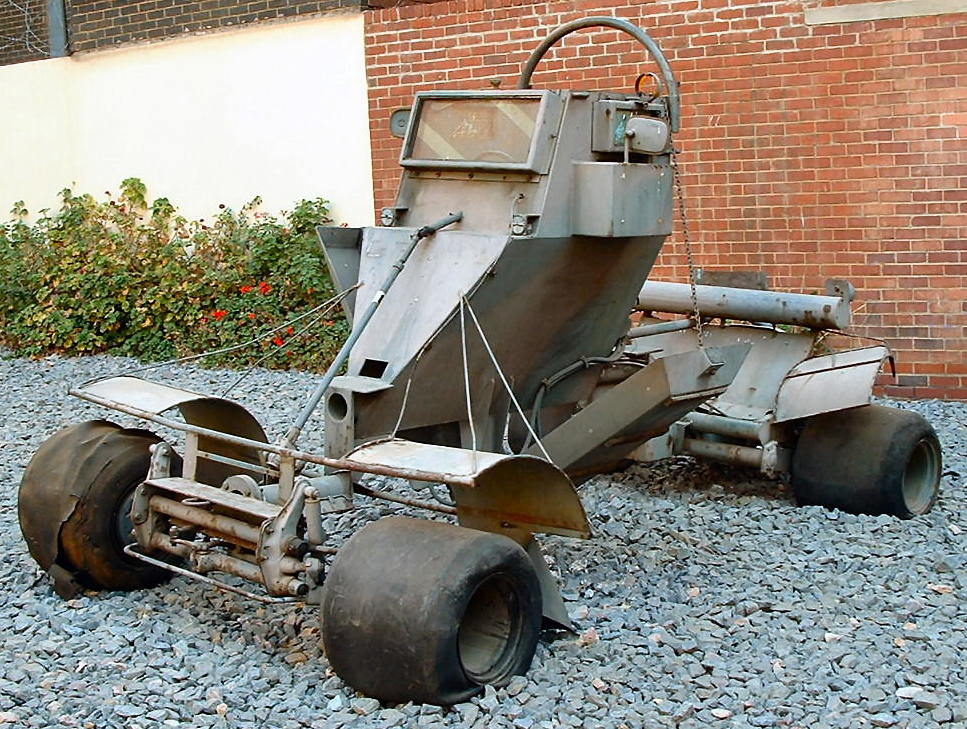
The Rhodesian Pookie: Expediency Turned Excellence

A surviving Pookie on display at the South African Police Service Museum in Muizenberg, Cape Town, Western Cape. The mine-detector "wing" pans are shown in the stowed position. Photograph by Steve Barrow.

      Desperation has often proved to be catalyst for solutions to a problem. During the Rhodesian Bush War which raged for 15 long years from July 4, 1964 to December 12, 1979, the guerilla forces of the Zimbabwe African National Liberation Army (ZANLA) and the Zimbabwe People's Revolutionary Army (ZIPRA) waged a campaign of mining roads as a means of limiting or cutting off roads, isolating Rhodesian Security Force garrisons, and also as a means to instill fear in any user of roads, civilian or military, by way of casualties and deaths caused by the mines. Rhodesian Security Forces took numerous steps to try to curb the mine campaign by interdicting supply lines of the guerillas, paving roads using tar (which made burying mines more difficult), and improving mine detection methods. In time, it was seen that finding every buried mine simply wasn’t possible and so another avenue was to improve the survivability of military vehicles that struck a mine. At first, improvised methods were used and while there was an improvement in survival, it was seen that the mine’s explosion was essentially trapped beneath the flat surface of vehicles (such as trucks) which caused severe damage. From this, vehicles began to be purpose built using V-shaped bodies which dissipated the explosive force of the mine away from the vehicle. It was seen that crew/passenger survivability improved significantly and that vehicles could be repaired rather than scrapped. 

     Still, the means to detect mines continued and using the new mine resistant vehicle technology, automotive engineer Ernest Konschel designed the Pookie (named after the Galago, a nocturnal primate) mine-detection vehicle. The driver sat in an armored monocoque capsule which was connected to the frame by shear bolts and the armor was proof against small arms fire. The frame utilized the front and rear suspension units from a Type Two Volkswagen Kombi as the units exerted less downward force than conventional coil springs. For wheels, the Pookie was fitted with used Formula 1 racing tires as their width was often wider than holes used to bury mines. For power, the Pookie used a 1,600cc Volkswagen engine and carried 40 liters of fuel. On each side of the Pookie was a “wing” which contained a Milton detection pan. In all, the Pookie had a ground pressure of 3lbs. per square inch which was less than that of a human which meant it could drive over a mine (even anti-personnel mines) and not detonate it. 

     Sixty-eight Pookie vehicles were built (some sources say seventy-six) starting in 1976 and were quickly deployed and by 1980, Pookie drivers located some 550 mines without a single loss to them. Twelve vehicles were damaged from rocket fire and also command detonated mines. Only a single driver was killed when the capsule was hit by an RPG. The Pookie would later be fitted with the “Spider”, a 24-barrel, 12-guage rotary shotgun system as a means to respond to guerrilla ambushes. The driver, using a chain rip cord, could ripple fire the barrels, throwing buckshot across a 270 degree arc. So devastating was this weapon that guerillas would often let the Pookie pass (as it typically led convoys) before launching their ambush. In 1999, MineTech (a British company) built a number of vehicles which looked much like the Pookie except for using different engines and other enhancements. These were deployed by private “de-mining” contractors in Afghanistan and Somalia.