Sunday, July 27, 2025

Remnants of War: Type 89B Otsu I-Go, 38th. Independent Mixed Brigade

Source: Justin Taylan

     The Type 89B Otsu I-Go medium tank in the photograph had sat in the jungle in the vicinity of Tarlena which is located on the northwest coast of the island of Bougainville since 1945. The tank was one of four such tanks that had been shipped from Japan via Truk then Rabaul. At Rabaul, the tanks were loaded aboard the Japanese freighter Bunsan Maru when, on September 1943, the ship arrived at Tarlena and unloaded its cargo. The tanks had been assigned to the 4th. South Sea Garrison which had been formed in Wakayama, Japan back on June 26, 1943.

     The Type 89 was, by 1943, long obsolete. The design of the tank had begun back in 1927. Japan's first indigenous tank design, the Type 87 Chi-I, was dismissed as being too heavy and too under-powered and so the Imperial Japanese Army (IJA) issued specifications for a new tank which had to weigh no more than 9 tons. The design was heavily inspired by the Vickers Medium C tank, a single example of which the Japanese had purchased from Britain in March 1927 for study. In April 1928, the design for the new tank was completed and construction began on a prototype. Completed sometime in 1929, the tank was given the designation Type 89 and after evaluation, it was approved for production. This was problematic as the IJA's Sagami Arsenal was incapable of mass production and so the IJA had to contract out to Mitsubishi Heavy Industries. Mitsubishi constructed a new factory solely to build the Type 89 and by 1931, production had commenced. By now, the Type 89 weighed in at a little over 12 tons and so the Type 89 was reclassified from a light tank to a medium tank. In 1934, a new model of the Type 89 was put into production. The main change was removing the water-cooled 100hp 6-cylinder Daimler gasoline engine and replacing it with an air-cooled 120hp Mitsubishi A6120VD diesel engine. It also simplified the frontal armor arrangement and reshaped the turret. The new model was given the Type 89B Otsu designation while the previous make was called the Type 89A Kō. For armor, the Type 89 had a maximum of 17mm of frontal armor down to a minimum of 6mm. For weapons, it used the Type 90 57mm gun, a hull mounted Type 91 6.5mm machine-gun and another Type 91 fitted to the back of the turret. The Type 89 had a maximum speed of 16mph and had a four man crew. All told, 113 of the Type 89A tanks were built and 291 of the Type 89B.

     The Type 89 was the main tank of IJA armored forces for many years and against the Chinese who lacked anti-tank capability, the Type 89 was proof against small arms fire and the 57mm gun was adequate enough. Still, the IJA was attuned enough to know the Type 89 was reaching the end of its usefulness and by 1942, the Type 89 was being withdrawn from front-line service, having been replaced with the Type 97 Chi-Ha. Still, despite being obsolete and ineffective against most Allied medium tanks as the Type 90 gun could only penetrate a paltry 20mm of armor at 500 meters, the Type 89 was still to see combat until the very end in August 1945.

     When the battle to take Bougainville Island commenced on November 1, 1943 with the U.S. landings at Torokina, the 4th. South Sea Garrison carefully hid the Type 89 tanks to protect them from U.S. air power. The fight for Bougainville slogged on for months and months, finally ending on August 21, 1945. By November 1944, Australian combat forces under the II Corps relieved U.S. forces and continued the fighting for the island. Earlier, the Type 89 tanks were turned over to the 38th. Independent Mixed Brigade. This unit was formed in June 1944 from what was left of the IJA's 17th. Division (code named the Getsu-heidan or Moon Division), specifically, the former headquarters of the 17th. Division and the 81st. Infantry Regiment. To bolster the brigade's armored capability, the four Type 89s were turned over to the new unit. The 38th. Independent Mixed Brigade's main battle with the Australians took place during the Battle of Pearl Ridge where the brigade took on the 25th. Infantry Battalion between December 30 and December 31, 1944. Led by General Kesao Kijima, Japanese forces were unable to dislodge the Australians from their positions and while casualties were quite light (10 Australian men killed with 34 Japanese killed in action), the Japanese loss was a blow to the brigade's morale and for the Australians, it was the start of a renewed push for further offensive action against what remained of Japanese forces. What was left of the 38th. Independent Mixed Brigade ended up at Numa Numa Mission on the east coast of Bougainville where it would eventually surrender in August 1945.

     Returning to the tank in the photograph, it was abandoned near one of the plantations that dotted the Bougainville landscape and would not move again until the 1980s. The tank was on the property of one Oscar Bond and the Kieta Lions Club desired to purchase the tank to restore and place it in the Kieta Memorial Park. Bond was receptive to the purchase, accepting a pig as payment (as a side note, pigs were and are still considered a status symbol in some of the cultures in New Guinea which includes Bougainville). Bond, however, wanted to keep the gun barrel of the tank. The tank was transported by a man named Bob Strong to Kieta Memorial Park where it was set on two concrete pads. The tank was cleaned and given a tan paint scheme with Japanese flags on the hull sides. A fabricated gun barrel was fitted to the tank to replace the one kept by Mr. Bond. The tank is incomplete and is missing the upper track fenders, the machine-guns (replica machine-guns were not added), the exhaust screen cover, the cover for the hull machine-gunner's square vision port, return rollers, the cupola hatch, and the engine. The tank can still be seen at the park which is located in Kieta along Aropa-Arawa Road. 

     The photograph depicts the tank as it appears today, having been left to deteriorate, and losing all of its initial luster when first put on display. It is clear no attempt has been made to return the tank to its original restoration condition and preserve it as best possible, let alone maintain the park which looks fairly overgrown.

Wednesday, July 23, 2025

Waifus with Raifus: The Rheinmetall-Borsig 30mm Maschinenkanone 108 Automatic Cannon

Artwork: Noriyasu Yamauchi

     The Rheinmetall-Borsig Maschinenkanone 108 (MK 108) 30mm automatic cannon first appeared in 1940, created by Rheinmetall-Borsig as a company endeavor. In 1942, the Reichsluftfahrtministerium (RLM; Reich Aviation Ministry) issued a requirement for a heavy cannon for aircraft which could engage Allied bombers and cripple or even destroy a bomber with minimal ammunition usage. Rheinmetall-Borsig dusted off the MK 108 and presented it to the RLM who, satisfied the cannon met the requirements, accepted the MK 108 for acquisition with the cannon entering operational service in mid-1943. The first aircraft to be equipped with it was the Messerschmitt Bf 110G-2 heavy fighter and the Bf 109G-6/U4.

     The MK 108, by itself, had a weight of 128 pounds with a barrel length of just under 2 feet (23 inches). The action utilized the principle of Advanced Primer Ignition (API) blowback. As is sometimes said of German engineering, this action required exceptional and precision construction and assembly to ensure smooth operation. API blowback works by igniting the primer within the round while the bolt is still moving forward and before the round is fully chambered. The rearward force of the detonating primer both slows the bolt's forward motion to prevent it from slamming into the breech while leaving enough momentum to send the bolt rearward to repeat the cycle. Such an action allowed the MK 108 to have a lighter bolt amd have a low recoil. 

     The MK 108 had a cyclic rate of fire of 650 rounds per minute with a muzzle velocity of 1,640 feet per second. This was rather low in comparison to other aircraft cannons and created a dangerously short effective range of 200 to 300 meters to ensure hits. While the MK 108 had a far longer maximum range, the round suffered from rapid drop which made accuracy at range poor. Testing showed that at 1,000 meters the round drop was as much as 135 feet from the aim point. However, the MK 108 was never designed to engage fighters (though, a single hit to a fighter could cause significant damage) but the much larger target profiles of bombers.

     The caliber of the MK 108 was 30x90RB. RB stands for Rebated which means the rim of the round has a smaller diameter than the base of the round. The main benefit of a rebated round is that it can be easily converted into differing ammunition without having to change the weapon's action mechanism. While the MK 108 had several ammunition types, the most common used in combat was the 30X90RB Minengeschoß (Mine-Shell) round. A thin-walled, steel cased round, it packed 85 grams of PETN (Pentaerythritol Tetraniotrate) explosive into the nose. Allied bomber crews were able to easily hear the MK 108's distinctive sound when it fired, nicknaming the weapon the “pneumatic hammer.”

     While the MK 108 had some success when equipping propeller driven aircraft, when the MK 108 was installed in turbojet aircraft, the short effective range made scoring hits a very dangerous affair for pilots. The Messerschmitt Me 262 jet fighters' speed was much higher than Allied bombers and so a successful engagement against bombers from the front or rear (an attack profile to minimize the number of defensive machine-guns that can take the aircraft under fire) was very difficult. With only 360 rounds to feed four MK 108 cannons, Me 262 pilots eventually developed an attack profile in which they flew above the bomber stream and once a target was selected, the pilot would put the Me 262 into a shallow dive which used the plane's speed to avoid escort fighters. Then, the pilot would continue the dive behind and below the bomber then pull up, bleeding off speed. This put the Me 262 around 1,000 meters from the rear of the bomber with the pilot opening fire at 500 meters then pulling away to avoid a collision at 200 meters. The rocket fighter, the Messerschmitt Me 163, had an even higher speed and pilots attacking bombers had between 2-3 seconds to execute an attack before having to pull away. 

     The lack of range saw the Me 262 equipped with 55mm R4M unguided rockets on underwing racks, 12 per wing. On approach, and outside of the bomber's heavy machine-gun range, the pilot would unleash the rockets which would create a spread pattern. Just one or two hits from a R4M was enough to down a bomber.

Tuesday, July 22, 2025

Russo-Ukrainian War: Training with Airsoft

Source: Sky News Ukraine

     Two Ukrainian soldiers photographed during training sometime in July 2025. The wire mesh goggles and mask worn by the soldier in the foreground might look very familiar to people who participate in airsoft games. Airsoft, which first started in Japan in the 1970s, is now played around the world and it consists of teams competing against each other with the sides utilizing airsoft weapons which fire 6mm spherical pellets. The Ukrainian Army, as far back as 2023, began using airsoft firearms to conduct training. Specifically, they are using AEG airsoft weapons.

     AEG, standing for Automatic Electric Gun, is the most common type of powered airsoft weapon. Based on airsoft spring guns (the cheapest type of airsoft weapon...requiring the firer to cock the weapon after each shot), the AEG uses a rechargeable battery pack to power an electric motor which handles the task of charging the weapon. As such, many AEG weapons are selective fire, permitting the operator to shoot single shot, 3-round burst fire, or conduct fully automatic fire. The typical AEG has a muzzle velocity of between 300 to 390 feet per second with an average range of around 200 feet. Getting struck by a 6mm pellet is said to feel like getting a sharp pinch.

     So, why use airsoft? It offers a number of advantages with the most obvious being safety and the prevention of serious injury. As the Ukrainian Army is at a disadvantage in regards to manpower versus the Russian Federation, airsoft reduces the chances of death or critical injury if the training is being conducted with small arms ammunition (even blanks can be deadly). Given that many AEG airsoft guns are externally replicas of genuine assault rifles, it provides the recruit or soldier with practical experience in handling the weapon. Likewise, AEG weapons are relatively inexpensive compared to their real counterparts and the cost of 6mm ammunition is far cheaper than small arms cartridges.

     Another obvious advantage is it permits realistic combat training that encompasses the broad spectrum of battlefield tactics across various terrain and situations. OPFOR (Opposition Forces) can be utilized to engage soldiers in combat simulations without much risk of harm during firefights which makes such “live fire” training far more real where there is no mistaking being struck and thus trainees can experience what it is to take “casualties” and how to deal with such situations. Also, airsoft training is more economical in comparison to using MILES (Multiple Integrated Laser Engagement System) equipment which is expensive, cumbersome for infantrymen to wear the required sensors in addition to their regular combat loads, and requires lasers to be fitted to weapons. This, in addition to the time needed to maintain MILES gear and replacement cost for damaged lasers and sensors.

     Airsoft, while providing limited benefit to marksmanship, is no replacement for training with actual battle rifles on shooting ranges with live ammunition...all under the guidance of instructors who can assist the soldier within the relative safety of a controlled environment.

     The AEG rifles shown in the photograph are replicas of the Colt M4A1 CQBR (Close Quarter Battle Receiver) using SOPMOD (Special Operations Peculiar Modification) accessories, notably the Knight's Armament Company rail interface system (NSN: 1005-01-416-1089) as the rifle's forearm. What make the AEGs are cannot be told with any certainty but Specna Arms is a possible candidate, if only by the design of the magazine.

Monday, July 21, 2025

Russo-Ukrainian War: Mikoyan MiG-29, 204th. Tactical Aviation Brigade

Source: Reddit

     A Mikoyan MiG-29 (NATO reporting name Fulcrum) belonging to the 204th. Tactical Aviation Brigade “Oleksandr Pokryshkin”.  The unit actually has two honorifics, the first being “Sevastopol”, which it received in 1996. As such, the unit is sometimes referred to as the 204th. Sevastopol Tactical Aviation Brigade “Oleksandr Pokryshkin”. The brigade first formed in 1992, following Ukrainian independence, when personnel of the former Soviet 62nd. Mixed Aviation Regiment swore an oath to Ukraine. This unit had been based in Sevastopol, hence the honorific.

     The unit's other honorific, received in 2018, is that of Soviet World War Two ace Alexander Ivanovich Pokryshkin who ended the war with 45 individual victories. Some of the kills were earned while flying over Ukraine starting in July 1943. His tally during this time included a Messerschmitt Bf 109 (flown by German ace Hans Ellendt), two Junkers Ju 88A-4 bombers (and one claimed), and two Junkers Ju 87D-5 dive bombers.

     At present, the brigade is commanded by Colonel Meretin Viktor Petrovych. The unit has two squadrons, the 1st. and 2nd. Aviation Squadrons which are made up of three flights. Regarding the current Russo-Ukrainian War, a notable aircraft loss of the unit involved Lieutenant Colonel Vadim Voroshilov, who uses the callsign “Karaya” (which, incidentally, was the same as used by Major Erich Hartmann, the most successful fighter ace in World War Two with 352 aerial kills). On October 12, 2022, Voroshilov was involved in night combat over Vinnytsia Oblast where he engaged Shahed-136 and Geran-2 (the Russian version) drones. However, the explosion of a Geran-2 following a successful engagement sent debris into the nose of his MiG-29 (a Fulcrum-C variant) that shattered the canopy and started a cockpit fire. Voroshilov managed to steer his stricken away from the city of Vinnytsia before ejecting. The plane came down near Turbiv, Vinnytsia Oblast. Some buildings were damaged by debris and power was knocked out but there were no civilian injuries. Voroshilov, following ejection, used his smartphone to take a selfie and that, despite having a bloody face, showed that he was alive.

For more information on the Mikoyan MiG-29, visit:

https://photosofmilitaryhistory.blogspot.com/2025/04/russo-ukrainian-war-mikoyan-mig-29.html


Sunday, July 13, 2025

28cm Haubitze L/12: Vintage Siege Howitzer


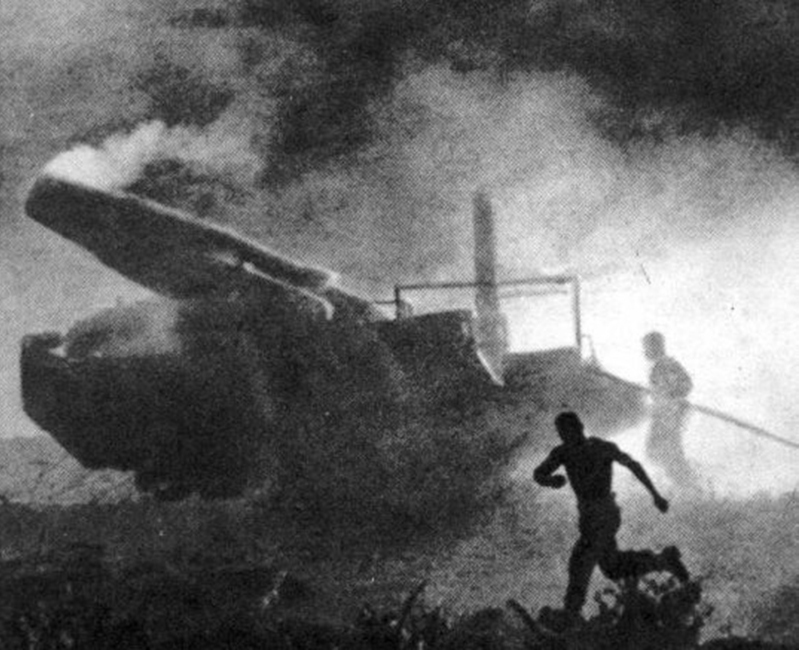
     On June 2, 1942, the Germans launched Operation Störfang (Sturgeon Catch) to take the Russian held port city of Sevastopol once and for all. Rather than launch conventional attacks as before which got them nowhere, the Germans instead elected for siege warfare, intending to pound the defenders into submission using heavy artillery before sending in ground forces. To do this, the 306. Artilleriekommando der Armee (Army Artillery Command) assembled the biggest siege guns and heavy artillery that could be had under the 11. Armee. All together, nine artillery battalions and three heavy and railroad artillery batteries came together, including elements from Artillerie-Bataillon 672 which fielded the massive 80cm Schwerer Gustav railway gun, Schweres Mörser-Bataillon 833 which operated two of the huge 60cm Karl-Gerät self-propelled siege mortars, and Schwere Artillerie-Batterie 459 that operated the sole remaining Krupp built 42cm Gamma-Gerät siege gun. Also in that number was Artillerie-Bataillon 744 and this unit and the guns it was equipped with is the subject of the photograph.

     Obscured by gun smoke and dust kicked up after firing is one of two 28cm Haubitze L/12 ( H L/12) heavy siege howitzers operated by Artillerie-Bataillon 744 during Operation Störfang. The gun was originally designed as a coastal howitzer (Küstenhaubitze) that was to be placed near critical coastal infrastructure and it was designed to fire projectiles at a high-angle so as to come down onto the thinner armor of a warship's decking rather than the much thicker belt armor (meaning, the sides). As a coastal defense gun, it was mounted on a turntable set into concrete and to protect the gun and crew, it had a 60mm thick armored dome fitted to it. The entire assembly was called the Mittelpivotlafette C/92 (Center Pivot Mount C/92). The H L/12 entered service in 1892 with a four gun battery being deployed in Tsingtao, China to defend the German colony there while another battery protected the ports of Wilhelmshaven and Blankenberge in Belgium. The only other user of the howitzer was Portugal who bought several of the guns in 1902 to protect the port of Lisbon. While the exact number of howitzers built by Krupp isn't known, some survived World War One and remained in the hands of the Reichswehr and ultimately it is believed nineteen examples were still on inventory at the start of World War Two. Long by this time, the howitzer had passed into obsolescence when the ranges of main guns mounted on warships exceeded that of the howitzer. Still, the artillery forces of the Wehrmacht lacked heavy siege guns and so a small number were pulled from static defensive locations in order to deploy them in the field. To do this required significant manpower, effort, and time.

     To transport the H L/12 required four loads: the barrel, the cradle, the gun mounting, and the components of the wooden ground platform. Once a suitable firing position was selected, a pit was dug and once that was completed, the wooden platform was assembled within the pit. After the platform was completed, the gun mount was fitted and secured down on the platform then the gun cradle and finally the barrel itself was installed. All together, to set up a single howitzer took between three to four days. The length of the H L/12 was 11.1 feet and the combat weight was 49.5 tons. The gun mounting provided a full 360 degree rotation thanks to a turntable situated on the bottom of the mounting. The maximum elevation of the gun was 65 degrees but the mounting provided no gun depression. The H L/12 used a horizontal sliding block breech and was percussion fired. Recoil absorption was by way of two hydraulic-pneumatic recuperator cylinders with additional absorption coming from the inclined plane of the gun mounting. The howitzer only fired one type of ammunition, the 28cm Sprenggranate L/3.5 high-explosive shell that weighed 772 pounds. To effect the maximum range of 6.5 miles, a seven-part powder charge that weighed 38 pounds was used. The H L/12 was not overly accurate and the effective range was a bit less at 6.2 miles. Against ships, the shell was able to penetrate 100mm of desk armor at a 63 degree angle. To facilitate loading, a crane was fitted to the gun mount and a trained crew could fire one round every one to four minutes. While the lack of accuracy of the H L/12 was an issue against mobile warships, against stationary targets like a city, the howitzer was more than effective in delivering its share of devastation.

     All told, the artillery amassed under 11. Armee dropped 46,750 tons of ordnance on Sevastopol and when the Germans took the city on July 4, 1942, only eleven buildings still stood without damage following both the artillery bombardment and the aerial bombing campaign. Although a German victory, the Germans suffered 27, 412 casualties and the Romanians 8,454 casualties in comparison to 118,000 Soviet casualties.

     The H L/12 howitzers would appear again in combat, this time during the Warsaw Uprising which commenced on August 1, 1944. There, the howitzers contributed to the purposeful destruction of Warsaw during the combat (which ended on October 2, 1944) and afterwards. By January 1945, some 85% of Warsaw was destroyed. The scale of the destruction was immense with 10,455 buildings, 923 historical buildings, 25 churches, 12 libraries, 81 primary schools, 64 high schools, and 2 universities being razed to the ground.

Char B1 (n° 309) “Rhône”: Scuttled in Beaumont

Source: Author's Collection

     What is left of No.309 “Rhône” in the streets of Beaumont, France. Built by Renault, this Char B1 bis was issued to the 37th. BCC (Bataillon de Chars de Combat; Combat Tank Battalion), 1st. Company on September 27, 1939. On May 16, 1940, remnants of the 37th. BCC retreated into Beaumont and were without fuel for their tanks and with no petrol forthcoming, it was decided to scuttle the unit’s tanks and to make for the French lines on foot. 

     “Rhône” was set ablaze and the subsequent explosion blew the turret off the tank. Unfortunately, the blaze from the tank spread to nearby homes, setting them aflame. It was not until the following day did the fires burn out. 

     “Rhône” had been commanded by Sub-Lieutenant André Marsais with the remainder of the crew being Master Corporal Emile Tourmetz (driver), Sergeant Jacques Tapol (radio operator), Private Defremy (gunner), and Private Feuillatre (mechanic).

Monday, July 7, 2025

Russo-Ukrainian War: The BPAK Vampire Bomber Drone

Source: Florent Vergnes

     A staple of Ukrainian UAV forces is the bomber drone. As the designation suggests, these drones are designed to deliver lethal payloads to the enemy and, if need be, bring needed supplies to friendly troops. Bomber drones are much larger than their smaller FPV drone counterparts and unlike FPV drones, bomber drones are meant to return to their bases once their mission is completed. There, they are readied for the next operation. Collectively, the various bomber drone types used by the Ukrainian military are nicknamed “Baba Yaga” by Russian troops who are unfortunate enough to be on the receiving end of the drone's payloads. The “Baba Yaga” bomber drone shown in the photograph is the BPAK Vampire.

     The Vampire is a six-rotor hexacopter design with a weight believed to be around 40 pounds and a production cost of around $10,000USD per unit. It has a payload capacity of no more than 33 pounds. Offensive payloads can include grenades, mortar bombs (up to 120mm), and PG-7 85mm warheads (used with the RPG-7). If required, the Vampire can carry a single TM series land mine if being utilized for area denial missions. The Vampire is primarily operated nocturnally thanks to the drone being fitted with a bispectral camera (which includes thermal). Navigation is aided by a GNSS (Global Navigation Satellite System) antenna. The top speed of the Vampire is 62 miles per hour and if carrying a payload, maximum speed is 37 miles per hour. The Vampire's operating altitude is 1,640 feet and in ideal conditions, the maximum communication range between the drone and the operator's controller is 25 miles. Batteries provide the Vampire with a maximum endurance of 45 minutes when empty and if carrying a payload of 22 pounds, the endurance drops to 30 minutes. The operational range is no more than 12 miles. Typical training time for Vampire operator recruits is three hours to become competent in basic flight tasks.

     A common non-combat use for the Vampire is resupplying Ukrainian troop positions where regular logistical vehicles would be hard pressed to access (or can't). Another use, though much less common, is fire-fighting using custom designed bombs filled with water. The Vampire has also been used for humanitarian operations, notably following the Russian destruction of the Kakhovka Dam, by delivering supplies to civilians cut off from ground-based rescuers. 

     Vampire missions can involve multiple sorties against Russian targets. Once the drone drops its payload, it returns to its base. There, the batteries are swapped out for fresh ones, the drone rearmed, and it is sent out again. Usually, reconnaissance drones identify Russian targets and then units operating the Vampire in the area are contacted with the information. Thus, with confirmed targets, only then are the bomber drones sent out. Depending on the level of activity, operators of the Vampire can fly multiple missions per night. One drone operator with the 100th. Mechanized Brigade flew his Vampire on 27 sorties in a single night.

     The Vampire is not armored but has proven to be resilient against Russian small arms fire, being capable of returning to base with damage from bullet strikes. It is also resistant to Russian frequency jamming. Another protective measure is that if communication between the Vampire and its operator is broken, the drone will automatically return to its point of origin.

Saturday, July 5, 2025

Postkraftwagenfahrer, Deutsche Reichspost


     The Deutsche Reichspost (DRP) can trace its roots to 1880 when postal services were put under the authority of the Reichspostamt (Reichs Post Office) led by the Generalpostmeister (Postmaster General). The DRP, not surprisingly, has a long history. In regards to women, the DRP, when first formed, did not permit women as employees unless they were the widow of a postal worker or relatives of a male postal worker. The reasoning, at the time, was that women could not exercise the needed official authority nor protect the confidentiality of postal mail. In 1919, the Reichspostamt was superseded by the Reichspostministerium (Reich Ministry of Post) which remained in existence until May 1945. The Postminister for the majority of World War Two was Wilhelm Ohnesorge though Julius Dorpmüller served as the Postminister under the extremely brief Flensburger Regierung (Flensburg Government) which assumed power following the suicide of Reichschancellor Adolf Hitler and lasted from May 2, 1945 to May 23, 1945.

     As noted above, women did find employ in the DRP and while their roles in it did grow over time, the DRP was still heavily weighted towards male employees. But as World War Two commenced and the German military was committed further and further, women soon found themselves with ample opportunity for employ not only in the DRP but other civil services such as the Reichsbahn (State Railways) and in the Zollgrenzschutz (Customs/Border Guards). The main reason for these opportunities was due to more and more men being called up for military service. Delivery of the mail was of vital importance, not only for government communication, but for civilians and the military. Postal mail was often the only way for soldiers to stay in touch with loved ones back home as well as receive letters and parcels from home while away on campaign. This was done through coordination with the Wehrmacht's Feldpost (Field Post) military mail service. In fact, on April 1, 1940, discounted postal rates, to include free postage for some mailings, were instituted for shipments to and from the military. To illustrate this, a Reichspostministerium report showed that in 1943 alone, approximately 7,652,000 pieces of mail (letters, parcels, etc.) transited to and from the Feldpost system.

     The photograph depicts a female postal worker, specifically, a Postkraftwagenfahrer, or Post Truck Driver. That she is a full functionary DRP employee, and not an auxiliary, can be told by the fact she is wearing the DRP uniform with rank insignia. This consisted of a dark blue beret with orange piping, a dark blue jacket, black trousers, and black shoes. The sleeve patch reads Deutsche Reichspost in a Fraktur-like script and has a blue background with the lettering and the adler (eagle) in yellow thread. Her rank, that of Postjungbote (literally “Post Boy”), is denoted by the black collar tabs while her truck driver status is told by the metal postal truck centered and pinned through the tabs. Underneath the jacket is a dark colored blouse and a black tie. She is likely entering information into a log book though what vehicle she is driving cannot be readily identified. The DRP utilized numerous models of trucks and cars including the Phänomen Granit 25, Mercedes-Benz L2500 and 2750 series trucks, Hansa-Lloyd Merkur trucks, and Volkswagen Type 82 (Kübelwagen) and Type 83 (“Käfer“ or Beetle) cars modified into Kastenwagens (box trucks) among others.

Wednesday, July 2, 2025

Russo-Ukrainian War: Robotized Complexes Plyushch UGV

Source: Robotized Complexes

     Even to the more casual follower of the Russo-Ukrainian War, it is clear that the conflict is very much dominated by electronic warfare (EW). The heavy deployment of UAVs (Unmanned Aerial Vehicles) and FPV (First Person View) drones by both sides in the war have shown the militaries of the world that no longer are UAVs just pure reconnaissance platforms and that effective drones and UAVs are no longer the province of military forces with massive budgets. The Ukrainian Army, by necessity, has revolutionized UAV and drone usage. In part, this is to create a low cost, but effective, force multiplier that permits the Ukrainian military to extend strike capability far into Russia. It also permitted the Ukrainian Navy to reassert dominance in the Black Sea where sea-going drones (USVs or Unmanned Surface Vehicles) have kept the Russian Black Sea Fleet impotent. Advancements in remote operated self-defense weapons on Ukrainian USVs has seen Russian aviation finding that attempting to destroy Ukrainian USVs is a risky prospect. The Ukrainian Army has been expanding the usage of UGVs, or Unmanned Ground Vehicles, to extend the capabilities of Ukrainian drone operations as well as defensive, offensive, and logistical support tasks. An example of the former is shown here, the Plyushch (“Plush”).

     Developed and built by Robotized Complexes, the Plyushch is a UGV that is designed to work in cooperation with Ukrainian UAV and drone units. The tracked vehicle is equipped with an electro-hydraulic motor that, at full charge, provides for a range of just shy of 25 miles (24.8 miles). Top speed is 5.5 miles per hour. By not having a internal combustion engine, the Plyushch enjoys a measure of stealth due to the lack of engine noise. The Plyushch is not light, having a weight of a bit over 1,700 pounds (1,708lb. to be exact). Using a commercially available 5.8GHz radio system and ground controller built by SIYI (a division of the Chinese company Reebot Robotics), the Plyushch can be remote controlled from as far away as 6 miles in open terrain. The Plyushch's small size makes it easily transportable and deployed quickly to where needed while that same small size provides for a level of concealment from detection.

     Of course, the main “weapon” of the Plyushch is a collapsible/telescoping mast antenna atop the vehicle's hull. It takes 1 minute, 20 seconds for the antenna to fully deploy and only a minute to return to travel order. At full extension, the mast is 32.8 feet high. The top of the antenna houses electronic equipment for two purposes...though for operational security, the specifics and capabilities of both have not been disclosed. The first purpose is for radio relay and this is used to extend the signal range of command channels of drones. This allows drones to loiter over the battlefield at further distances than would otherwise be possible without a relay. By consequence, this allows the drone operator to be further away from the front line and thus enjoying a measure of enhanced protection from detection and retaliation if spotted. Also, the use of the Plyushch as a relay means improved signal in areas where signal infrastructure is damaged or degraded, terrain lessens signal range, or Russian jamming is heavy. The second purpose is as a EW platform, jamming communication and navigation frequencies utilized by Russian UAVs and drones.

Saturday, June 28, 2025

Russo-Ukrainian War: Drone Strike on M1991 MRLS

Video Source: ukraine_defense on Instagram

     What is shown here is a unbelievable sequence of screenshots taken from video transmitted by drones operated by the 413th. UAV Battalion “Raid”. The target is a M1991 240mm MRLS (Multiple Rocket Launch System) operated by a Russian crew. The M1991, built by North Korea, was first confirmed in use by Russian rocket forces in April 2025. What follows is the timeline of the attack.

1) The M1991, detected by a Ukrainian reconnaissance drone, is followed to what is probably a hide for the vehicle. The whitish appearance of the rocket tubes indicates heavy usage.

2) At this point, the 413th. Battalion's FPV drone arrives and commences the attack on the M1991.

3) Of course, the most damage can be caused by hitting the launcher and so the drone operator targets it...

4) ...and the drone fires a charge into the launcher's rear. The reconnaissance drone, loitering overhead, remains to assess the damage.

5) The strike almost immediately causes one of the rockets to launch, which rips through the cab of the M1991, the exhaust from the solid fuel motor engulfing the vehicle in flame. It also incinerates the drone.

6) Amazingly, both of the crewmen in the cab survive, bailing out of the vehicle (their uniforms have been burnt away), and running off before the entire M1991 detonates in a massive explosion.

Thursday, June 26, 2025

Russo-Ukrainian War: The Nudelman-Rikhter NR-30

Source: Reddit

     A Ukrainian gun truck crew, photographed sometime in 2025, looking after their weapon: the Nudelman-Rikhter NR-30 30mm autocannon. Entering service in 1954, the NR-30 is exclusively a weapon utilized in Soviet-era aircraft which included the Mikoyan-Gurevich MiG-19 (NATO reporting name Farmer), early models of the MiG-21 (Fishbed), the Sukhoi Su-7 (Fitter-A), and the Sukhoi Su-17 (Fitter). It is the latter where this weapon likely came from as the Ukrainian Air Force operated the Su-17M3 (Fitter-H), Su-17EM3 (Fitter-G), and Su-17M4 (Fitter-K) until 2004 when some 24 of the UM3 and M4 aircraft were overhauled and sold off to Yemen and Vietnam while the remainder were put into storage, dispersed between facilities in Odesa and Zaporizhia. As such, since these airframes are likely no longer airworthy or worth the effort to return to service, stripping their weapons for ground use is a logical option to “recycle” old components.

     The NR-30 is a short-recoil action autocannon with a weight of 145 pounds without ammunition. Speaking of ammunition, the NR-30 fires a 30x155mm round which was replaced by the 30X165mm round that remains in use to this day. As such, the NR-30 is not compatible with these rounds, making supply a potential issue since most of the Ukrainian Army uses the 30X165mm round in their BMP-2 IFVs, BTR-82A IFVs, BMP-3 IFVs, and 2K22 Tunguska SPAAGs. Likewise, the Ukrainian Air Force and Army Air Force use the round in the Mikoyan-Gurevich MiG-29 (Fulcrum), Sukhoi Su-25 (Frogfoot), and Mil Mi-24 helicopter gunships (Hind).

     Rate of fire is between 850 to 1,000 rounds per minute with the effective range (when mounted in aircraft) being a relatively short 200 to 800 meters against aerial targets and 1.1 miles against ground targets. Again, when used in aircraft, the NR-30 was usually provided with 70 rounds of belted ammunition. Typical ammunition types include the BR AP (Armor-Piercing), the OFZ HE-I (High Explosive Incendiary), and LP training projectiles. The OFZ round contains between 40 to 48 grams of explosive while all rounds had between 95 to 99 grams of VBP smokeless powder propellant.

     If one looks closely, one can see two blue gauges and a heavy hose coming from what is possibly a regulator valve. The hose runs underneath the custom fabricated gun mount. The valve is no doubt connected to a compressed air cylinder and the reason for this arrangement is because the NR-30 requires such an apparatus for operating the cocking cylinder to initially charge the weapon. Called pneumatic tensioning, the initial action triggers the recoil accelerator that unlocks the chamber and pushes the breech block backwards where it is held in place by a trigger. This action advances a round into the breech. The compressed air then releases the breech block forward, chambering the round, and the NR-30 is then ready to fire. 

Monday, June 23, 2025

Russo-Ukrainian War: The IRM Zhuk

Source: Reddit

     Engineering vehicles, while not glamorous nor getting the limelight of photographic coverage, are an important component of ground forces and the Ukrainian Army is no exception. This particular vehicle, photographed sometime in early June 2025, is fairly rare in Ukrainian service though it has a rather unique purpose. Called the IRM Zhuk, the IRM stands for Inzhenernaya Razvedyvatel'naya Mashina (Engineer Reconnaissance Vehicle) while Zhuk means “Beetle”. A Soviet-era vehicle, the IRM entered production in 1980 and by 1986, only 50 IRMs rolled off the line. What makes the IRM rather unique is that it is optimized for route reconnaissance. U.S. Army manual FM 3-90 Tactics defines route reconnaissance as an “operation to obtain detailed information of a specified route and all terrain from which the enemy could influence movement along that route.” Where able, the U.S. Army would deploy engineer reconnaissance as they have the expertise to evaluate the terrain, bridges, tunnels, roads, trails, gap/water crossings, and other infrastructure to determine not only enemy potential to target assets on the route but also if the selected route is capable of being traversed by follow-on units. To that end, the IRM Zhuk is outfitted to accommodate such a task.

     The 19-ton IRM is based on the BMP-1 Infantry Fighting Vehicle but has a lengthened hull with seven road wheels per side rather than the BMP-1's six road wheels. Power comes from a UTD-20 inline 6-cylinder, water cooled diesel engine that generates 300 horsepower and this provides a top road speed of 32 miles per hour. The IRM is amphibious and mounted on the rear hull are two, 3-bladed propellers within cowls. In calm water, the IRM has a maximum water speed of 6 miles per hour. There is a trim vane on the hull front to keep water off the upper hull. With 158 gallons of fuel, the maximum operational range is 310 miles.

     For protection, the IRM uses all-welded, steel armor but the exact level of defense is not easily obtained but it is thought the maximum thickness is 19mm. This provides the six man crew (commander, driver, and four engineers) with a measure of defense against some small arms and shell splinters. Other protective measures include a NBC (Nuclear Biological Chemical) overpressure-type system (with scrubber) and smoke screen generator. The latter is accomplished by injecting diesel fuel into the exhaust where the fuel vaporizes on the hot exhaust, condenses, then cools which forms a white smoke cloud. Finally, the IRM is equipped with automatic fire extinguishers.

     The only defensive armament consists of a turret mounted 7.62mm PKT machine-gun which is provided with 1,000 rounds in 50-round ammunition belts. Aiming is manual and done using iron post sights. The crew, of course, can utilize their own small arms to defend the vehicle.

     Of course, as a engineering reconnaissance vehicle, the IRM has a lot of tools to perform its tasks. Firstly, the IRM is equipped with a TNA-3 inertial land navigation system. The TNA-3 uses accelerometers and gyroscopes to determine the vehicle's position, orientation, and velocity. A benefit is that inertial navigation systems are independent of GPS and thus not susceptible to GPS jamming and can operate where GPS isn't available. Next, the IRM is fitted with a RShM-2 mine detector which is able to pick up ferromagnetic objects up to a depth just shy of 1 foot. The apparatus is mounted on hydraulically operated arms, one per side of the hull (the right side arm is visible here in the stored position). The arms can be deployed to the front of the vehicle in less than 3 minutes. When using the mine detector, the IRM can drive no faster than 3 miles per hour. If an object is detected, the IRM is automatically brought to a halt. Kept inside the IRM are three hand-held mine detectors; the RVM-2M, IMP-2, and RVM-2. In order to accurately test water depth at river crossings, the IRM has a EIR echo-sounder which can give depth values up to 65 feet. The EIR is paired to a recorder for data retention. To compliment the EIR, the IRM has three sonar transducers which work by sending out sound waves and then detecting the returning echoes. For measuring the azimuth for the purposes of determining both horizontal and vertical terrain angles, the IRM has a PAB-2AM aiming circle. For surveying from within the vehicle, the IRM has an extendable PIR-451 periscope for the commander which includes a DSP-30 rangefinder. Other equipment includes an AGI-1S horizon indicator and a man-portable PR-1 penetrometer. The latter, used by a dismounted engineer, tests for soil crossability and when coming upon ice, the AGI-1S has a ice drill and ice stake to determine ice thickness. For communication, the IRM has a integral R-147 radio set while two portable R-147 sets are kept in store if needed. Finally, the IRM is equipped with TNP-370, TNV-25M, and TNPO-160 periscope observation blocks.

Saturday, June 14, 2025

Russo-Ukrainian War: The Sukhoi Su-24MR Fencer-E

Source: ArmyInform

     Photographed in late May 2024, the Sukhoi Su-24MR (NATO reporting name Fencer-E) “Yellow 11” rests in its revetment. The aircraft belongs to the 7th. Tactical Aviation Brigade “Petro Franko”. The Su-24MR is the dedicated reconnaissance variant of the Su-24M tactical bomber and first entered service in 1983 with production ending in 1993 after 130 examples were built.

     Externally, the Su-24MR looks much like the Su-24M upon which it is based. But, there are some visible differences which tell them apart. The first can be seen underneath the fuselage, along the centerline, a bit forward of the side intakes. In place of the Gryazev-Shipunov GSh-6-23M rotary 23mm cannon, a fairing contains a AP-402M panoramic 90.5 focal length camera and behind it, a “Aist-M” (“Stork-M”) TV camera/reconnaissance system. Of interest, the cassette cartridge that stores the photographs taken by the AP-402M can be jettisoned, the cartridge falling to earth via parachute.

     Another external means to tell the Su-24MR apart from the Su-24M assumes it is fitted with a SRS-14 “Tangazh” (“Pitch”) ELINT (Electronic Intelligence) pod, as fitted here underneath the fuselage. The SRS-14 is designed to detect emitting radars then determine their origin point, the type of radar(s), and the mode the radars are operating in. Another specialized pod which is used is the Shpil'-2M (“Spire”) laser imager with a 25cm resolution. Altitude affects the image quality so that when flying at low altitudes, the quality improves to almost photographic levels. The “Spire” can be used day or night and the image data can be transmitted to ground stations in real time.

     On the outer pylon of the right wing looks to be a M-341 Efir-1M (“Ether-1M”) radiation detector. It measures radioactivity levels and records the data onto magnetic tape or, if desired, the pod can transmit the data to ground stations. The drop tanks are PTB-3000 models which hold 793 gallons of fuel each.

     The nose-mounted Orion-A radar suite used by the Su-24M is replaced with a RDS-BO “Shtyk” (“Bayonet”) SLAR (Side-Looking Airborne Radar). The minimum range of the radar is .2 of a mile to a maximum range of 17 miles. The RDS-BO (sometimes designated the M-101) is a pulse-only radar, is able to classify ground targets, and is equipped with a moving target indicator. This data is compiled via the BCR-1 intelligence complex (which also assesses information taken in from other sensors).

     Because the Su-24MR is unarmed, it is fitted with extensive defensive systems, collectively called the BKO-2M Karpaty complex. It consists of the SPO-15M Bereza (“Birch”) which alerts the crew to being “painted” by radar and also homing radar as used by missiles. Against infrared homing missiles, the L-082 Mak-UL (“Poppy”) detector is fitted for alerting to missiles that utilize infrared seeker heads. Another piece of the complex is the SPS-161/162 Geran-F (“Geranium-F”) radar jammer along with the APP-50A flare dispenser. The entire complex was controlled by a Neon-F digital computer system.

     Other reconnaissance equipment include the A-100 oblique mounted camera which has a 1,000 focal length. The aperture for the camera is mounted underneath the left air intake. Finally, there is a “Zima” (“Winter”) infrared sensor system mounted beneath the right air intake and it can just be seen near the rake fitted to the edge of the intake.

     “Yellow 11” first saw combat during the Donbas War when, on July 2, 2014, a separatist fired MANPADS (Man Portable Air Defense System) struck the aircraft while it was operating over Slavyansk, Donetsk Oblast. The strike caused a fire which forced the crew to shut down one of the engines. The stricken Su-24MR was able to return to base but upon landing, a new fire started which caused significant damage before it was extinguished by ground crew. It would take many months to repair the aircraft but in April 2015, “Yellow 11” was back in service.

For more information on the Su-24M, visit:

https://photosofmilitaryhistory.blogspot.com/2025/06/russo-ukrainian-war-sukhoi-su-24m.html